Euro failure could cost FAI €12m
Reaching the finals in 2012 grossed the FAI a qualification bonus of €8m, income pivotal to prevent their 2013 turnover falling any more than the 19% it did over a two-year cycle.
Although details of the FAI’s latest accounts, published in yesterday’s Irish Examiner, demonstrated turnover to have slightly risen by 4% in 2014, a serious jolt in revenue streams is needed if the overall debt figure of €51.2m is to be tackled in the coming years.
One such bonanza is only months away from being secured, dependent on results in the remaining four qualifiers.
As well as the guaranteed €12m qualification prize for reaching France next year, increments like the €500,000 per point gained on offer three years ago are set to rocket.
“2016 will be the first time in 20 years that the tournament will be hosted in a ‘big five’ market (France), which makes it a more premium valued event for commercial partners,” Guy-Laurent Epstein, marketing director of Uefa Events, told Sports Sponsorship Insider.
“And the competition will grow from 16 teams to 24 teams, which means the competition becomes interesting and relevant in eight additional markets. This is particularly important when sponsors come to sell-in their programmes to their local subsidiaries.”
Ireland’s qualification prospects, however, are reliant on snookers at this stage of the campaign — and that’s only to catch Scotland for third place and a play-off.
Failure to gather 10 points from the final four ties, including the meeting with world champions Germany, will likely leave Ireland staring into a year of abyss until the World Cup qualifiers kick off in September 2016.
As has been the norm in recent years, anything resembling a proper debate on the finances of the organisation is not expected when delegates gather at the FAI annual general meeting on Sunday fortnight.
Last year, only 130 legislators — from the biggest participative sport in the country, played by 400,000 people — were present for the event in Athlone.
Just one question related to football or finances has been asked from the floor since 2009.
Such as been the climate, that it’s only in written correspondence — like last year when the Cork Schoolboys League requested chief executive John Delaney to consider his position amid a row over perceived preferential treatment for the Dublin league — that grievances tend to get an airing.
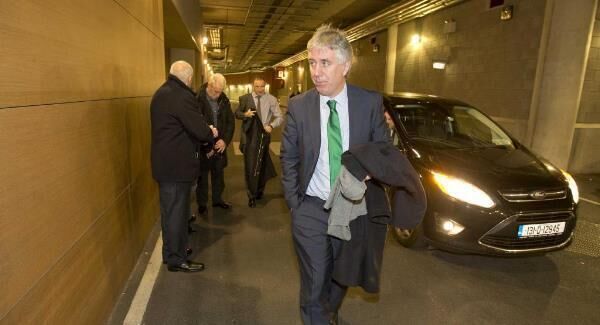
Members received a surprise with their accounts this time on Monday, with a letter from FAI chief executive John Delaney and FAI president Tony Fitzgerald outlining the positive strides made by the organisation over the past year.
Many of the supposed achievements relate to plans and strategies. Actions, like those in the National Development Plan for underage football, haven’t started.
Whilst this charter will be announced at the AGM in Sligo, implementing it is a different story.
One of the main platforms to the FAI’s vision for improving elite youngsters is to regionalise leagues from U11s upwards, yet that aspect is at least a year from kicking in and that’s only if currently-sceptical leagues embrace the changes.
Roy Keane last week lamented the scarcity of players emerging to challenge for starting slots at senior level.
The statistics support Keane’s concerns, as no Premier League team has an Irish-born regular under the age of 25 in their team ahead of the new season.
Planning of a financial nature is naturally a difficult situation for the organisation at present.
“We have a five-year plan and, when it has run its course, we’ll draw up with another one,” said FAI treasurer Eddie Murray in 2010.
Forecasting a debt-free status by 2020 may be absent from the proclamation this time.
CONNECT WITH US TODAY



Be the first to know the latest news and updates