Sepp Blatter exits stage but Fifa issues remain
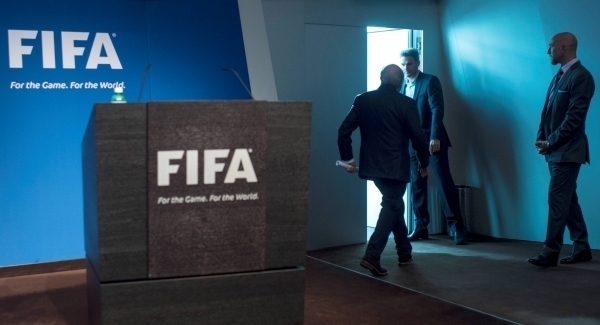
Blatter has announced he will step down as Fifa president on a day of stunning developments in world football. The 79-year-old Swiss has called an extraordinary congress “as soon as possible”, saying “a new president will be elected to follow me”.
Prince Ali Bin al Hussein, who challenged Blatter in last week’s election but withdrew after finishing second in the first round of voting, has hinted he will run again in an appearance on CNN.
“I am at the disposal of our national associations,” he said.
Even with sponsors threatening to pull the plug, the media sensing blood and household names joining the chorus of derision it seemed as though Fifa’s autocratic president, secure with his inbuilt majority, would continue to ride out the storm.
He had done it before and even last week he was telling Michel Platini that resignation would be “too late”.
“Football needs a strong, experienced leader,” he said. “Why would I step down?”
Exactly four years ago, within an hour of being re-elected, Blatter was declaring he would appoint a “solutions committee” of the great and the good. There would be new processes and procedures, transparency and good governance.
His chosen reformer? Henry Kissinger, a long-time associate and well-known football fan.
Quite what Kissinger, 88 at the time, really made of this nomination is not clear, but in retrospect, it seems grotesque.
As former Secretary of State to Richard Nixon he is presumably used to dealing with presidents who are out of touch with reality.
But it seems especially bizarre given that Kissinger then became a board member of USA2022, whose bid to bring the World Cup to America was rejected in favour of Qatar.
Who or what finally persuaded Blatter he needed to go?
“He doesn’t have any real friends, apart from his daughter and Fifa,” according to Guido Tognoni, the Fifa marketing executive who Blatter first sacked 20 years ago and then reappointed to deal with the mess after the collapse of their marketing partner ISL, before sacking him again two years later.
“When the men around him become strong, he does away with them. His passion is power. He manipulates everything to retain power.”
Tognoni is a Machiavellian character himself. After his first sacking he went to work for Uefa and spent time helping journalists investigate Blatter’s 1998 election campaign.
Five years later his boss made sure the same thing did not happen again. Tognoni continued to draw his €200,000 salary in return for a confidentiality agreement.
The reaction around Europe to Blatter’s declaration has been a mixture of surprise and relief, tinged with suspicion.
Italy’s Gazzetta dello Sport, long-time foes of Fifa in general and Blatter in particular, are linking it to the claim by the New York Times on Monday that Fifa general secretary, Jerome Valcke, was aware of a $10m payment that allegedly ensured the North, Central American and Caribbean (Concacaf) vote for South Africa to host the World Cup.
However, Fifa have been claiming that the man responsible was the head of the finance committee, the Argentinian Julio Grondona, who died last year.
Valcke is now Blatter’s closest associate within the Fifa hierarchy, and for him to be personally linked with this case would leave the president’s claims of ignorance in tatters.
The other factor is the evident determination of the US authorities to pursue their prosecution and the likelihood of Fifa officials facing extradition.
Switzerland is famously reluctant to agree to extradition, especially for tax-related issues. But it does have an extradition treaty with the United States, and the alleged crimes in this case — wire fraud, money laundering and tax evasion — are crimes in Switzerland as well as the US.
Cases take a long time to process, a year or more, especially with appeals, but if extradition fails the US authorities would be able to issue “red notices” in other countries, which would mean Fifa officials facing arrest and detention as soon as they travelled abroad.
As Samuel Johnson remarked to Boswell: “When a man knows he is to be hanged in a fortnight, it concentrates the mind wonderfully.” In this case, Blatter announcing his departure and an extraordinary conference may well protect him from an indictment and buy time so that he can himself follow the example of Chuck Blazer, the former Concacaf general secretary, and offer to help the FBI with their enquiries.
If so, a root and branch reform of Fifa might become possible. But is it really possible for the organisation to reform itself?
For Fifa to change will require a revolution, not reform.
Governments and the law are best kept away from sport, but in this case it is hard to see how change can be achieved without the removal of the men who have been running world football for their own benefit for the past four decades.
And there are more than a couple of hundred of rotten apples in this barrel.
CONNECT WITH US TODAY



Be the first to know the latest news and updates