Financial gaps in football fuelling match-fix scourge
Brett Forrest can recall the spark that led to his book on match-fixing in soccer: the curiosity of his editor at ESPN the magazine.

Financial gaps in football fuelling match-fix scourge

“He said, ‘I keep seeing these crazy scorelines coming from soccer games, what’s going on? I’ve been reading about match-fixing, will you make a few calls and see what’s going on?’”

Forrest spoke to Chris Eaton, then head of security at Fifa, who opened his eyes to the realisation that these fixers had “penetrated the game at almost every level, in almost every country, that they were highly active and that this was growing — it made me realise there was a real story here.”


Forrest soon discovered the hard facts of the fix.

“Think in terms of areas of vulnerability. The less a player makes in salary, the more liable to take some side money to fix a match. The smaller the economy, the greater the difference that match-fixing money will make to his life or his family’s.

“Conversely, the more money he makes, the less likely he is to risk his livelihood for a little money on the side.

“However, you have to realise the size of the pot. Nobody knows the number for sure, but the hypothesis from Interpol and bookmakers I’ve spoken to is upwards of one trillion US dollars per year.

“That’s a staggering figure, the kind of money that attracts organised crime, and which may attract a player in a big club playing in a first-tier European league, because they don’t all make vast money.

“We hear of the guys with huge contracts but there are guys who don’t play very often, or for very long, so they could be vulnerable to an approach.”

Forrest points to disquieting developments in Australia, for instance, where several individuals were charged with match-fixing only last year.

“Let’s not be naive. The big guys are unlikely to be tempted but others might be vulnerable.

“My research shows that fixing syndicates are focused on two things — on the totals market, such as the amount of goals scored in a game, and on the result itself.

“Proposition bets are out there, but you have to understand the fixers are looking for liquidity in the marketplace — games which will attract a lot of money, because the larger the pool of betting on a particular game, the more they can bet on it and thus hide it in the wider amount. The amount of betting on those proposition bets — the red cards, number of corners and so on — means there’s not as much liquidity in those markets and they’re not as attractive to the syndicates — so it’s not something to waste energy on, really.”

When Forrest says all levels of the game, he means it — the World Cup included.

“The big players on the big national sides — they aren’t vulnerable, but the World Cup isn’t a representation of the best national teams in the world.

“It’s an artificial construction by Fifa in order to give a geographical representation of teams.

“So there are a lot of teams comprised of players who don’t make a lot of money — from impoverished areas. The current head of Fifa security, Ralf Mutschke, recently said the final round of group games is the most vulnerable — you have teams which are already eliminated, nothing to play for, and a lot of those teams will be from poor countries.

“And even though those games don’t matter and the players are of lesser ability, simply because it’s the World Cup, there’ll be tremendous betting on those games — so the syndicates will feel they can hide their betting in the legitimate bets.”

“That was the view of Ralf Mutschke, who came in after Chris Eaton left the organisation in relative disappointment at their lack of enthusiasm for tackling the problem, saying these games are in doubt.”

T he obvious question, then, is what can be done? “Why do people love the game so much? Partly because it’s so international, because it cuts across different economies, languages, cultures and economies. So on one level you have to accept it’s essentially ungovernable — look at the world itself.

“Furthermore, it’s not Fifa’s fault the game has been targeted by organised crime. Fifa is not a policing agency, its employees don’t carry guns. They can’t make arrests.

“But there is no other organisation in the game with Fifa’s authority, and this issue is a fundamental threat to the viability of the game and to the business of the game.

“If the fans believe what they’re watching is rigged, ultimately you must believe they will stop watching.

“It’s in Fifa’s best interests and the best interests of the game to take more responsibility and to get ahead of the issue rather than trail behind it — to say, ‘this is our responsibility, we’ll take charge and put together a real strategy which hands out real punishments to people’. Because now, when a national governing body reports to Fifa that it suspects it is dealing with match-fixing in its league, Fifa routinely says that it has no responsibility in the area and that the body must appeal to its own government. That’s not a strategy that will help to protect the game.”

Are there any sports organisations which offer a good template for dealing with this?

“I don’t think it’s good to look our (US) way. The NFL, MLB and so on, have a set number of teams and a commissioner charged with enforcing discipline for players, teams and owners. So it’s not analogous to international soccer. You should look to organisations which tackle serious transnational crime, such as money laundering, human trafficking and so on. That’s the root of the problem — pan-Asian organised crime and its ability to manipulate the growing betting market to fund and plan match-fixing, and to profit from that.

“That’s a faceless, nameless world which is incredibly difficult to penetrate. You need to take an international policing approach rather than an international sports approach.”

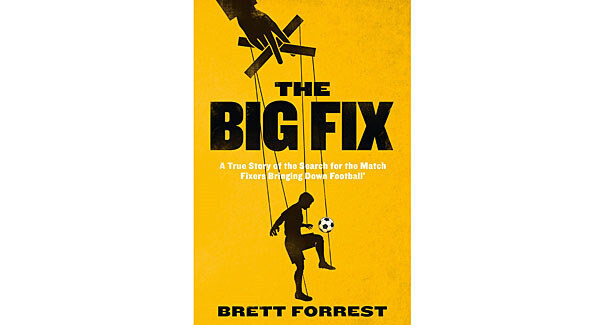
* The Big Fix: A True Story Of The Search For The Match Fixers Bringing Down Football (Harper Sport, £14.99).

More in this section

Sport

Newsletter

Latest news from the world of sport, along with the best in opinion from our outstanding team of sports writers. and reporters

Cookie Policy Privacy Policy Brand Safety FAQ Help Contact Us Terms and Conditions

© Examiner Echo Group Limited