Living in different worlds
A day in the life in Brazil. The bus in the suburbs arrives rickety and baking hot as always, but with the news that fares have increased.

Living in different worlds

They don’t reflect the service though, as en route it still manages to break down and everyone is told to get out with barely time to gather your belongings and no refund in sight.

So you walk the rest of the way to a city centre verification bureau that exists solely to photocopy and stamp photocopies of documents so that officials know they are real. Only the officials are located nowhere near the bureau so it’s another bus to the federal police with your new sheets of paper covered in fresh ink to get to the bottom of some visa problems.

Issue one involved the use of a middle name on a passport but not on a marriage certificate. Embassy verification not being accepted, it took an age to sort. Finally solved, issue two arose around the difference between Irish and English spellings so you queue for an hour to get a number to check online so you can send more documents when requested, are told there’ll be an agent randomly visiting your house over the next few months to make sure your marriage is real and it’ll take seven or so months in total to sort.

But getting that news took so long, it means the traffic Brazil does better than anywhere (Sao Paulo holds the world record for a traffic jam at 192 miles) awaits along with a 90-minute trip home across a mere 10 kilometres.

Okay, so not every day here is like that and Brazil has endless upsides that come thanks to its people, its food, its drink, its culture, its diversity, its sport, its weather and its perpetual welcome.

Even the police did their best while tangled up in endless red tape and besides, it’s far worse for others on those buses. Prices relative to wages here are much higher than we’re used to and many of these people’s lives are built on crazy credit just so they can own an overpriced box apartment miles from where they work without adequate transport links in between. It’s just that after such experiences, it’s always light amusement to tuck into the latest ramblings of Jerome Valcke, the secretary-general of Fifa who, it seems, could claim to have his finger on the pulse while stood over a corpse.

At no point across this World Cup build-up does Valcke appear to have realised the problems that exist for the majority of the people in Brazil in terms of transport, education or health. Indeed recently an in-law with the best insurance available was taken an hour away to a hospital that was full, transported to another full hospital, before being taken back to the original hospital where he was left on a trolley. This was following a stroke he’d die from.

Nor does it appear Valcke has noticed who exactly has funded the massive bill for this ego-driven and bloated tournament that has run to over €11bn.

Having paid, the taxpayer here should be the customer but instead they are treated as a mere nuisance who dare make life difficult for Fifa who in time will run away with most of the profits.

In recent days alone, Valcke started his latest comedy act by attacking Brazilians for their insolence in attempting democratic protests.

Not satisfied with that, he said “the biggest challenge” would be for tourists, forgetting locals have to deal with a shortage of 168,000 physicians in a nation where 15% of children under four live in areas where there is sewage running openly, where illiteracy averages 10%, where 13 million are underfed and where 42,785 were murdered last year.

Meanwhile, his remark that Fifa has “been through hell” came after an eighth worker died building a stadium.

“You cannot talk about the legacy at or right after the World Cup,” he insisted to Fifa.com. “You need few years to see what the legacy is. There are legacies at different levels. The first level is the football infrastructure. Then you have the different cities. Those cities will have changed from the times when they received the organisation of the World Cup, to the time when they will have the games played in the city. There is a different level or urban mobility, accommodation and road network.”

Curious words at best, clueless most likely, given that some of Brazil’s new stadia that hold more than 60,000 people will be inherited by clubs that don’t get more than 1,000 into games.

As for his comment on improvements of cities, this week the Folha newspaper ran the rule over the reality. Of 167 World Cup projects, 68 are ready. In Cuiabá the light rail system was cancelled because of companies terminating contracts. Salvador cancelled its bus corridors and other projects with excuses that included rain. Recife said it couldn’t expropriate land, Porto Alegre blamed fund delays, Fortaleza’s bus corridor isn’t ready because of project changes, while eight airports haven’t been upgraded.

The Sports Ministry has said all delayed projects will be finished after the World Cup, but then again this is the same ministry that said before the World Cup that no public money would be used. Once bitten, twice shy.

And anyway, with 50 days to kick-off, their World Cup site ran 50 reasons why Brazilians had got bang for their buck and how it has changed the country. It included coin and stamp collections, volunteer work, arts and crafts production, cultural diversity and even stooped to transparency.

You won’t hear Valcke mention that though, because from on high, he and Fifa know nothing about the reality in Brazil.

If he cares to take a look before the World Cup kicks-off though, there’s usually a spare standing space on the rickety and baking hot bus into town.

If it makes it that far.

Disgruntled workers promise more protests

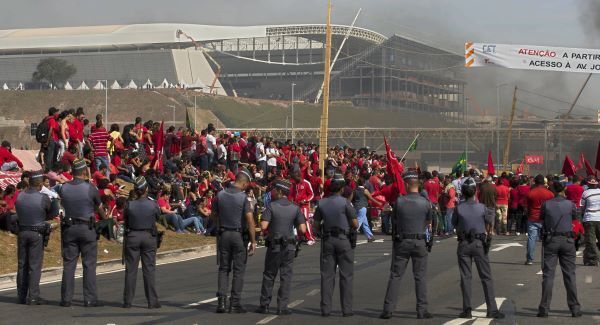
In the shadow of the Arena Corinthians in Sao Paulo, the stadium that will host the opening ceremony and game of next month’s World Cup, members of the ‘Workers Without a Roof’ movement this week took to the streets in anger.

Employed but homeless, the group has existed and has been squatting since 1997 and have long confronted numerous governments about the lack of homes in the country and the half-a-million empty units they claim exist in abandoned buildings.

They are now demanding new policy in the area that resolves their situation. They’ve insisted all properties they take over before the tournament begins be given to them on a full-time basis, including some beside the stadium, and they’ve promised to take over more buildings in protest at the spending on the World Cup.

They were far from alone though, as a nation took to the streets yesterday amidst calls for further social unrest. From steelworkers protesting the economic slowdown in recent times, to police and firefighters in the north-east walking out over their contracts, to teachers striking over their pay, united by the countdown to a tournament that has cost €11bn of mostly taxpayers’ money.

By nightfall, some of the protests had resulted in angry clashes with police. In what Fifa will have seen as a test of security ahead of the event, leaders of the protests have promised not to stand down and warned much more of the same once the football begins.

More in this section

Sport

Newsletter

Latest news from the world of sport, along with the best in opinion from our outstanding team of sports writers. and reporters

Cookie Policy Privacy Policy Brand Safety FAQ Help Contact Us Terms and Conditions

© Examiner Echo Group Limited