Spain’s cavalier clubs dicing with danger
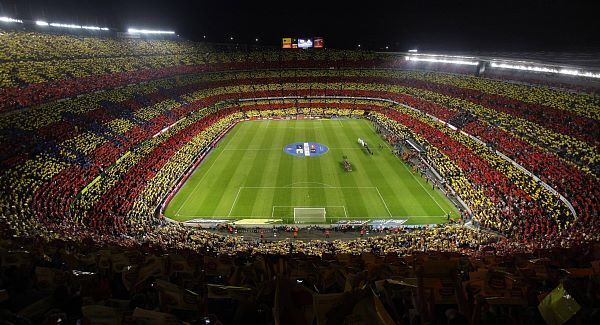
Redeveloping the Camp Nou and expanding it to seat 105,000 spectators is clearly president Sandro Rosell’s preferred option. A new build looks unlikely as Barcelona University won’t sell the only potential site identified, and blaugrana directors regularly warn about the dangers of doing nothing. Even though well-connected Catalan paper Mundo Deportivo claim the renovation will finally cost 500 to 600m, it looks set to go ahead.
Barca’s plans match those of rival Real Madrid to spend 400m upgrading the its Estadio Santiago Bernabeu, adding better match-day facilities including air-conditioning throughout, while affixing a new luxury commercial and hotel complex on one side. The rebuild is a pet project of Blancos president Florentino Perez, also chief of Spanish construction giant ACS, and mastermind of the club’s recently completed suburban training facility and various controversial land-swap deals with Madrid’s city council.
Madrid’s city neighbours Atletico also have their stadium project — with hopes to begin the 2016/17 season in an new ultra-modern 69,000 seater ‘La Peineta’ ground near Barajas Airport. The move was announced in 2007 by Atletico president Enrique Cerezo, Madrid town hall and brewers Mahou. That idea is currently under review with Spain’s housing bubble long burst.
Valencia also have a half-built new stadium, having likewise gambled and lost on the local property market. Egged on by its bankers and the regional government, then club president Juan Soler borrowed huge sums in 2007 to start building a shiny new 70,000- seater home. W, but work stopped in 2009 when money ran out. Current president Amadeo Salvo recently unveiled scaled down plans to restart work on a ‘Nuevo Mestalla’ for 60,000 spectators, but has yet to raise the 100m required even after trips to China and the UAE to meet potential private investors.
Athletic Bilbao’s stadium plans are a rare success. The Basque club demolished its 100-year-old Estadio San Mames last summer, and now play just next-door in a superb new 53,000 capacity ground, where they recently beat Barcelona 1-0. But Athletic are one of La Liga’s best run clubs, and thanks to controversial help from the local government reportedly paid only a fifth of the 173m cost of the ‘New San Mames’.
Most of Spain’s major stadiums (including the Bernabeu and Camp Nou) were built in the 1950s and 1960s and then improved for the 1982 World Cup. Some smaller clubs (Espanyol, Villarreal and Real Sociedad) have neater, newer nicer grounds, but most (including Sevilla, Real Betis and Deportivo la Coruna) play in huge lumps of crumbling concrete.
Few complained about facilities until the mid-2000s, when credit was flowing during a short-lived economic boom. Many limelight-loving club presidents and local politicians wanted their club and city to have its 21st century equivalent of a medieval cathedral. Given the tensions between the centre and regions like Catalonia and the Basque Country, nobody wanted to be left behind.
Such delusions of grandeur should have dissipated in the current mood of austerity, but nobody has shouted stop. Barca and Madrid are discussing selling naming rights to their homes, and considering using future season ticket sales as security, as both clubs have too much debt to borrow more. Valencia was last week put up for sale as when its bankers finally ran out of patience. Atletico fans have gone to court to try and stop their club’s move. But it seems nothing can stop La Liga’s construction madness.

CONNECT WITH US TODAY



Be the first to know the latest news and updates