Time to spin the wheel
What Ireland need to do now and why Martin O’Neill is the man to do it.

Time to spin the wheel

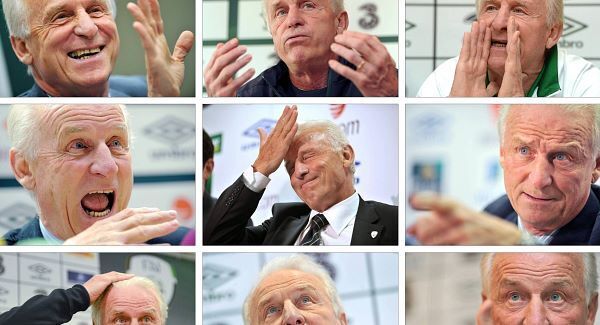
The more they change the Irish managers, the more things stay the same. For those who think the departure of Giovanni Trapattoni might herald a sea-change in the way the national team plays its football, a little bit of recent history offers some wise and sobering counsel.

When Robbie Keane said this week that, in his time as an international, Ireland only ever had a Plan A, never a Plan B — and robustly added that any suggestion to the contrary was “crap” — he was only using exaggeration to underline a basic truth. From the watershed success of Jack Charlton onwards, successive Ireland managers have, of course, sought to put their own imprint on the job, but none has dared to try and reinvent the wheel.

Yes, Ireland has been blessed with a sprinkling of outstanding individual talents over the years and, for sure, there have been games and performances which have lifted the nation’s spirit and thrilled the purists in equal measure, but when it comes to our essential identity as a football nation, nobody is ever likely to confuse the green and white with the canary yellow and cobalt blue.

Charlton was unusually lucky to have a formidable crop of players at his disposal — not just good footballers but big characters as well. Yet, underpinning the unprecedented success he brought to Irish football, was a no-risk tactical approach based on his famous maxim that since we couldn’t beat them at their game, we’d beat them at ours.

Mick McCarthy, billed in advance as ‘son of Jack’ confounded expectations by deviating from the rigid script. He too had the benefit of a strong group of players, as Roy Keane grew into maturity on the pitch while battle-hardened warriors such as Niall Quinn and Steve Staunton blended perfectly with rising stars like Robbie Keane and Damien Duff.

Unfortunately, McCarthy’s success in guiding his team to a terrific showing in the World Cup in Japan could not be replicated by Brian Kerr, despite some promising signs. And then, when the wheels well and truly came off under Steve Staunton, it was the cue for one of world football’s most highly regarded figures to take his bow on the Irish stage.

Trapattoni set about restoring

confidence and purpose to a demoralised side and, in taking Ireland to the brink of World Cup qualification at the first attempt and then, in only his second campaign, overseeing the long-awaited return to Europe’s top table, he succeeded in doing much more than that. By any objective assessment, these were achievements of real substance which, for all the flak which has since come his way, don’t deserve to be revised downwards in light of the crushing disappointment that was Euro 2012 and the subsequent slippage which has now cost him his job.

That said, the bald stats of the current campaign confirm Trapattoni’s methods had passed their sell-by date or, perhaps more to the point, were simply just not suited to the job of managing a period of massive transition in the squad.

One point from three home games against our main group rivals made one good night in Stockholm seem like a mirage, before those back-to-back defeats at home to Sweden and away to Austria put the final seal on the Italian’s time in charge.

Yet, it would be silly and hugely counter-productive to condemn all his methods as unsound.

The famous ‘attention to the leetle details’ would continue to be bedrock stuff for any thinking successor, as would the clear-eyed recognition that, for all the promise we like to think this current panel holds out, the players — as individuals and as a collective — are still a long way short of being world-beaters. Even before he gets to grips with tweaking the tactical approach, perhaps the most pressing task for the new man will be to address the fragile psychology of the national team.

This is a recurring problem which pre-dates Trapattoni, but it’s one which resurfaced with a vengeance in the latest campaign: the phenomenon whereby Irish teams so often retreat from a position of strength, as if paralysed by finding themselves in the ascendancy. Hence, the no longer funny joke that just about the worst thing Ireland can do in a match is take the lead. How to transmit a sense of self-belief to what is still a very inexperienced side, will be a significant challenge for Trap’s successor.

The idea of an Irish side suddenly discovering the joys of the beautiful game and passing opponents off the pitch is simply fanciful. Again, as Robbie Keane suggested this week, to get to that glorious mountain top will require probably years of hard work from the bottom up. That’s a debate for the longer-term.

In the short-term, Ireland can and must mix it up more than Trapattoni was prepared to countenance. Long ball, short ball. In the air and on the ground. Steel and style. Heart and head. The Irish game has always been at its most effective as a tactical hybrid, executed by fully committed players who, if not necessarily among the cream of the crop technically, shouldn’t ever be found wanting in terms of competitive spirit.

The undoubted tendency in this country to hype certain players above their status met its stubborn opposite in Trapattoni’s reluctance to see, for example, that Wes Hoolahan was the one footballer in the squad who, even if only used sparingly off the bench, could bring an entirely different dimension to Ireland’s creative play. If the next manager can bring to the Italian’s basic principles of organisation and hard work, a degree of flair and imagination in how the team works with the ball, the results could be very productive, as well as being a bit more pleasing on the eye.

Of course, much will also depend on the continued progress of those younger players in whom the nation’s football followers are investing so much hope — Seamus Coleman, James McCarthy, Robbie Brady and even, though he’s hardly a rookie any longer, Shane Long.

It’s a truism that an international manager can only do so much to develop his players in the limited time he has with them, having to trust in the main that they will continue to flourish and learn good habits at their clubs.

But if there’s one candidate for the Ireland job who seems ideally suited to that crucial task — as well as most of the other challenges outlined above — it’s surely Martin O’ Neill. Smart, passionate and highly regarded as a man-manager, his appointment would not only be broadly popular but, much more importantly, likely to produce a positive response from the people who matter most — the players.

Concerns about a perceived tactical conservatism seem to me to be misplaced and are probably rooted more in the frankly silly idea of the need to be seen to appoint an ‘anti-Trap’ than in any realistic appraisal of what the Ireland team needs right now. And that’s someone, like O’ Neill, who can bring his own hybrid of the pragmatic and the inspirational to the training ground and the field of play.

To repeat: the object isn’t to reinvent the wheel but to get the existing one spinning happily again.

TRAP: THE HIGHS AND LOWS

1. Friendly, Serbia (h), May 28, 2008, 1-1

The beginning of a memorable journey. A half full Croke Park watched Trapattoni’s first game in charge as Andy Keogh rescued a draw in injury time.

2. World Cup 2010 qualifier, Italy (a), April 1, 2009, 1-1

Trap brought Ireland to Bari and set them out in such a way that it was like watching two Italys face off. Robbie Keane’s late strike cancelled out Iaquinta’s opener for the hosts.

3. World Cup 2010 qualifier, Italy (h), October 10, 2009, 2-2

It could have been a famous win only for Gilardino’s last minute strike to spoil the party. That Ireland were neck and neck with the World Cup holders was, at the time, a credit to Trap and the players.

4. World Cup 2010 play-off second leg, France (a) November 18, 2009, 2-1 (aet on agg.)

Thierry Henry’s hand effectively denied Ireland a place at international football’s grandest stage. The sense of injustice only increased Trapattoni’s popularity.

5. Euro 2012 qualifier, Russia (a), September 6, 2011, 0-0

The Moscow miracle. A defensive masterclass from Richard Dunne with Russia trying everything to find a goal was another high point during an incredibly steady campaign.

6. Euro 2012 play-off first leg, Estonia (a) November 11, 2011, 0-4

The standout moment of his time in charge. The biggest winning margin under his time and the first qualification in a decade. Earned him a contract extension.

7. Euro 2012, Croatia, Spain, Italy, June 10-18 2012, 3-1; 4-0; 2-0

It was all downhill from here. The group was extremely difficult and there was little expectation that Ireland would progress any further but the manner in which they slumped to three defeats hurt. A lot.

8 World Cup 2014 qualifier, Germany (h), October 12 2012, 1-6

The hammering by Germany was the most humiliating moment of Trap’s tenure. Victory away to the Faroes four days later saved him from the sack.

9. World Cup 2014 qualifier, Sweden (h), September 6 2013, 1-2

Having looked so good when ahead early on, the feeble second half showing after falling behind highlighted the rapidly widening cracks in his system.

10 World Cup 2014 qualifier, Austria (a), September 10 2013, 1-0

Though his time as manager was coming to an end anyway, the defeat in Vienna simply served as confirmation.

- Alan Smith

More in this section

Sport

Newsletter

Sign up to our daily sports bulletin, delivered straight to your inbox at 5pm. Subscribers also receive an exclusive email from our sports desk editors every Friday evening looking forward to the weekend's sporting action.

Cookie Policy Privacy Policy Brand Safety FAQ Help Contact Us Terms and Conditions

© Examiner Echo Group Limited