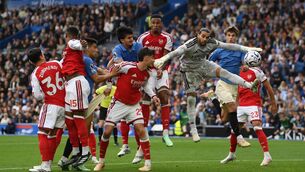
Will Ferguson act first or be forced to react second?
Even more curiously, it was after an identical attitude from his team saw them leave Real Madrid with what many perceived as a fine score. Not the Manchester United manager, however.
âA lot of people on our side of the fence thought 0-0 was a good result but I was disappointed and worried,â Ferguson said of that first-leg draw in the 1999-2000 Champions League quarter-finals. âI could sense the rain coming.â
There were a few levels of irony to that comment, though, which add even more dimensions to tonightâs rematch.
For one, it was actually Unitedâs second-leg attacking that Ferguson ended up lamenting most in the long term. Whatever about rain, his side absolutely poured forward in the return leg. Famously, Real Madrid picked them off on the break, went through 3-2 and conditioned Fergusonâs attitude to Europe for the next 12 years.
âOne of the forceful reminders delivered by that defeat was that consistent success in Europe would be more readily achieved if we improved our capacity to defend against the counter-attack,â he said.
Instead, United actually restructured their team along those lines. The span of success between 2006-11 was founded mainly on defensive strength and dynamic breaks.
In many ways, it was an inversion of the clubâs European history. And itâs even more resonant given the recent anniversary of the Munich Air Disaster, and the amount of nostalgic coverage the Spanish media have afforded Unitedâs ties against Real from 1957 and 1968.
With just 45 minutes left in the latter of those contests, Matt Busby had a simple enough message. âJust go out there and play.â
It remains the only time United have actually eliminated Real, and Ferguson himself lamented a failure to do similar in 2000 and 2003. âReal are the team with the greatest record in the European Cup. I was disappointed we didnât take the opportunity to show our true worth (when we played them in the past).â
The Scottish legend finally has the chance to make amends tonight, however. Even more importantly, such an attitude might actually best serve United rather than try to prove the kamikaze approach of the past.
Because, for what is really the first time since that 1999 side, United are overwhelmingly built on attack. Ferguson himself flagged the change in emphasis in the summer when he counter-intuitively signed Robin van Persie rather than use his available money to buy the defensive midfielder the team seemed to need.
Similarly, although United showed some of their old 2006-09 resilience against Everton at the weekend to claim cleansheets in successive games for only the second time this season, there is quite a difference between holding firm against Fulham and then Marouane Fellaini, and doing the same against Cristiano Ronaldo and one of the most prolific attacks of all time.
Indeed, the very make-up of Real only indicates a further need to take the initiative. Because, for all their power going forward, the Spanish championsâ defence has proven extremely vulnerable to braver attacking from teams like Getafe and Real Sociedad.
And, while the motivational powers of Mourinho will surely mean this match is played on a different level to what both teams are used to, is it not better to try and get ahead on your travels when conceding isnât so costly, rather than leaving yourself open to an away-goal sucker punch in the return? Ferguson has learnt the danger of that from this fixture in the past.
The question is whether he will now have the assurance to act on it.