Ireland rediscover fighting spirit
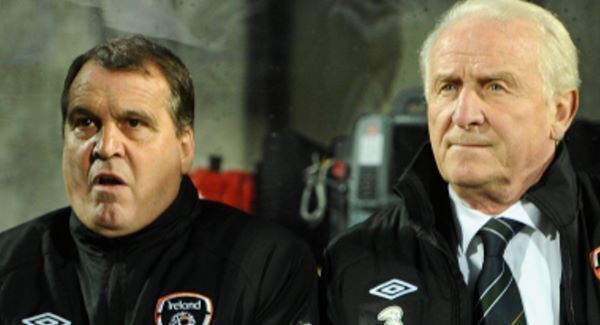
The manager insisted he would be back for more after this restorative 4-1 win but also admitted that he didn’t know what way the FAI would jump. With the expectation still being that it will be in a direction away from the Italian, it might be some consolation for Trap that his players finally found a performance of some quality in World Cup qualifying — albeit against part-timers and mainly in the course of an encouragingly productive second half.
In truth, there had been a lot of huffin’ and puffin’ from the visitors in the first half in Torshavn but a dominant second period eventually saw them run out comfortable winners.
Rarely can a precious three points have been played for against a backdrop of such feverish speculation about the winning manager’s position, FAI chief executive John Delaney, having taken his seat in the stand before kick-off, waving away attempts by journalists to get some clarity. And he again dismissed a media approach after the final whistle. But from early in the day in the tiny Faroese capital, even the visiting Irish fans about town were claiming that they had it on good authority that Trapattoni could be gone by the end of the week.
Against that backdrop, even a World Cup qualifier could seem almost like an afterthought — and, indeed, the Irish players themselves appeared to have their mind on other things in a distracted and disjointed first half. In the game’s opening exchanges, Ireland were struggling to get into any kind of stride on the artificial surface but then, in the 12th minute, squandered a gilt-edged chance to settle themselves when, after a Robbie Brady short corner, Aiden McGeady clipped a cross into the box to Keith Andrews but, though straight in front of goal, the midfielder somehow directed his header an inch wide of the post. Ten minutes later, but from a more difficult angle, Jonathan Walters headed another fine McGeady cross over the top.
Somewhat ominously for the visitors, it was the lowly Faroes who were passing the ball better as they endeavoured to match manager Lars Olsen’s vision of growing into a more technically adept side. But it was Ireland who continued to make the more clear-cut chances, Faroes keeper Gunnar Neilsen doing well to keep out another Walters header after good work by Robbie Keane.
Still the Faroes never lost their composure, and although Keiren Westwood was largely underworked between the posts, there were still more than a few nervy moments in the Irish defence, not least when it took a last-ditch Darren O’Dea block to deflect Joan Simun Edmudsson’s effort on goal out for a corner.
Scoreless at half-time, the Irish headed for the dressing room having shown scant evidence of the spirit of resistance which Keane had so passionately called for on the eve of the game. It was the other Robbie, young winger Brady, who made way after the break, Trapattoni once again hardly endearing himself to Shane Long’s many supporters by sending Simon Cox into the action.
A minute into the second half, however, and with a fresh urgency evident in their play from the restart, the visitors suddenly made the breakthrough, Marc Wilson advancing up the left flank before cutting inside and, with his right-foot, letting loose a powerful shot which — with the aid of a deflection off the head of Jonas Tor Naes — flew into the top corner.
Then the impressive Wilson turned architect in the 52nd minute, his cross reaching the head of Jon Walters who found the back of the net, even though Robbie Keane who was claiming a decisive touch before it beat Neilsen in the Faroes goal. And just moments later, and after some deft footwork to create space, the skipper — an increasingly influential figure in the game — came close to claiming one for himself, his rifled shot flashing just past the post.
But, not for the first time, the Irish couldn’t fully press home their advantage, instead allowing the Faroes back into the game in the 67th minute, as substitute Arnbjorn Hansen headed home a cross from Tor Naes.
Happily, in terms of both points and goal difference, the Irish quickly reasserted their two-nil advantage, Walters crossing from the left and, when the ball fell a little behind Aiden McGeady, a desperate attempt at covering the danger saw Pol Johannus Justinussen direct it into his own net.
With 10 minutes left, Shane Long finally made it onto the pitch, in place of Keane who had done very well to be so lively for so long, considering he had been concerned about the impact of the plastic pitch on his fragile Achilles. Then, after a brilliant spin and shot by Aiden McGeady had been well saved, the winger floated in the resultant corner which John O’Shea rose high to head home for Ireland’s fourth.
Down on the touchline, Trapattoni looked happy and fulfilled in the moment but would have been forgiven for perhaps reflecting wryly on all the moments which had led up to this since he was named Ireland manager in January 2008. Even allowing for some contentious selection decisions which bordered on the eccentric, Trapattoni is absolutely entitled to point to the limited pool of talent from which he had to choose as a legitimate reason for Irish failings in the last few months, especially up against the cream of world and European football.
Despite the almost hysterical reaction in some quarters to the crushing disappointment of Ireland’s brief summer in Poland, it was hardly a disgrace to be beaten by teams of the calibre of Croatia and, especially Spain and Italy. But, having possibly even overachieved in getting there in the first place, it was the sense of underachievement at the finals themselves — especially in the error-strewn opener against Croatia — which suggested that Trapattoni was losing the knack of, at least, getting his teams over the line. He has always held up results rather than performance as the benchmark by which his management of Ireland should be judged but was obliged to look on almost helplessly as his players could deliver neither.
Had the Irish licked their wounds and begun again with renewed purpose in the World Cup qualification campaign, Trapattoni would have restored credit in the bank of popular opinion. Instead, he and his players lurched from near-crisis against Kazakhstan to outright calamity against Germany, a spiralling downward arc which even Trapattoni — with his penchant for totting up points on the board when faced with critical disapproval — could do nothing to disguise.
Happily, that slide was arrested in Torshavn last night but it could still be that even a convincing scoreline in the North Atlantic was simply too little too late to save the manager’s bacon.
Faroe Islands subs: Erling Jacobsen for Odmar Faroe 60, Arnbjorn Hansen for Daneil Udsen 60, Hjalgrim Elttor for Joan Simun Edmundsson 79.
Republic of Ireland subs: Simon Cox for Robbie Brady 45, Shane Long for Robbie Keane 80, Meyler for Andrews 90.