Trap outlines vision for brighter future
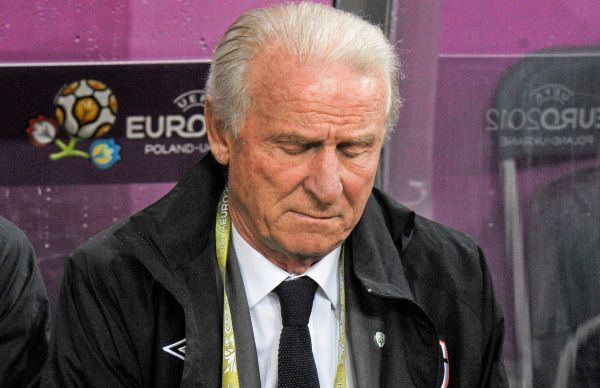
The manager highlighted the August friendly away to Serbia as an opportunity to test a new formation before Ireland commence a World Cup qualifying campaign which will see them compete in a group containing Germany, Sweden and Austria, as well as the Faroes and Kazakhstan.
Speaking in Poznan before the Irish team flew home from Poland yesterday, the manager reiterated his commitment to staying at the helm and said he would try to convince senior players who might be considering retirement to remain on board. But he also signalled a desire to freshen up the side, suggesting that players like James McClean, Darron Gibson, Seamus Coleman, Greg Cunningham and, in particular, James McCarthy, can feature much more prominently in the future. Of the Wigan midfielder, who missed the Euro finals because of his father’s illness, Trapattoni said: “He allows us to change the system.”
Trapattoni defended sticking with the old guard for the final Euros game against Italy, arguing that an improved Irish performance, even in losing 2-0, had vindicated his decision.
“It was not just out of loyalty,” he said. “It was so we could ask of them a good performance. And we played well. We played at the same level as Italy. Picking the likes of McGeady and Keane — that was out of respect.
“We couldn’t be sure that if we made big changes the result would have been different. That was the doubt. When you are sure, you can make changes like that, but not if it’s 50-50. You can’t just turn the page and forget. That is not professional or correct.”
Trapattoni said that talk of players retiring had thus far been confined to the media, before revealing that he had himself taken the initiative of telling Richard Dunne and a couple of others not to be rash in making a decision to call it a day.
“I never heard anything retirement from the players,” he told a press conference, “only from you. Maybe you are in touch with an agent but my players never said this to me. I have said before that it’s important these senior players help the young with their experience. The young can be shy or arrogant. The seniors help them grow.”
His voice rising, Trapattoni also stood over his own record as Ireland manager.
“Spain and Italy are top-ranked teams,” he said. “And don’t forget that teams like Russia, Holland, Denmark and Poland go home early like us. I am proud to have achieved qualification with this team. I’m not interested in staying on just because I am paid for this job. I would remind you that Ireland hadn’t qualified for the Euro finals for 24 years. We are proud to have been here. And maybe, with the handball in France, we would have been at the World Cup in 2010 too.
“We must defend our jobs because it is true. This achievement is solid, like this (hits table). Words fly. But I accept your criticisms. I’m not arrogant. The manager can be grateful when we win but he must also accept defeat.”
Indeed, Trapattoni could hardly deny that nothing was added to that record at the finals themselves. But while he declined to be drawn on what he regarded as specific problems, he indicated that he is ready to reappraise his commitment to 4-4-2.
“We built a team with this system but already we have an idea of what we can do differently in August,” he said. “It’s the players who give us possibilities, whether it’s 4-3-3 or another. We have to try. In August we can try.
“We can discuss it a million times but it has to be tested and if it doesn’t fit the quality of your players, it doesn’t work.”
Asked if he felt his players’ faith in him had been shaken, Trapattoni said: “I know what the players think after these defeats. But in every conference when you put the question to them, I hear them say they believe in what the coach says.”
CONNECT WITH US TODAY



Be the first to know the latest news and updates