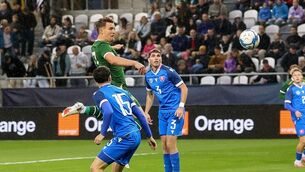
The Life of Brian: it might not be the high life but it’s a good life
HE’S a seasoned professional footballer in England and he bears one of the most famous names in Irish sport to boot, but the tall, dark-haired 32 year old doesn’t turn any heads in London’s Euston Station, even though it’s evening rush hour and the place is thronged with commuters.
Maybe it would be a bit different up in Bury, where he played for five years, or neighbouring Rochdale where he is now midway through his first season with the League 1 club. But, even then, you suspect that Brian Barry-Murphy would be treated in those parts more with the easy familiarity which is accorded ‘one of their own’ rather than with the shock and awe which attends the rare sighting of a celebrity footballer in public. In fact, he’s amused to find himself the centre of media attention. “When Jimmy rang to say that you wanted to meet me,” he says over a cup of tea in a noisy café, “I said to him, why would he want to talk to a journeyman like me?”
At that, Brian laughs loudly and infectiously, as he does frequently over the course of our conversation. Talking over the hubbub in a Cork accent that hasn’t been eroded one bit by 16 years in England, he is hugely convivial company: bright, funny and self-deprecating. But, make no mistake, he is also a committed football man, despite only taking up the game at 14 after initially following in his father’s footsteps by concentrating on hurling and football for St Finbarr’s.
The aforementioned ‘Jimmy’ is, of course, Jimmy Barry-Murphy, the celebrated Cork dual GAA star. And you can’t help wondering if part of the reason Brian turned his back on the native codes all those years ago was because he worried that he might never quite escape from under the shadow of his legendary father.
“I was always asked that when I was 15 or 16 and straight away I’d say ‘No, no’,” he recalls. “Now, when I look back I think maybe so. When I was playing hurling, I’d always hear the opposition talking about who I was. It was always ‘the son of’. But when I was playing soccer it was different. You know yourself, you’d go up to Dublin for games and nobody would give a damn who you are. We used to train at Clonshaugh and you’d hear the odd fella saying, ‘Your man’s dad’s a great hurler’. ‘Yeah, who is he?’’.
‘Jimmy Barry Murphy’. And they’d go, ‘Ah, I don’t really follow the GAA’. You know the Dubs, like, they wouldn’t have a clue! I thought it was great in a way.
“My dad always liked soccer. He was very pro the opening up of Croke Park to soccer and rugby. His argument would have been that they were already opening it up for concerts to every Tom, Dick and Harry and he would have wanted to see people like Keane and Irwin there. He had so much respect for those guys in Cork. And to be fair to Jimmy, when I was coming over, I’d say there may well have been times when he might have got a bit stick. I think when I was going for trials, like, there’d be guys in the GAA saying to Jimmy, ‘Where’s yer man?’ And he’d say, ‘Ah, he’s off doing his own thing’. So, yes, he was unbelievably supportive of me. He never put me under any pressure.”
BRIAN signed for Cork City in 1995 and went on to spend four years at the Cross, a period which he recalls fondly and regards as “a great grounding in the game”. He was in the stands when City won the FAI Cup in 1998 but couldn’t join his team mates for the celebrations because he had to rush off to link up with Ian Evans’ Irish U21 panel who were travelling to Scotland for a friendly tournament. And it was while playing for the Irish in a friendly against Northern Ireland in Inverness that he was spotted by Preston North End, a League 1 club then managed by an up and coming gaffer by the name of David Moyes.
Brian had previously had trials with Arsenal, Celtic and Middlesbrough but he remembers the one for Preston as, well, a trial.
“It went on for about three weeks. Moyesy takes a bit of convincing. I did really well in the first week and I thought ‘I have this gig’. Then the next week, it was ‘You need to show me more’. And finally, at the end of the third week, after we’d played Everton in a friendly, he said, ‘Right, you’re ready, go home and get your stuff.’ He only gave me two days. It was on my 21st birthday, I went home for one night, had my birthday, and came back the next day. But I didn’t think anything of that. I was just desperate to give it a lash in England.
“But Moysey was tough, like. At Preston, he used to work us into the ground, we’d be training night and day. At the time it felt like hell but he taught us everything. I often wondered though if he could do with lads in the Premier League what he used to do with us. We weren’t exactly clones but whatever he told us to do, we did. The intensity of our games at Preston was unreal and if you didn’t reach that standard you were left out.”
In only his first year in England, Brian suffered the setback of a knee injury – sustained while playing for the Irish U21s – which required an operation. Preston got promoted that season and, the following year, Brian made a quite a few appearances off the bench as Moyes burnished his growing managerial reputation by taking his side to the Championship play-off final in Cardiff against Bolton. Brian was on the bench that day, watching helplessly as Sam Allardyce’s team came out on top. It would prove to be the closest Barry-Murphy ever came to gate-crashing the Premiership.
After that, Moyes wasn’t long following Big Sam up into the top-flight, as a replacement for Walter Smith at Everton, while Brian was also on the move, albeit in the other direction, with loan spells at Southend United and Hartlepool, before he signed for Championship side Sheffield Wednesday in 2003. But the former giants of the English game were on the slide, slipping into League One and giving Brian his first bitter taste of relegation. Still, he relished his time at the famous Hillsborough ground.
“Wednesday is an extraordinary club,” he observes. “The fans are great but they have this expectation that they really should be a Premiership club. They have this great history there and they’ve had brilliant players, like Di Canio. When we were relegated we were hot favourites to get promotion from League One – Alan Quinn from Dublin was one of our strikers then – but we were flopping, we were in mid-table and we used to be getting hammered by the fans. I used to go to the dogs all the time and you’d meet the lads and they’d be going, ‘what the hell is going on?!’
“But, in fairness, they were used to having Andy Hinchcliffe playing left-back and the next season they had your man Barry-Murphy from Cork playing there (laughs).”
At the end of that season, Brian was one of 14 players let go by Wednesday and was left twiddling his thumbs for two or three months waiting for an offer to come. But, a naturally positive individual, he wasn’t inclined to panic.
“I wasn’t that worried. I used to think, sure. if the worst comes to the worst I’ll just go back home. Derry City definitely rang me but I thought I’d bide my time. I was getting married and happy in England. Then I got a call from (former Ireland international) Kelham O’Hanlon who was number two at Bury. He rings me and says, ‘Have you got many options?’. And I’m on the phone going: ‘Ah yeah, I have a few’. And I had f***-all, like! (laughs).”
By coincidence, Rochdale came in for him around the same time, although it would be five more years before Barry-Murphy would hook up with Bury’s rivals. Instead, the Gigg Lane club became his longest-lasting home to date in English football as well as the scene of another painful brush with glory. Two years ago, Bury played Shrewsbury in the League 2 play-off semi-final, live on Sky. They won away 0-1 in the first leg, but then missed a penalty at home before Shrewsbury grabbed an equaliser in the last minute of stoppage time. Shrewsbury won the ensuing penalty shoot-out, despite Brian doing his bit by converting his own spot-kick.
AND that was the thing which, in advance of the game, had most preoccupied his dad.
“Jimmy was saying, if it goes to penalties, don’t take one. He didn’t want to have to watch. The mother wouldn’t watch at all. But I didn’t care.”
By which Brian doesn’t mean that it didn’t bother him if he scored or missed or if the Shakers failed to go up. It mattered a lot. What he means, he’s at pains to clarify, is that he has always regarded it as a privilege to have made a career out of playing the game he loves; it’s just that he has never been able to bring himself to regard it, as some do, as a matter of life and death.
“Never did,” he reflects. “I never had any real big money from football and I always kinda thought I could have been working in an ordinary job. I never really thought I was a Premier League player. I didn’t think I was that kind of class. I played with some of those lads for the Ireland U21s, like Richard Dunne. And I never thought I was going to play at that level. At home, we were brought up around greyhounds and horses, so we were always quite good judges of ability (laughs). You always dream, of course, and when I’ve played against Premiership teams in the Carling Cup or pre-season friendlies, I’ve sometimes thought well, maybe I could have played at that level. But then, in one-off games you can always do well, can’t you?
“I thought playing in the Championship was brilliant, though. And I think I had the right attitude. Moyesy used to bring me in at the end of a season and say: ‘Your greatest asset is your attitude toward the game: you play as if you really enjoy it.’ And I think that’s true. There might be spells when you’re under pressure but I’ve always loved it.”
He has also grown to love the intimacy and camaraderie of the lower leagues. He tells a story about his old Cork City mates Derek Coughlan and Neal Horgan coming over to Gigg Lane to watch him playing last year.
“It was only Bury against Barnet with about 1800 there and the pitch was frozen but the lads thought the atmosphere was unreal,” he grins. “It was great craic. John O’Flynn was playing for Barnet that day and, after the match when we came off, Derek Coughlan, who’s a gas man, was in the tunnel. And no-one comes in the tunnel, like. And he says to me, “Well done Brian, you played well.” And then he turns to John and says, “John, you were brutal today, boy, what was up with you?” Pure Cork humour.
“At Sheffield Wednesday we’d had a couple of players on huge money. They were great guys but it was all a bit distant, y’know? But when I went to Bury it was like a GAA type thing, where the lads would all socialise together. Whenever we’d get a good run of results we’d be on top of the world, we’d all be in Manchester having a few pints. We thought we were great.”
ACK in June, Brian somewhat reluctantly ended his long association with Bury. The club wanted him to stay but an offer from League 1 Rochdale proved too tempting.
“It was loath to go elsewhere but I wanted one last challenge. This was the league I started off in when I came over all those years ago and I thought I’d give it one more go. It’s a more competitive league and I think I’ve adjusted quite well. I’m glad I did it. The manager, Keith Hill, has me playing in central midfield which is my favourite position. Not to sound big-headed but everything goes through me and I can try to control the game.
“And the football we play is unreal. Keith is a real student of the game. You’ll laugh, but we study videos of Barcelona all the time. We watch all the Spanish teams. Hilly has really opened my eyes over the last few months. The problem is that, although we started off like a house on fire — beating Southampton away and Huddersfield at home — we’re on this run now where we’ve lost six out of seven. Now every other club I’ve been at, the managers would say, ‘Right, we’re going more direct.’ But he says, ‘Nah, we’re going to kill teams with possession’. And I admire that about him. And he’s brilliant at bringing through good young players.
“The problem is we’re not shutting out teams. And we’re not taking our chances. He wants to play expansively but he knows there comes a time when you can’t keep giving goals away. But I want to do well for the manager, not just survive, push on.”
LONGER term, Brian hopes to be able to stay in the game but he doesn’t really like thinking too far ahead.
“People say I’ve only got a couple of more years left but I don’t think that way because I keep myself in great shape. I started doing the coaching badges a few months ago but I didn’t want to put it out there because when you start saying that, the next thing managers are putting you on the bench and clubs start thinking you’re on the way out. Which I’m not. But Jimmy had been saying it to me for a few years to get the badges done. And then my wife started to say the same thing: ‘Jimmy knows what he’s talking about’. And I was surprised how much I enjoyed it. I go to a lot of games to watch the top teams. And whenever any Spanish team comes to England I go to watch them. I’ve always valued my own opinion of games. I think I can read the game well. But who knows who makes a good manager?”
Has he any regrets about missing out on all the stuff that goes with being a top-flight footballer, from wags to riches?
In response, he mentions his wife, Tam, who, as we’re chatting away, is taking the opportunity to get in some last minute shopping at Euston before they head back to their home in Warrington. “She met me when we were on the verge of the Premier League and I always say to her, ‘Ah see, you were a typical wag then’,” Brian says with a grin. “But to be fair to her, she’s stuck by me through the lower leagues.
“The thing is, I don’t look back too often but when I do it’s with a great deal of satisfaction. I really enjoyed it. I played at Hillsborough for two years which was brilliant and I still go back to the ground for games and have great craic with the fans there. And when I go back to Preston it’s like going back to Cork City, I like the people there. Bury the same.”
If there are any deep regrets for Brian Barry Murphy, he hides them well. More likely is that, with him, what you see is really what you get: the personification of the notion that happy is the man whose hobby is also his career.
“I’ve had a ball really – I mean, some of the friends I’ve made,” he says. “They’re the kind of things I look back on. Journeyman pro? I label myself as that, tongue in cheek, sometimes. But I think I’ve had a good deal.”

CONNECT WITH US TODAY



Be the first to know the latest news and updates