Function v flair: the juggling act facing Munster and Leinster's young and gifted No 10s
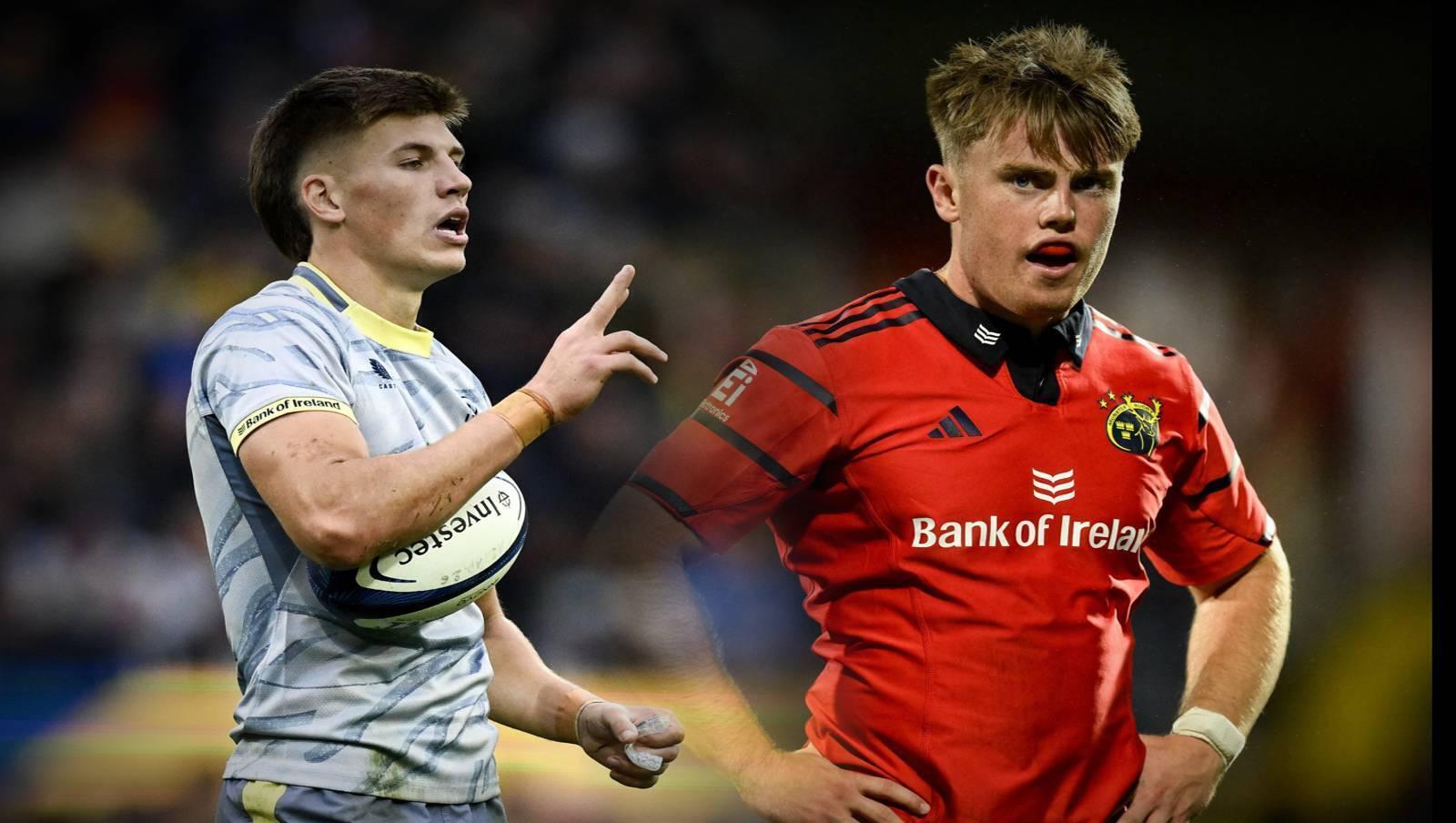
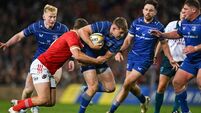
Leinster's Sam Prengergast (left) and Munster's Charlie O'Shea (right).
Half-time was imminent in Munster’s Champions Cup pool opener when, with Racing 92 turning the screw and threatening the 22, Sean O’Brien stole in for an intercept that met with a roar from the Pairc Ui Chaoimh stands.
The siege had been lifted but it was only when Charlie O’Shea took possession from the ruck and loosed a high clearing kick down the other end, and Nicolas Martins got pinged for not releasing on the ground, that the hunters really became the hunted.
Plenty needed to happen for that swing in momentum.
Munster had to hold the line in the first place and frustrate the French into a sloppy pass. O’Brien had to make his move. John Hodnett had to turn on the burners to clear out the first ruck.
Sean Edogbo had to be on hand to act as auxiliary scrum-half, and Alex Nankivell had to lead a quartet of chasers down to the City End of the ground to force the Racing flanker into the offence that confirmed Munster’s huge territorial grab.
But Jim Hamilton, commentating on Premier Sport, had eyes for only one man.
“The kick selection there, if this was Sacha Feinberg-Mngomezulu or Ciaran Frawley that’s burst onto the scene at ten we would be going mad,” said the Scot. “So we are going mad. This young lad’s the real deal.”
Read More
Hamilton had started his soliloquy by stressing the need not to go overboard about the young Munster ten, then followed it up by saying the kid was basically building the energy in the stadium all by himself.
O’Shea’s impact on the province has been astonishing, from that first competitive start against the Bulls in Limerick where he scored two tries and kicked three conversions before exiting to a standing ovation.
His night in the Pairc showcased an ability to stitch things together, attack the defensive line, make searing breaks, and produce with the boot.
He kicked all three conversions and showed a willingness to kick from the hands and keep the visitors guessing.
Bernard Jackman had spoken beforehand about a player who “wants to make things happen”, a quick-witted out-half who can use his skillset and take people on. He wasn’t the only Irish ten doing that on Saturday.
Hours earlier, Sam Prendergast was recovering from a bumpy start away to Clermont Auvergne with a performance that employed the same arsenal of chips and dinks that, done right, can be so effective in modern paint-by-numbers pro rugby.
The breakaway try that Prendergast instigated and scored just after the interval was a thing of pure, instinctive beauty and showed just how profitable it can be to play what you see and not always what you’re programmed to expect.
“There is elements of coaching a team to be comfortable with going with the flow, if things are done off script or if opportunities present,” said Leinster’s attack coach Tyler Bleyendaal. “Players like Sam on the weekend, he took nice opportunities that maybe weren’t in the script or in the traditional structure of the game. It was nice.
“Sometimes (with) especially 10s, you’ve got to give enough confidence to the guys around you, that there’s consistency to what happens, but then we want to be able to attack the best space, and someone like Sam is really good at that. Whether it’s with running or kicking. He’s got a nice passing game too.
“Sometimes it’s the ‘not coaching’. As in don’t coach things out of them. He has to still experience that as well. Try something in your head that maybe wasn’t the best option. He is quite good at recognising that pretty immediately and putting it in the memory bank. ‘How come that didn’t work’.”
Rugby, like most team sports, has flipped from a player’s game to a coach’s game at the highest levels.
Pick up Peter O’Mahony’s book and make for the chapter where he details Joe Schmidt’s painstaking methods with Ireland and you will see that concept taken to the absolute limit.
Individuality and instinctiveness don’t always find a warm welcome at rugby’s hearth. O’Mahony makes that clear in detailing Schmidt’s relationship with Simon Zebo.
Out-halves with minds of their own, or just occasional urges to ad lib, can generate more suspicion than most.
Carlos Spencer, one of the most talented players ever, won just 35 caps for the All Blacks across seven years. Danny Cipriani, a player of boundless talent and promise, earned just 16 for England. Quade Cooper was never fully secure with the Wallabies.
“Entertainment is a big part of rugby and it is one of the reasons I love the game so much,” said Spencer in 2005. “I get excited about pulling off tricks and being cheeky. That will be the case until the day I retire from the game.”
The likes of O’Shea and Prendergast can’t be classed in the same bracket as those out-and-out mavericks, but they do lean further in that direction than modern Irish predecessors and contemporaries like Ronan O’Gara and Johnny Sexton.
There is a beauty in the rugby Schmidt’s Ireland played and, if few people could chuck a pass through their legs to set up a Joe Rokocoko try in a World Cup quarter-final against the Springboks like Spencer did, then there is a middle ground that can be found.
Bleyendaal was watching an old Bledisloe Cup game between New Zealand and Australia recently.
It was played some time in the early noughties and he was struck by how every player tried to have a crack at something every time they got the ball.
It was all reactive.
Mike Ford had only started to open Irish eyes to the realities of modern ‘D’ when that Bledisloe game was happening. The levels of structure now are endless. All of that makes it so much harder for No.10s now to express themselves.
“It’s definitely harder now because there's an expectation from other guys on the field that they also trying to achieve something, being in a position so they can do well for the team,” said Bleyendaal, whose days as a ten ended with retirement in 2020.
“And if it's going forward, or if you have pods of forwards or whatever it might be, it's about recognising when you've now used that structure to create opportunity, and then that's when the player's individual characteristics can maybe come out.
“Yeah, it's a different game.”
CONNECT WITH US TODAY



Be the first to know the latest news and updates