Munster COO explains how lack of central contracts is hurting province financially
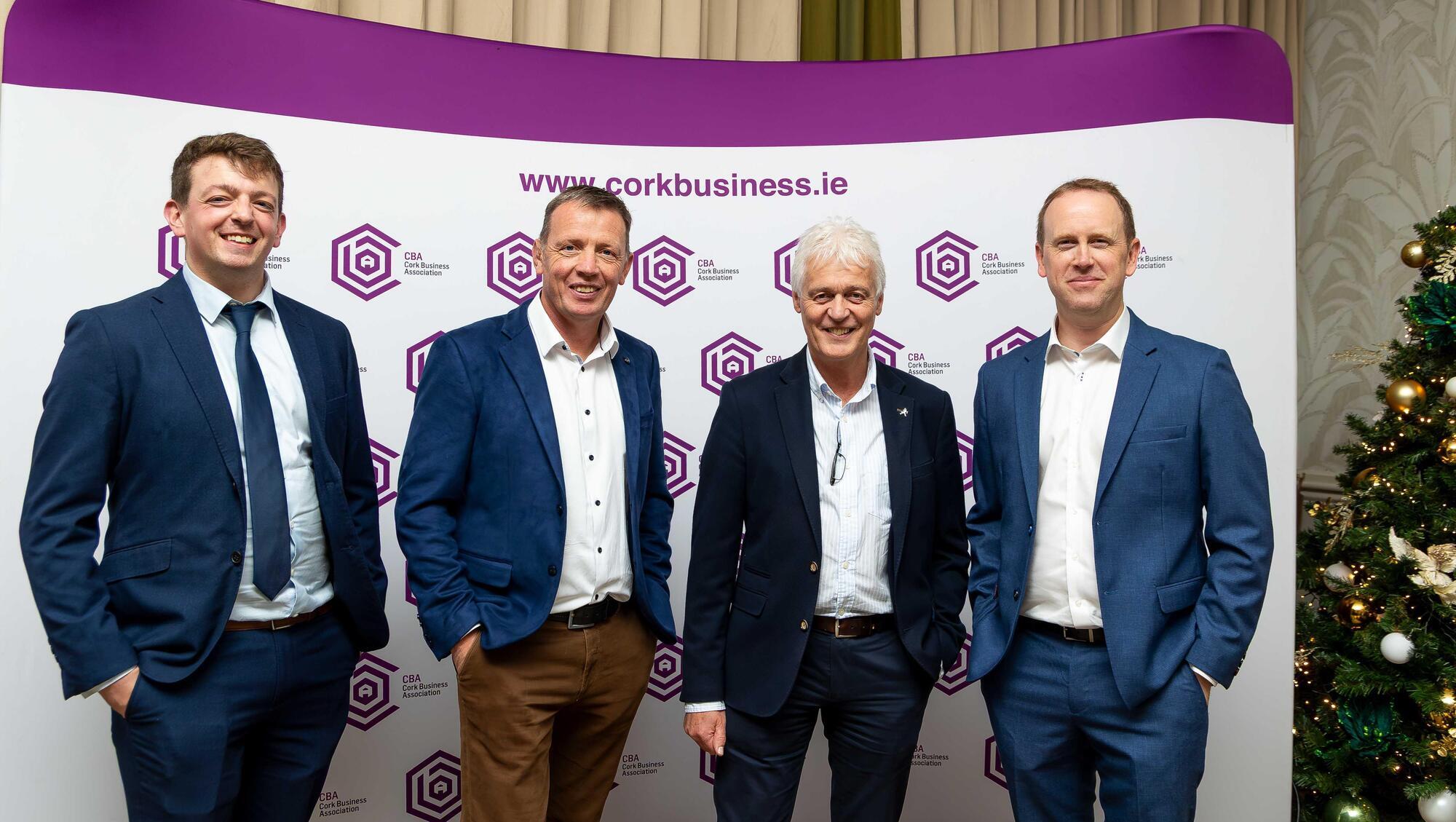
Sean McMahon, Munster Rugby; Ian Dunne, Munster Rugby; Niall Fitzgerald, Horgan Lynch; Phillip Quinn, Munster Rugby. Pic: Alison Miles / OSM PHOTO
Munster Rugby’s inability to produce players worthy of IRFU central contract players has been pinpointed as one of the main reasons for the province’s financial hardship.
Munster’s Chief Operating Officer Philip Quinn told the that the ongoing cost-cutting programme, which has included a small-scale round of non-rugby staff redundancies, was undertaken to protect investment in the organisation’s player pathway programmes.
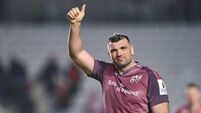
Tadhg Beirne, the Ireland lock/flanker and Munster captain, is the province’s sole player on an IRFU central contract currently, following the retirements of his predecessor as skipper Peter O’Mahony, Conor Murray and Keith Earls in between October 2023 and June 2025, with Quinn admitting it was “hard to argue” any more members of Clayton McMillan’s squad were deserving of a similar status within Irish Rugby.
That has an economic impact, with the loss of recently increased IRFU allowances to the province for centrally-contracted players contributing to Munster Rugby’s €1 million capital deficit for 2024-25 revealed at their Annual General Meeting on June 30 and a similar forecast for the 2025-26 accounts to be reported next June.
Failure to secure a home knockout match in either the Champions Cup or URC competitions and the subsequent loss in gate income, the lack of a money-spinning fixture at Páirc Uí Chaoimh, and general inflationary costs were also significant factors to the 24-25 deficit, as the Munster COO explained, with the focus remaining on producing a new generation of players capable of earning the coveted IRFU contracts as Ireland regulars.
“The one thing we've avoided is reducing our investment in the player pathway and all our youth programmes because that is an option for us,” Quinn said.
“We've invested heavily in that over the last couple of years, but we want to keep that up at the level because that's where we're going to see success in the next couple of years.
“And especially if we want to arrest that slide in terms of the IRFU funding model and getting more players up to national level, that's our focus and obviously it's going to lead to more success from a Munster perspective as well. So I don't see a major move on (the deficit forecast for 2025-26).
“In terms of the knockout income themselves, a home knockout fixture can have a massive impact. A home European game wipes out your deficit nearly in one go, whether that's a Round of 16 or a Quarter-Final and we haven't achieved those.
“The URC wouldn't be as big, but what you do see on the URC matches then is a huge amount of revenue and a huge amount of cost because we're only getting say 25% of the revenue, or whatever it is depending on the match.
“So they do jump up and down and what we're trying to do is get away from having a reliance on those knockout incomes. That doesn't mean our ambition is not to be at that level, but we don't want to have that reliance within our finances. And that's why we've had to go down the cost-cutting route then as well.”
Quinn said the “minimal” redundancy process, believed to account for no more than 10 jobs at Munster Rugby, was “nearly complete”, having initially asked for voluntary redundancies.
“We did a comprehensive business review, looked at a cost reduction programme. We've implemented cost reductions right across all areas of the organisation. Our focus, again, is long-term sustainability.
“We're not taking any short-term fixes on it. We have had to make some difficult decisions. A small redundancy programme is nearing completion.
“These things do take a bit of time. They are very difficult decisions. No matter how small a redundancy programme is, the impact it has on the staff, and staff generally across, is absolutely massive.
“You don't take those lightly. However, saying that, we will still be very well resourced going into the current season. As I said, the numbers themselves will be quite small.
“I read reports of we're getting rid of 100 staff, but that would mean we wouldn't have anyone left in the building. That would be absolutely our whole organisation. No, it is a fraction of our overall staff.
“It's nearing completion. We've made savings right across the board. Not only staff costs, operational costs, rugby costs, while trying to protect performance.
“It does come down to that, still making sure we are competitive on the pitch and protecting our investment in the player pathways. That's where initiatives like our patrons programme really come in, and our commercial dinner in New York. They are bringing revenue specifically to be invested in rugby development, youth development, player pathways.
“All those players we're seeing coming through into year one in the academy, they've come through the programmes that have been invested heavily in the last couple of years. That's what brings the confidence.
“This isn't a short-term fix. This is a long-term plan for us. We want to bring through more homegrown talent. That has never changed at Munster. It's how we continue to do that is the challenge. It's not only getting them into red shirts, it's getting them into green shirts and getting them on national contracts because everything follows there - success on the pitch, financial support from the IRFU in terms of player funding as well.”
As for Beirne flying a lone flag for Munster Rugby as a centrally contracted player, there was no suggestion from the province’s hierarchy that more of their squad number should be on an IRFU deal right now.
“I think it's hard to argue that,” Quinn said, “from our perspective, because we need to have them starting regularly (for Ireland).
“Look, Leinster would have the argument that they should really have more central contracts than they have because they have so many involved in squads.
“We have a nice number involved in squads. We would like more and it does come down to overall team performance there. But we wouldn't be giving out to the IRFU and saying, 'oh no'.
“They don't give out token national contracts. It's not the way the model is based and that's why we have to take responsibility ourselves and get more players into national squads. Get them starting for Ireland because then the national contracts will follow.”
CONNECT WITH US TODAY



Be the first to know the latest news and updates