Ireland must find plan B for Gibson-Park ahead of World Cup tilt
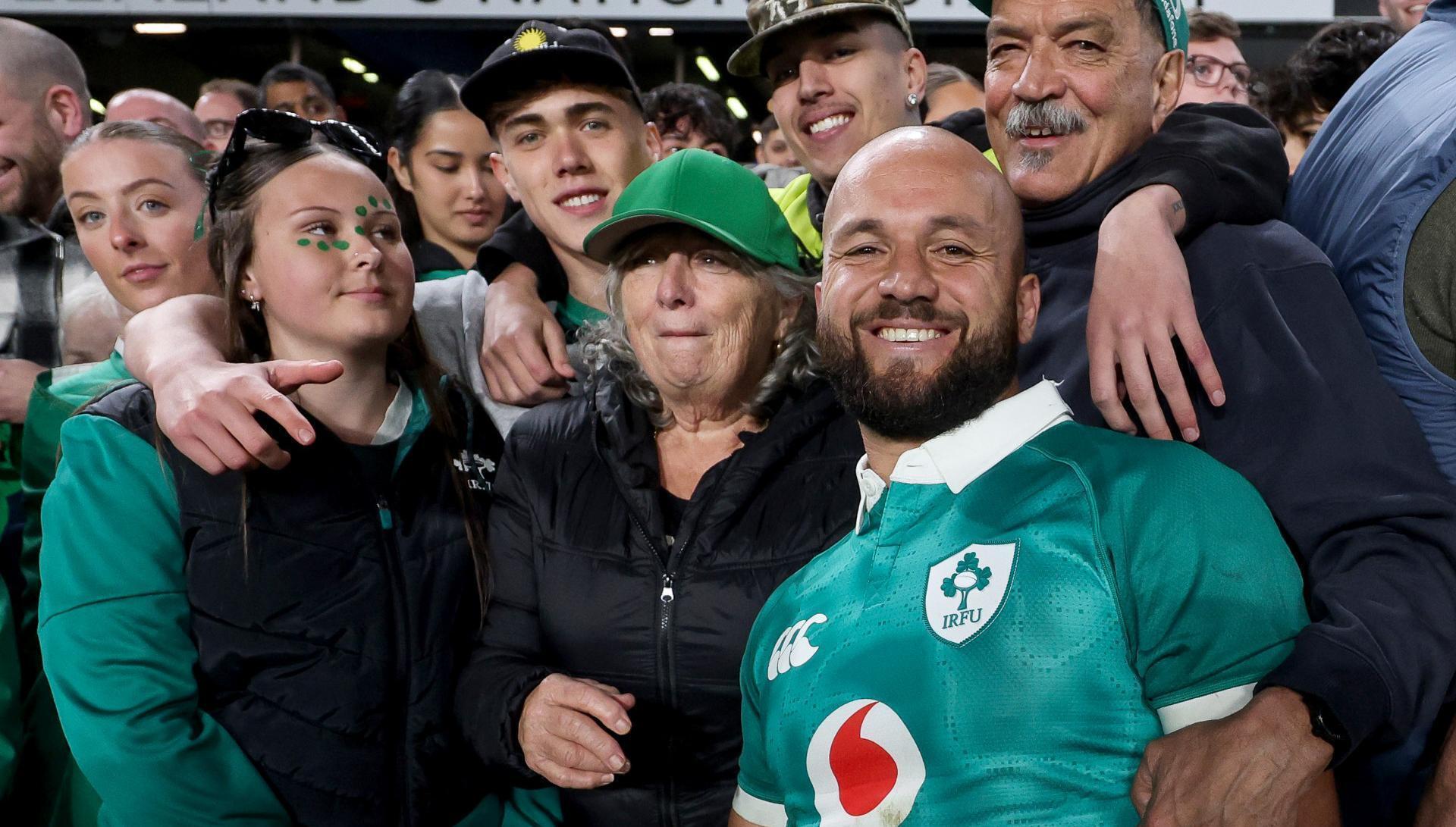
HOMECOMING: Ireland's Jamison Gibson-Park with friends and family after the game. Pic: INPHO/Billy Stickland
Almost three years ago, Fabien Galthie learned the toughest of lessons in his backyard at the Stade de France: you can’t bet your house on one player.
Up against the all-conquering Springboks in a World Cup quarter-final in Paris, Galthie felt he couldn’t replace his general and star halfback Antoine Dupont with the game in the balance.
As gallant as they were, Dupont, who was tiring and running out of ideas the deeper the Test went, was curtailed and Les Bleus lost 29-28. All the while Maxime Lucu, who would start for most other international sides, sat warming the bench. His qualities went to waste.
In the post-Conor Murray world, Ireland might not have someone who is equal or even close to Jamison Gibson-Park, but if there is a lesson out of France’s agonising defeat to the Springboks, it’s that depth and energy off a bench is paramount.
Currently, if Gibson-Park were to be injured, Ireland would all but certainly be in a hole without him.
Even on Saturday, Ireland’s shortcomings were firmly on show as Andy Farrell turned to Craig Casey despite Gibson-Park having a stinker. Will Farrell have the courage to do so in a knockout match when the stakes are at their highest? Evidence suggests he won’t. He didn’t in the 2023 World Cup at the quarter-finals 24 hours before France’s heartache when Johnny Sexton played out the entire 80 minutes.
It’s why Farrell has to turn increasingly to Casey, or find someone else, over the next 14 months in the lead-up to next year’s World Cup.
While Ireland wants to remain near the top of the World Rugby standings and not lose further ground on South Africa, France and New Zealand, the reality is that Farrell might have to if he wants to safeguard them ahead of the 2027 tournament.
Currently, Casey is only trusted against rugby’s tier-two outfits. That’s been the case for years, with the Munster man’s only starts in recent years against Japan, Italy, Fiji, Georgia and Portugal.
Against the Wallabies, with the Test going down to the wire, Casey went unused. A fortnight later, Casey received just five minutes.
No wonder the 27-year-old has struggled to kick on and take his opportunities at Test level.
Of course, Farrell might have been trying to afford out-half Sam Prendergast every opportunity to succeed outside his Leinster teammate.
But the reality is that if Farrell trusted Casey, he would have been on far earlier than when he entered the fray against the All Blacks on Saturday.
Other coaches like Eddie Jones might have even replaced him before half-time. He did so in 2016 and in 2022 with England against the Wallabies in Australia, and on both occasions the changes, including replacing Danny Care for the then-inexperienced Jack van Poortvliet in the series decider in Sydney, worked a treat.
Farrell, to his credit, left some players behind in Ireland to build depth ahead of next year’s World Cup. But the vast majority of players that failed to board the plane to Australia and New Zealand were injured.
The Irish boss will still be concerned that he’s not yet nailed his out-half for next year’s World Cup. Prendergast, of course, could be it, and the 23-year-old had some encouraging moments throughout the Nations Championship.
He stood up when it was needed against the Wallabies and he grew into the match against the All Blacks, with his line kicking, goal kicking, and double-pump and cut-out pass to send Hugo Keenan over revealing the playmaker’s temperament and qualities.
But he also rarely threatened at the line like his counterparts wearing black, who stood flatter and challenged the line regularly with their pace.
It remains an issue for Ireland, especially given their aging midfield and the absence of some genuine size and physicality out wide despite the promise and quality of Rob Baloucoune.
At least Farrell recognises there’s plenty of work to do, and he also has time up his sleeve to work with.
“We have to scrutinise what's happened over the last 12 months, take all the good and the bad and see what we can do with it,” Farrell said following the defeat to the All Blacks, where “uncharacteristic” errors were plentiful.
He also said he wouldn’t sweep the mistakes under the rug, including those from seasoned pros.
“You have to (address the errors), because you don't want to get to a World Cup knockout stage, round 16, quarter-final, semi-final and final and be worrying about the outcome of those type of mistakes,” he said.
“You want to be nice and calm and calculating in the way you go about your business, and that's the way to be accurate. And unfortunately, we weren't tonight.”
Part of that introspection should extend to the coaching team, which Farrell said would occur.
“It's up to us as coaches to come to the party on that and challenge the players and show them how to do that, and make sure that the players have got the hunger to come back into pre-season and show that they're willing to take that challenge on,” Farrell said.
While the season might have come to an end, the hard work is really just beginning as Ireland plots a historic run at next year’s World Cup.
That must include ensuring Ireland has a plan B beyond Gibson-Park.

CONNECT WITH US TODAY



Be the first to know the latest news and updates