Thirty years of Champions Cup has given us the beastly, beautiful and bizarre
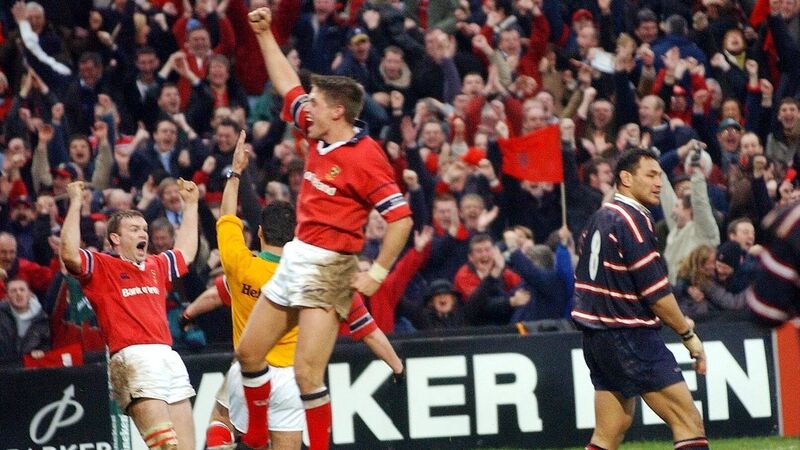
MIRACLE MEN: Munster's John Kelly celebrates scoring his side's fourth try in the last minute of the 2003 Heineken European Cup pool win over Gloucester. The game is commonly referred to as the 'Miracle Match'. Pic: Des Barry, Irish Examiner
On the eve of a new Champions Cup season it is worth remembering when and where it all began. The answer is 30 years ago on the shores of the Black Sea where Farul Constanta of Romania hosted France’s mighty Toulouse in the opening pool game of the old Heineken Cup on October 31, 1995.
Let’s just say they were different times. The match was played on a Tuesday and, while the crowd was recorded as 3,000, eyewitnesses were focused on the large number of security personnel with barking Alsatian dogs straining at the leash. Toulouse, boasting an array of internationals including Émile Ntamack and Thomas Castaignède, duly registered eight tries and won 54-10.
Only one British media representative – the late, great Terry Godwin – was in attendance while the Welsh referee, Robert Davies, recalled passing numerous donkey-drawn carts on the five-hour minibus journey back to Bucharest. “Every now and then the curtain would pull back on a cart and a child would shine a torch our way,” Davies subsequently told the Western Mail.
The evening function also proved to be an eye-opener. With Toulouse having to rush off to catch a charter flight home, the remaining five-strong group of match officials and tournament reps were taken out and entertained by dancers, magicians and singers in an otherwise thinly populated nightclub. “At one point several ‘ladies of the night’ appeared but, as they used to say in the newspapers, we made our excuses and left,” recounted Davies.
From small acorns and all that. It was certainly the start of a tantalising new era for the European club game. In that first season – Toulouse were duly crowned champions – England and Scotland were not represented, having declined to compete for varying reasons. Both, however, were involved the following year when Brive, fizzing with power and pace and captained by Alain Penaud, Damian’s dad, shredded Leicester in the final in Cardiff.
It is just one of a kaleidoscope of searing memories from a tournament that, at its best, had everything. Some of the cross-border battles in the early years were scarily intense, notably when Pontypridd went over to play the aforementioned Brive in an ill-tempered contest in 1997 during which a player from each side was sent off after a mass brawl. The niggle then erupted again that evening in Bar Le Toulzac amid wild west scenes of flying chairs and fists.
But amid the beastly stuff there has been much beauty, too. Four of the most compelling sporting events your correspondent has ever attended all involved Munster at various stages in their pursuit of their European holy grail. Stitch together the breathless 31-25 semi-final win over Toulouse on a roasting hot day in Bordeaux’s Stade Chaban-Delmas in 2000, the “Miracle Match” against Gloucester in Limerick in 2003, the barely believable 37-32 semi-final win for Wasps in Dublin the following season and the 30-6 semi-final drubbing of Leinster in 2006 and Munster’s contribution to European history is impossible to overlook.
The best side ever to lift the trophy? Probably a split decision between the brilliant Toulon side who won successive titles in 2013 and 2014 and the modern Toulouse juggernaut with Antoine Dupont at the wheel. For sheer showpiece excitement you also have to credit Leicester, Leinster and Exeter Chiefs for winning quite extraordinarily vivid final games in, respectively, 2001, 2011 and 2020.
But maybe what truly elevated the tournament were the dramatic eccentricities – some of them beyond bizarre – that have entered rugby folklore. Remember, for example, the deflected drop goal off a Llanelli player by Elton Moncrieff that earned Gloucester a 28-27 pool win in 2001. “When a drop goal hits someone on the arse and bounces over how do you blame yourself for that?” sighed Llanelli’s frustrated coach, Gareth Jenkins, afterwards.
The Breakdown was also present earlier the same season when Wasps’ Richard Birkett, leaping up to try to intercept a long-range penalty attempt by Diego Domínguez at Loftus Road, inadvertently knocked the ball over the bar to help Stade Français win by three points.
Then – move over Scott McTominay – there was Geordan Murphy’s overhead kick for Leicester against Swansea that narrowly failed to yield the ultimate crowd-pleasing try at Welford Road, again in 2001. Not to mention Tim Stimpson’s kick from another postcode that bounced off bar and post from fully 60 metres out to win the Tigers a semi-final at Nottingham’s City Ground in 2002, again at Llanelli’s expense.
From Bloodgate to the “Hand of Back” to the gripping 2009 semi-final penalty shootout in Cardiff there was, for years, no other tournament like it. What a pity, then, that its allure is in some danger of diminishing as it enters its fourth decade. Whether it is the amended format – six pools of four teams with two second-place “fastest losers” meant every single point truly mattered and connected every fixture – or familiarity or the seeding minutiae that gave certain teams crucial home knockout advantage, the pool stages have not had the same frisson.
It would also be nice if a wider spread of European nations were involved. Beyond the South African sides plus Black Lion from Georgia in the Challenge Cup, it is otherwise the same old Six Nations suspects. No Spain, no Portugal, no Belgium and – these days – no plucky Romanian hopefuls either. Club rugby in Europe has come a long way in some respects but – let’s be honest – less so in others.