Big Interview: Nora Stapleton on winning the battle before it's ever fought
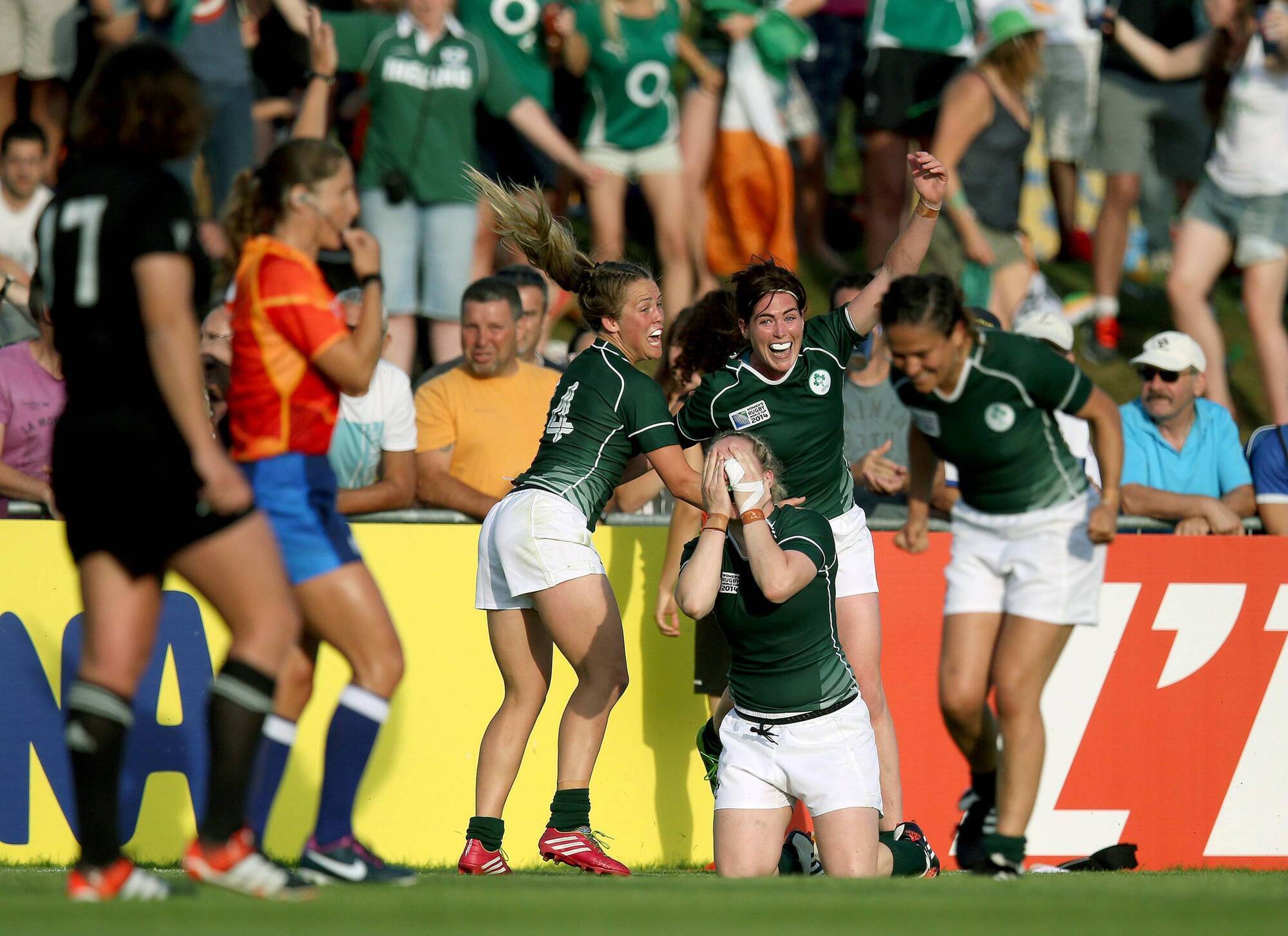
Nora Stapleton (centre) celebrates the 2014 win over New Zealand with teammates Ashleigh Baxter and Niamh Briggs celebrate at the final whistle Pic: ©INPHO/Dan Sheridan
Two years before Soldier Field there was Marcoussis – and a year before Marcoussis there was Old Belvedere.
When a week like this inevitably triggers memories of that landmark win on the outskirts of Paris in 2014, Nora Stapleton tends to think of the maxim that a battle can be won before it’s ever fought and that the hardest fight of all was out on a training pitch in Ballsbridge.
“Our preparation for beating New Zealand would have started whenever the groups were made. The structure of the World Cup back then was very different to what it is now; you had just three groups of four after which it went straight to the semi-finals featuring the three group winners and just one of the second-placed teams. So we pretty much had to beat New Zealand if we were to get through.
“We trained so hard for it. I can still picture the fitness sessions in Old Belvedere. We’d to sprint out to a cone and back in less than 23 seconds, get 15 seconds recovery, then repeat and then repeat and repeat. The way Marian [Earls, the team’s S&C coach] had it laid out, it was scientifically meticulous but it was brutal. I’d be dry retching, making it back to the cone, bending over, thinking, ‘How the hell am I going to go again?’
“Yet 15 seconds later you’d straightened up and were able to go again. Because during that recovery you’d either say to yourself or someone beside you would say, ‘This is to beat New Zealand. We’re beating New Zealand. We’re fitter, faster, stronger.’
“That was our mantra. We believed we were going to be far fitter than them. And as you made your next sprint, you imagined yourself chasing down one of their girls.”
Months later Stapleton found herself in the late summer heat of Marcoussis, racing after Selica Winiata dashing towards the try line, forcing the Kiwi to touch down in the corner. The conversion was missed. Ireland won, 17-14.
It was a massive achievement at the time, and in a way is even more remarkable now.
The Black Ferns were – and remain – as invincible as the All Blacks have ever been. New Zealand had won the previous four women’s World Cups. They’ve won the two subsequent to that tournament as well. The only time since 1994 so that anyone other than the Black Ferns have lifted that trophy has been the 2014 edition when they were dumped out of it by Ireland. A country that didn’t even make the tournament in 2021.
“A standout memory for me is being in the dressing room after, sitting on the bench, catching Lynne Cantwell’s eyes and us just looking at each other, laughing as if to say, ‘What the hell just happened? We’ve just beaten New Zealand!’
“It was very disappointing how the semi-final turned out – [eventual tournament winners England beat Ireland well] – but as time goes on you do remind yourself how lucky you were and what a privilege it was to be part of that 2014 team.”
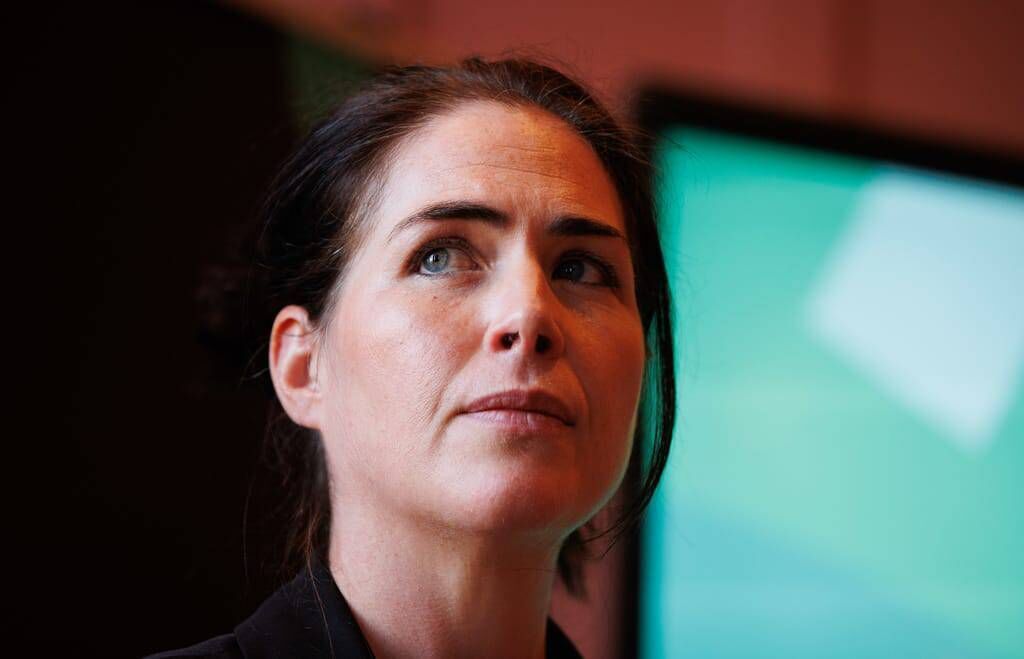
It was a remarkable day in a remarkable career of a remarkable sportsperson, on and off the field.
Stapleton played out-half in that World Cup; of all the players Ireland could have identified as having the necessary smarts, ball-handling and kicking skills or at least one who would develop them, they settled on Stapleton as that quarter-back. In the previous World Cup of 2010 she had played on the wing. The World Cup before that again she hadn’t even been playing rugby. She only took it up at 24.
Instead ladies football and soccer were her sports, ones she excelled at.
In UCD as part of the first intake of students to undergo its sports management degree, she won an O’Connor Cup, prompting an instant call-up to the Donegal senior women’s team which she’d play on and off with for close to a decade, climaxing with winning an intermediate All-Ireland title.
Also during her days out in Belfield she won three successive FAI Cups and played in three successive UEFA Cup campaigns.
Who does that and play in three consecutive women’s rugby World Cups, wins a Grand Slam and another Six Nations championship on their way to winning 50 international caps?
“I suppose from a young age I was fairly handy at it [sport],” she says now. “And I loved it.”
Opportunities were limited though, growing up in Fanan, just outside Buncrana. She didn’t even know Donegal had county underage football teams for girls.
“I remember waiting to be collected by a bus to go off and play camogie with Donegal but I don’t know if that bus ever stopped in our place. And whenever you played a sport, it was almost always mixed. I played on a lot of boys’ teams.”
In rugby there wasn’t even that option. “I remember a friend of mine going off to play rugby and being told I wasn’t allowed to go, because I was a girl. I had the grá but I hadn’t the opportunity.”
The memory of that still informs and fuels her.
For most of her professional career, Stapleton has worked in sport. She has served as a GAA games development officer with Ballinteer St John’s, overseeing the introduction and growth of the likes of Orlagh Nolan, player of the match in this year’s All-Ireland ladies football final, in the sport. For six years she worked as the IRFU’s women rugby development manager. Now she works for Sport Ireland as its women in sport lead and its director of strategic national governing body programmes. Trying to spread the grá and the opportunity for all – especially girls and women.
“I remember when I started out working with the IRFU we were directing young girls to the mini-rugby setups that were already in place. Because clubs were saying, ‘Yeah, girls can come down and play here, no problem’ and they’d play together with the boys.
“But when you have a girl who goes down there and discovers everyone else there is a boy, there’s a loneliness in the only-ness. When we dug a bit deeper, we were finding girls were dropping out after only a few weeks because they were uncomfortable joining a group of boys who had been playing rugby together for a few years and weren’t inclined to pass them the ball.
“So ahead of the 2014 World Cup we created Give It A Try, an eight-week programme in selected clubs in which it would be girls-only, simply to make it a more fun, welcome environment, grow the base and make it normal for clubs and their older alickadoos to see girls coming down to the pitch with a rugby ball in their hand.”
Ten years on Stapleton would be in a waiting room when the woman next to her started talking about her daughters and this great initiative the local rugby club had which got them into the sport.
She can see the good work and importance of her old colleague Lynne Cantwell as the union’s head of women’s strategy for Irish rugby. “You need someone in the most senior level of management in any organisation who has that experience, insight and passion and wakes up every morning just thinking: how do I make a difference for this cause?”
But there needs to be more women in leadership roles in rugby. And Irish sport in general. In the boardroom, committee room, coaching committees and coaching teams. From the elite right down to the grassroots.
“If you have only men in those decision-making roles, then you’re missing opportunities. Because if you only have men looking at appointments, there’s just a natural unconscious bias that comes through whereby you either don’t consider females for the role or you do but consider them not good enough.
“But if you have a female in there, they’re going to pose some questions that challenge and arrest those biases and you’re going to have healthy debate and decisions then.”
For instance, how come there are only 30 female rugby referees in the country? Joy Neville has ended up being like Tiger Woods; instead of opening the floodgates, hardly anyone who looked like her followed her.
The other day Stapleton was talking to Cora Staunton. For the past two seasons Staunton has been a coach with reigning men’s Mayo county champions Ballina Stephenites, team manager Niall Heffernan having the intelligence or just basic cop-on to identify that his players could learn a lot from one of the best forwards the county has ever produced and the best women’s football has known.
Despite Ballina’s success, Staunton said that over those two years she has not seen another single woman as a coach or a selector on an opposing sideline. That’s a lot of men on the line – and a lot of women being overlooked. Not even seen.
“It’s almost like women are made of glass,” Stapleton put it recently upon the publication of Sport Ireland’s Spotlight on Coaching survey which found that women still only make up 36 percent of all volunteer coaches and 17 percent of high-performance coaches employed in this country.
“Men will look right past or through you to go and approach a man on the side of a pitch to help coach their kids. Existing coaches tend to gravitate to the dads and ask them first towards doing some coaching rather than think to have a conversation with the mothers. It’s no one’s particular fault. It’s just been bred into people.”
And so, norms, biases, have to be challenged, and initiatives, informed by data like those in the Spotlight report, have to be supported.
She’s a big proponent of more recreational team sport for all, especially adults. Whereby you can just rock up and play a sport’s equivalent of five-a-side soccer. No formal league. No huge requirement. Just a bit of craic, an outlet, a chance to run around.
“Any sport that doesn’t come up with some social version of it in the next couple of years will be missing out big time. Because they’ll miss out on future volunteers who will gravitate to the sports that do provide that outlet without them having to conform to a strict competition structure they don’t have the time or inclination for.”
And so to get a bit of a break from the day job and Claire and the kids, she’s back playing a bit of camogie, for the first time that bus failed to stop or show in Fanan. “It’s lovely to be back at it and feel challenged: Can I get this ball into my hand?”
There are many other schemes to be invented or replicated for all kinds of demographics, young as well as old and anything and everyone in between. She was intrigued and delighted by Asics recently linking up with a UK mental health charity and a secondary school in Burnley to design PE kit to make girls feel more comfortable and stay participating in sport and physical activity. A study found only 12 percent of UK girls are completely satisfied with their current school PE kit while 74 percent said they would be more likely to participate in PE lessons if their kit was more comfortable.
“That’s exactly what we should be looking at doing in Ireland. At the moment PE classes are mixed. That’s not helping matters. Girls are forever saying if we could have PE at the end of the day it would be so much better because they wouldn’t have to go back to their class sweaty or uncomfortable.
“I’d love to be able to do some initiative like that, to encourage schools to redraw the timetable and separate the boys and girls for PE and reimagine the kit.”
So like her so many more can have both the grá and the opportunity for a lifetime in sport.


CONNECT WITH US TODAY



Be the first to know the latest news and updates