Ian Costello: 'If they didn’t have AIL where would they be playing?'
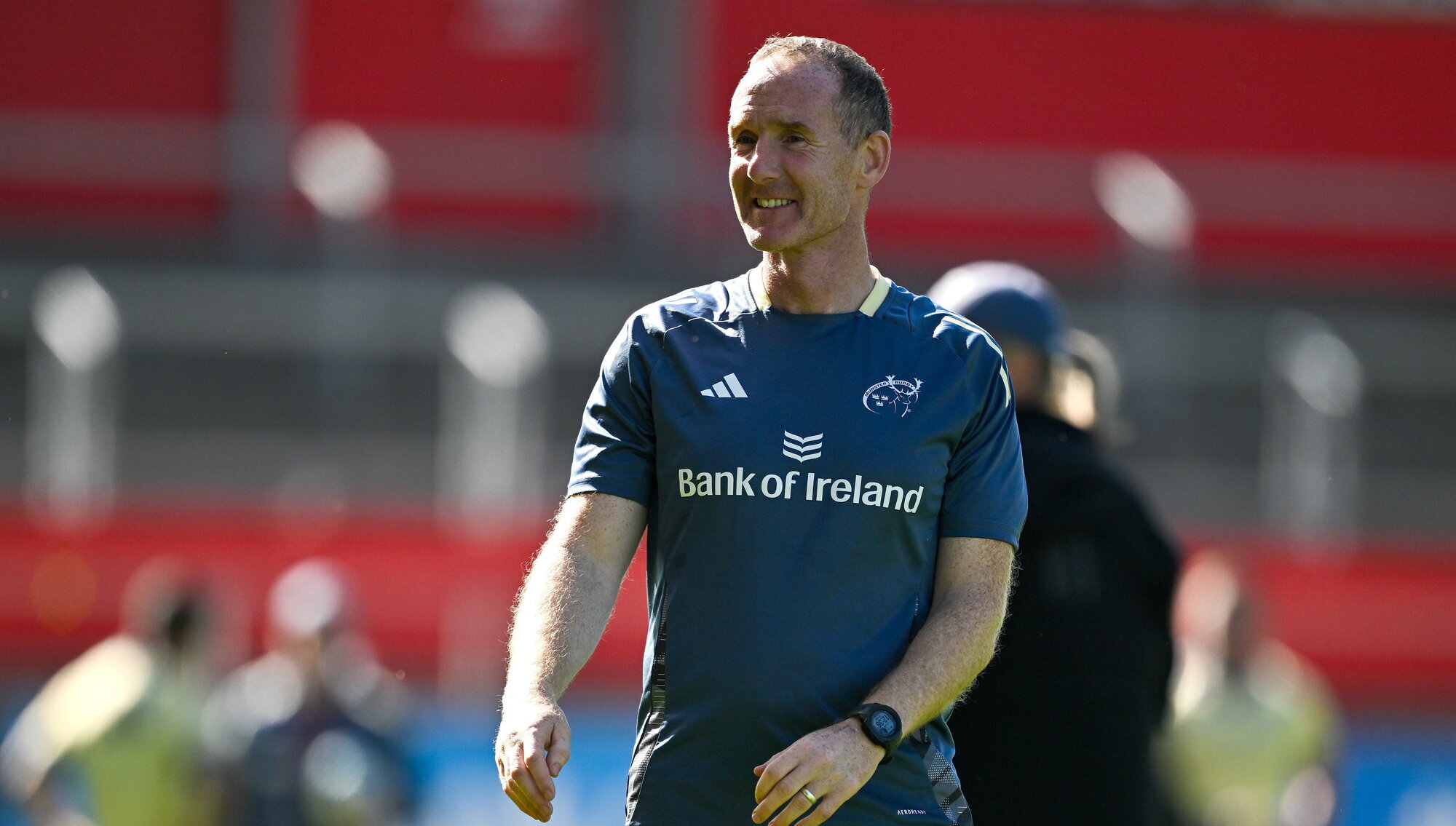
AIL KEY TO MUNSTER SUCCESS: Head of rugby operations Ian Costello during Munster rugby squad training at Thomond Park in Limerick. Picture: Brendan Moran/Sportsfile
Munster’s Ian Costello has given club rugby a reassuring boost on the eve of the new Energia AIL Men’s season by declaring the province believes the league is “100%” relevant to its success.
As Munster prepare to welcome Connacht to Thomond Park for the opening game of the new URC campaign on Saturday evening, clubs up and down the province will have completed their first games of 2024-25 with defending AIL champions Cork Constitution leading the charge in Division 1A.
Munster’s head of rugby operations Costello is a product of the AIL having played for Garryowen and UL Bohemian, whom he also coached before professional posts with his home province, Nottingham and Wasps. Since returning to Limerick and Munster’s High Performance Centre, first as head of academy, Costello has worked hard to restore open lines of communication between pro rugby and the club scene and this week he explained: “We present to the clubs every season in the Charleville Park and the first thing I write down is ‘Strong clubs = Strong Munster’… and we back that up by our player release.
“And Wig (head coach Graham Rowntree) is so good at modifying their training so that they can go out and give their best for their club as well.”
Player release is mutually beneficial, giving academy and development players valuable playing experience at the coalface of the AIL’s 1A and 1B divisions, though Costello sees a perfect balance of Munster A games and club appearances.
We want our players to play AIL, we also want them to play games together in a Munster jersey so that gives us an opportunity of a development team or an A team.
“We play Leinster in a few weeks in an A game. They’re really important too and I think there’s a blend of somewhere between six and 10 A games a year and 10 AIL. That would be a sweet spot.
“There’s six on the calendar this year, six A games, and we dot in a couple of development games. And even having two A games in a row makes a big difference because players actually learn how to prepare for a week, to review, to get better and have a chance to go and perform again.”
Asked to confirm that the AIL was still relevant to Munster Rugby, Costello added: “100%… it’s part of our player development environment. Our lads go out and play a lot of rugby there and if they didn’t have AIL where would they be playing?
“They need to play competitive games, and against different oppositions, different experiences. We don’t want everything to be the same. We went to Harlequins last spring and 21 out of 24 came through our pathway and that was massive for us to be able to bring a team away and do that and create an experience for them. We’re trying to create a couple of those a year and that’s the kind of stuff that in two or three years’ we’ll be getting a reward for it.”
Talent identification for the next generation of Munster academy players is an ongoing challenge and Costello does not restrict his scouting to inside the province, or even strictly to rugby.
“We look everywhere. ‘Next up, first up,’ so have we got something in the building. I heard a really good phrase last week, ‘before you go looking for something else, make sure you know what you have’.
“So us being really informed on what we have, knowing where they are, how we benchmark them, how we rate them on performance potential. It allows us to look at somebody through that type of lens, whereas before we might have seen it as a bit of a punt, or a bit of a feel.
“We don’t discount feel but now there’s a bit more substance. I looked at a guy recently from another sport, similar to rugby union, but we probably won’t go there, and looked at two people from outside the country but again, we haven’t signed them.
“But yeah, open to anything that makes us better. We definitely, from an identity point of view, would love to be producing our own but not to the detriment of us being successful.”


CONNECT WITH US TODAY



Be the first to know the latest news and updates