French media acclaim Toulouse's sixth star 'after a suffocating tug-of-war'
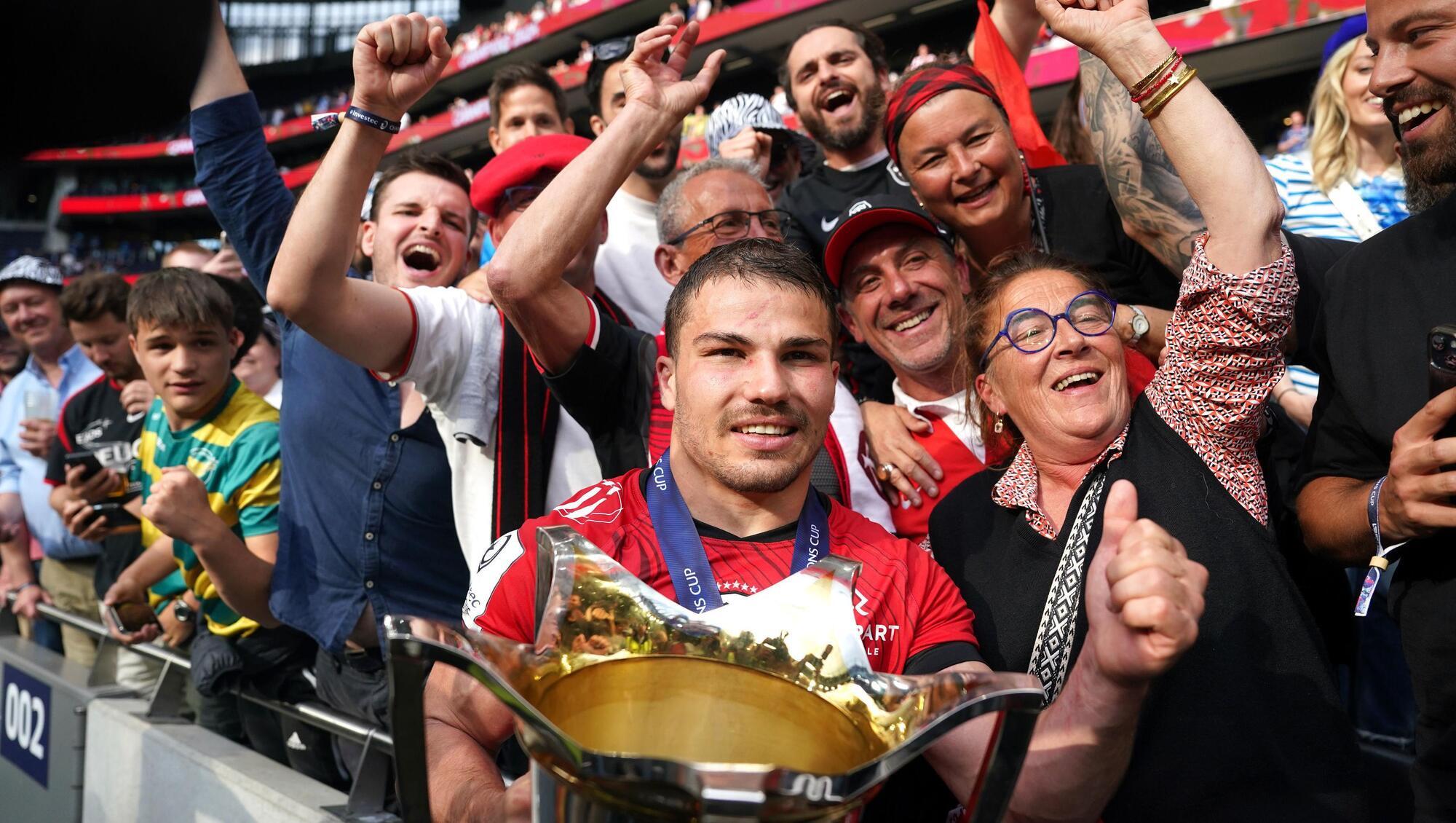
Toulouse talisman Antoine Dupont with the trophy and family following the Investec Champions Cup final at the Tottenham Hotspur Stadium
Toulouse love finals. They have won nine – six in the Top 14 and three in the Champions Cup – since they last came off second best in a showpiece decider in 2008.
So, there may have been a certain inevitability about this one – even though it was a win so atypical of Toulouse that there may be a hint of a suspicion that it was, in part, planned. A certain highest-risk, highest-reward rope-a-dope quality to it.
Head coach Ugo Mola, who’s developing a gnomic quality to rival that of his long-term predecessor in the Toulouse hotseat, wasn’t giving any gameplan away even after the match. “A final, you win it when you are able to compete on the strengths of your opponent, and that is exactly what happened,” he said.
Not that the French press cared. They were too busy celebrating star number six.
The morning after events in London, the Sunday edition of Toulouse’s local newspaper La Dépêche du Midi splashed with “Jusqu’au bout du rêve” – the French title of Field of Dreams, while the headline to its match report broad stroked the game with: “A sixth star after a suffocating tug-of-war”.
“We predicted a magical final,” opened correspondent Philippe Lauga. “[And] it was, thanks to its total commitment and suspense, if not spectacular play. It was suffocating, oppressive and stifling. But [it was] ultimately magical since it allowed Stade Toulousain to win a sixth star; the second for this generation”.
Midi Olympique’s leader couldn’t resist a dig at the southern hemisphere with its broad strokes view of the game, which it said had, “an intensity that was ultimately worthy of this magnificent, fantastic competition, which is now far superior to Super Rugby and its horrifying farandoles”.
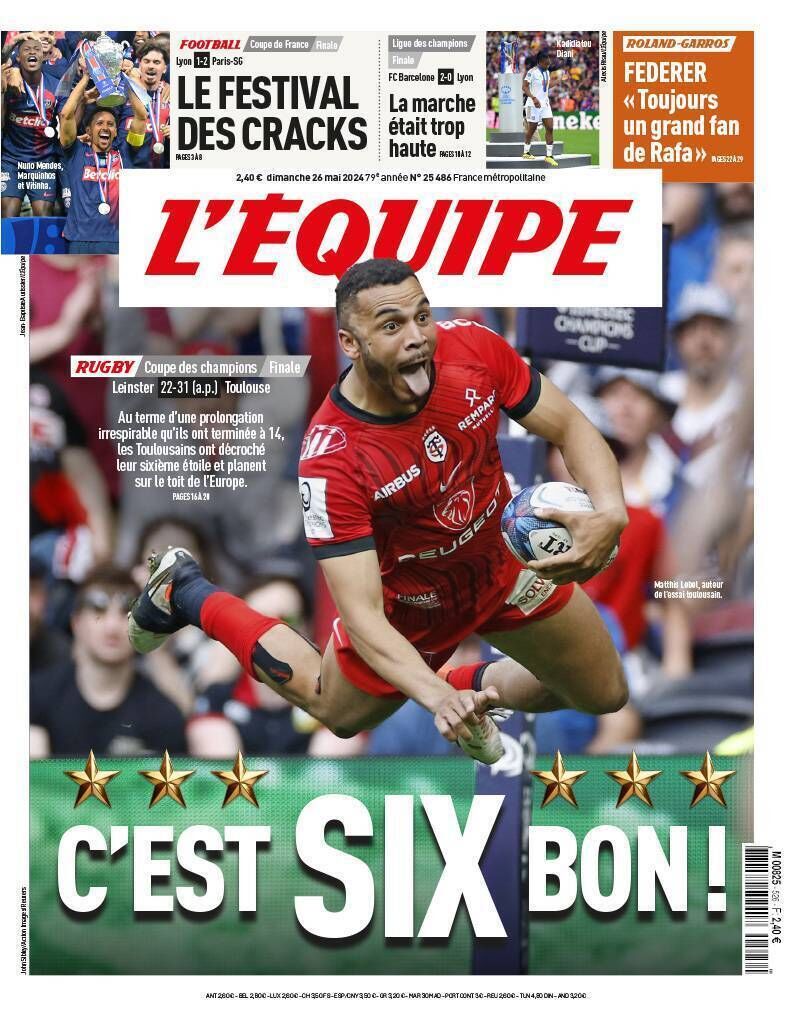
As it was in London, which hosted the FA Cup and Champions Cup on the same day, so it was in France. Toulouse’s glory competed for column inches – and splash space on the front of Sunday’s L’Equipe – with PSG’s 2-1 Coupe de France win over Lyon.
“Head in the stars” ran L’Equipe’s match headline at the top of five pages of reaction to the events at Tottenham Hotspur Stadium.
Laurent Campistron kicked off: “You don’t win nine finals in a row in all competitions by chance. It’s the result of know-how, of the art of winning, of a club’s never-give-up mindset, that has ‘competition’ in its blood, and that transcends itself like never before when the winds of history promise to carry it even higher.”
He went on: “On Saturday, Stade Toulousain achieved the feat of adding a sixth star to their jersey without really dominating, but without being down by a single point either.”
So ran the common thread through the French rugby press. This was a win built on wall-to-wall defence and the smell of team spirit.
Romain Ntamack had told French broadcasters pitchside immediately after the match: “We didn’t play our best rugby, but in terms of solidarity we couldn’t do any better. Our defence won the day. We stuck together. As for Leinster, I think it hurt them mentally not to score. It was a small victory every time we beat them back.”
The French media’s match analysis followed the defensive line – heaping global praise on Antoine Dupont and Jack Willis in particular.
“We were expecting spectacle and tries from Europe’s two most spectacular teams, and we got fight, fight and more fight,” wrote Arnaud Coudry in Le Figaro. “The Irish, dominant in the scrum, lost the ground battle … pushed and shaken around and unable to implement their usually polished game.”
Le Monde colleague Clément Martel’s report ran on similar lines: “The Stadistes suffered … held firm at the back, and eventually prevailed,” he wrote.
“Toulouse thought they had started the game with a bang. But the ‘jeu de mains, jeu de Toulousains’ launched and concluded by Juan Cruz Mallia after a tightrope act by Antoine Dupont did not lead to a try in the second minute. After that, the game was essentially a duel between defenders and kickers.”
L’Equipe brings us back to the movie tropes that La Dépêche started in its praise for Willis. “100 minutes pour survivre, or Piège de métal?” wrote Alex Bardot in a review of one man’s performance, playing on the French titles of the first two Die Hard films.
“We hesitated between two references to Bruce Willis’s filmography when choosing this article’s headline. Both suited Jack Willis’s performance – “100 minutes pour survivre” was a nod to the length of the match (excluding stoppages) played in its entirety by the Englishman, intensely, without faltering... “Piège de métal” is the impression he gave – a player made of the hardest material, whose every move seemed to stifle Leinster.”
In the end, L’Equipe ran with the latter.
CONNECT WITH US TODAY



Be the first to know the latest news and updates