Ciaran Kearney: Deeper meaning fuelled Springboks' mission
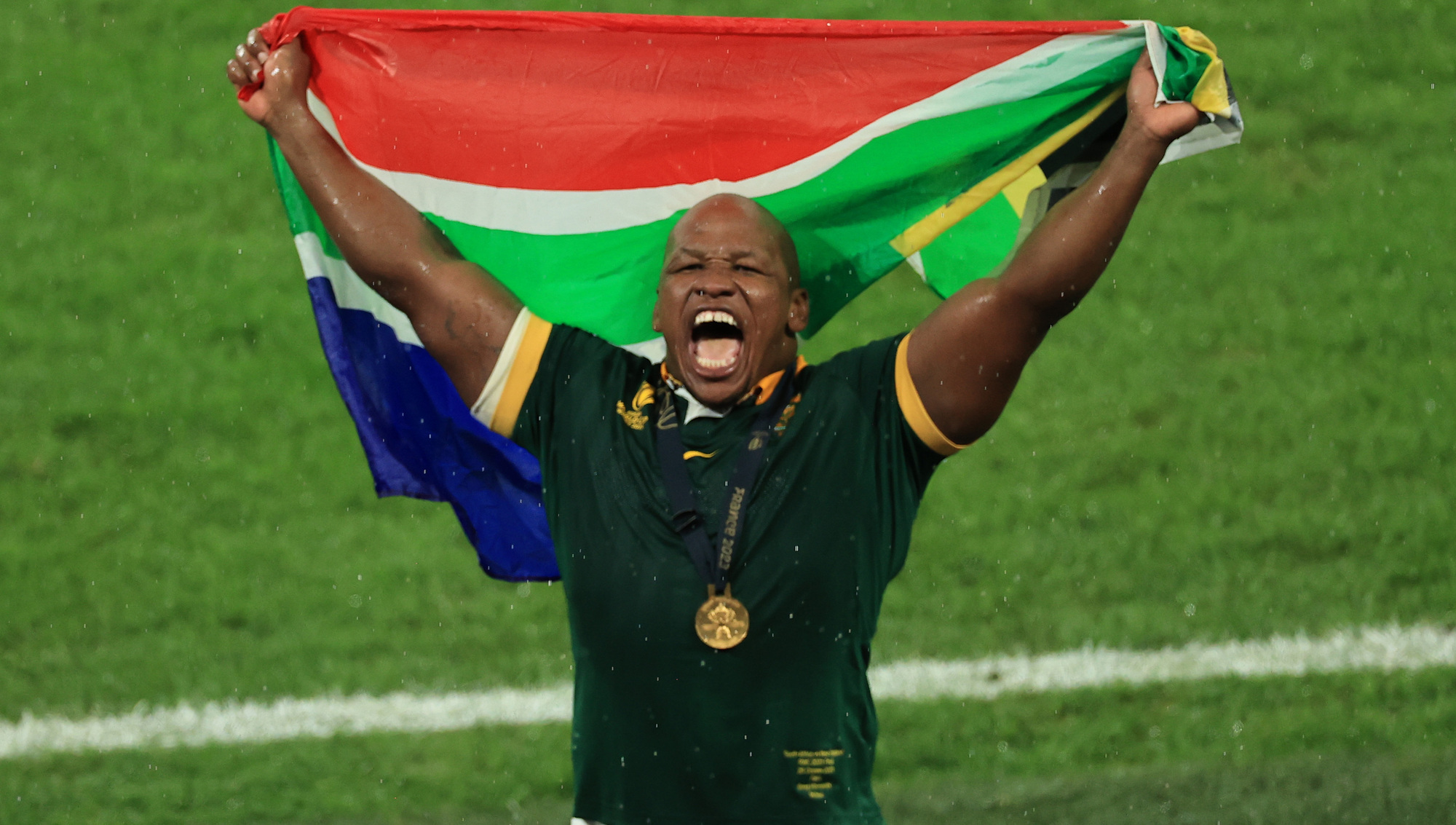
CELEBRATIONS: Bongi Mbonambi celebrating after South Africa’s RWC win. Rugby saved him from the worst side of life, fuelling his passion and love for the game.
With the Indian Ocean temptingly close to the back of King’s Park, Bongi Mbonambi stood beside me chatting. Bongi was brought up in Bohlokong township in Bethlehem, 400km from where we stood at his current club, the Durban Sharks. His township had no grass pitch. Only he and one other got to attend a Model C school, where they had rugby. For Bongi, rugby saved him from the worst side of life, fuelling his passion and love for the game.
On the morning Bongi and I caught up, the Springbok hooker and South Africa’s vice-captain had his right leg in a full-length brace. Unfortunately, it was the same leg which he injured 90 seconds into last week's Rugby World Cup final as All Black Shannon Frizzell hurt him in a dangerous clear-out. Frizzell got a yellow card while Bongi got taken off. He took no further part in the match but reappeared later, on the sideline, enthusiastically encouraging his teammates playing the game. Such is the depth of psychological connection in this South African rugby team, that Bongi’s presence pitch-side was emblematic. Throughout the campaign, South Africa’s ‘squad depth’ was there for all to see. Less visible to outsiders was the depth of meaning in this Springbok team’s mission.
The last time the All Blacks and Springboks competed in the Rugby World Cup Final was 1995, a year after the end of apartheid in South Africa. While apartheid endured, an international sporting boycott enhanced support for democratic change. Back then, the Springboks were synonymous with a political regime which legalised white supremacy. Political transformation provided an opportunity to change this. As President of a new government of National Unity, Nelson Mandela lobbied for the 1995 Rugby World Cup to be staged in South Africa. The relationship Mandela forged with Springboks captain Francois Pienaar was brilliantly dramatised in the movie ‘Invictus’. Before the final, President Mandela walked into the Springboks changing room wearing the team jersey with Pienaar’s number 6 on the back. His gesture reinforced the vision of a shared mission.
That moment still has special resonance for South Africa. To see Mandela present the Webb Ellis Cup to Pienaar projected a much-needed vision of the post-apartheid rainbow nation. But the team itself didn’t reflect this vision. The only person of colour was Chester Williams. Bongi Mbonambi and the Springboks captain Siya Kolisi were both four years old at the time. As Kolisi has openly admitted, he had no dream of playing for his country, much less being the first person of colour to captain the Springboks to a historic fourth title and back-to-back championships.
Kolisi’s personal journey has embodied the life struggles of many people in post-apartheid South Africa. His mother was a 16-year-old girl who gave him over to be raised by his father’s mother. By the age of eight, he was smoking with his friends. Soccer was the popular sport in his Zwide township, but Kolisi preferred the skills of rugby. Like Bongi, school became his salvation and his springboard in rugby. Kolisi was the first recipient of a Vincent Mai bursary to attend Grey’s High in Port Elisabeth. He still describes Vincent Mai as the person who changed the course of his life.
In turn, Kolisi himself has created a philanthropic foundation, in part to campaign against gender-based violence in South Africa. Again, his purpose is deeply driven by the goal of collective impact. He saw his own mother have teeth beaten out of her mouth by a man. Success in sport helps Kolisi garner support for his foundation. Winning is his way to prosper his personal values and link them to a wider social good.
In analysing high-performance teams, factors like this are too often overlooked. Performance targets are elevated, even abstracted, from a clear articulation of personal and collective purpose. The psychology of meaning goes deeper than mental skills. No amount of changing room posters, cryptic symbols, team contracts, or ‘secret’ performance calls can compensate for a lack of understanding of group and team dynamics: purpose, values, meaning, and belonging. All of these are rooted in the science of human behaviour. From the work of Kurt Lewin to Uri Bronfenbrenner, psychology has striven to explain the interaction of person, place, context, and time.
Recently, at an event at St Mary’s University College in Belfast, sport psychology in high performance was discussed. More than 300 people gathered to hear an expert panel, underlining growing interest in the subject in Ireland. One of those panellists, Dr Kate Kirby, spoke about her support work since 2017 with Irish athlete Ciara Mageean from Portaferry, Co Down. Positive change takes time, she said. Former Ulster and Irish rugby international Chris Henry said family visits to Ireland’s camp during this year’s Rugby World Cup were considered a distraction during the 2015 campaign. The context is different now, he noted, and Ireland’s current team clearly benefited from these family connections.
Context is complex but it is this contextual intelligence which is sometimes misunderstood or neglected in high performance. It takes effort to understand differences in context and culture between the ‘global north’ and teams and people from the ‘southern hemisphere’.
Since 1996, I have been to South Africa several times, travelling throughout the country. When Kolisi says that hard work is the DNA of the Springboks, he is referring to the people in the townships who rise at 4am to get buses to work, perhaps to do two or three jobs. Those people, he says, are watching the Springboks compete. They don’t understand if their team doesn’t work hard. That ethos is the team’s identity on the field: with more tackles and turnovers than their opponents this year.
The World Cup victory has a deep meaning for Siya Kolisi’s team because of its meaning for 60 million South Africans. One generation on, the Springboks’ success still symbolises a hope that, in the words of Nelson Mandela: “It always seems impossible until it’s done.”
CONNECT WITH US TODAY



Be the first to know the latest news and updates