The Scotland view: Dumped on the side of the street, and driven home in a dinky Mazda. Quite appropriate
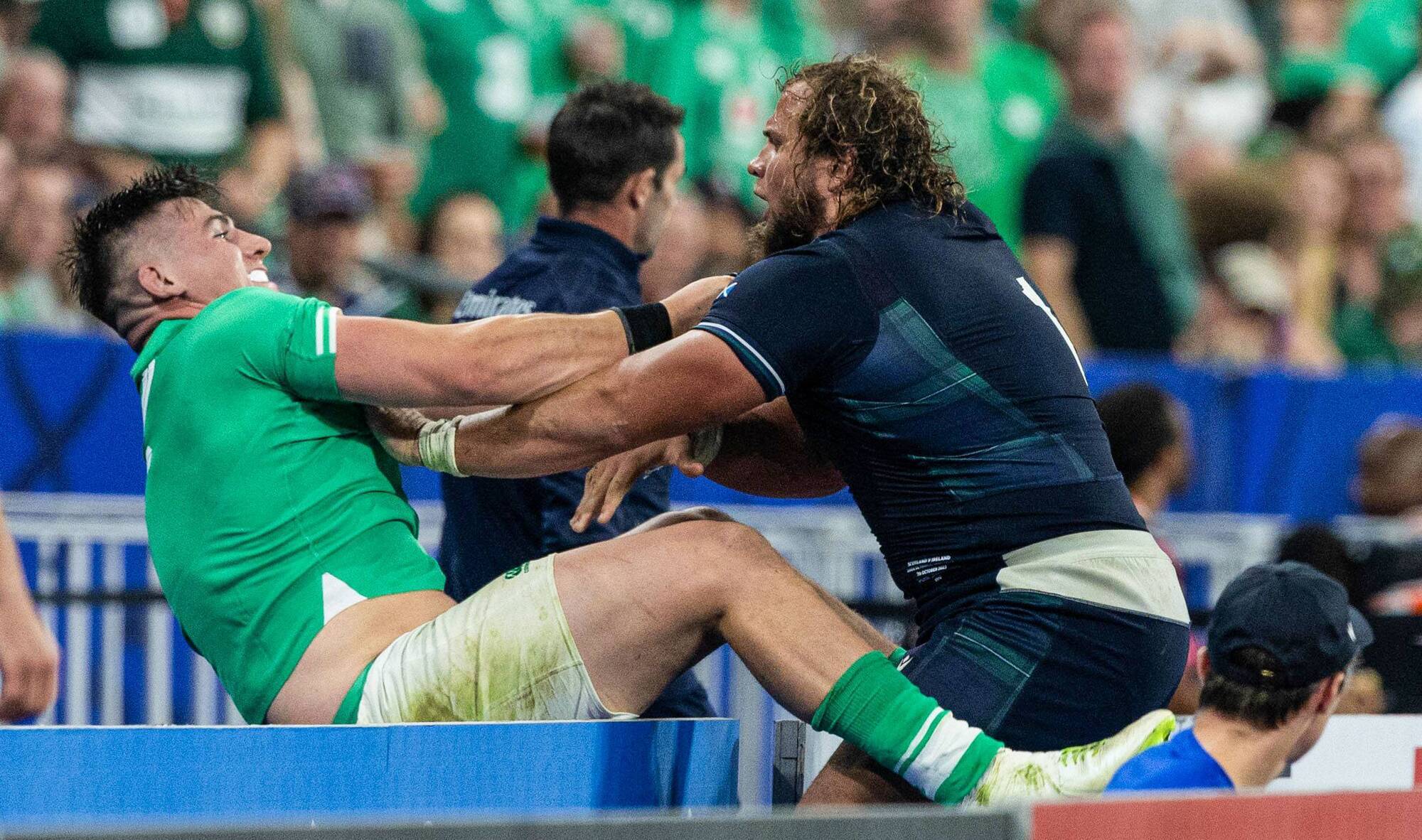
FAIR PLAY?: Ireland's Dan Sheehan is pushed backwards over an advertising hoarding by Scotland's Pierre Schoeman as tempers flared in Saturday's encounter at the Stade de France.
World Rugby laid on a bus for the press after Saturday night’s match which they promised would drop off the Scots journalists in Opera district of Paris, just a short hop away from our base in nearby Gare du Nord.
Except it wasn’t going there. And in a textbook demonstration of the global governing body’s disdain for those not directly supporting their commercial ambitions, nobody bothered to inconvenience themselves by telling any of the passengers that the driver would only deliver to Porte Maillot on the edge of the city.
It was a rough part of town and a miserable half-hour wait at 1.30am for our €25 Uber home, followed by three sturdy bodies squeezed into the back seat of a dinky Mazda with chunky computer and camera bags piled on top because our chauffeur refused company up front and had his shopping in the boot.
It seemed like an appropriate metaphor to our time covering Scotland at this World Cup.
We knew where we wanted to get to but found ourselves firstly setting off in the wrong direction, then suffering a long period in limbo while the world (World Cup) whizzed on around us, then enduring an uncomfortable final leg of the journey before being unceremoniously dumped at one of the main exit routes out of France.
Scotland will not be the only nation frustrated by the scheduling of this tournament. Trying to find a safe solution to reducing the length of time it takes needs to be a priority before the next World Cup in Australia in four years’ time. A pool stage that lasts almost four and a half weeks is frankly ridiculous, especially when you consider that the last football World Cup lasted just under four weeks in its entirety, while the Olympics went on for just a day over a fortnight.
But Gregor Townsend’s side did very little themselves to engender a sense of occasion or momentum at this tournament. Basing themselves at the secluded Golden Tulip Hotel – a 30-minute drive from Antibes, just along the coast from Nice – for pretty much the whole of September, we have been told that they had a lovely time and enjoyed visits from their families during their fallow week after the South Africa defeat, but we had to take their word for it.
They were very rarely, if ever, seen out in public, apart from being whisked by police escort to their training ground in Nice, and on the two occasions the press were invited to the hotel for official press conferences, they were sternly warned that they were not allowed to arrive early and should be ready to leave straight after the briefing (presumably because they didn’t want prying eyes spotting Pierre Schoeman strolling to the pool in his budgie smugglers).
Sinister-looking security guards prowling every exit and corridor ensured that these tight visiting times were enforced.
Fair enough, Scotland were here to do a job not make friends, but it all seemed so earnest, and you got a sense that the players suspected this World Cup may be passing them by when skipper Jamie Ritchie spoke during the lead-up to the Tonga match.
“It’s been a bit of a strange one for us being a wee bit out of any towns or cities,” he said. “We’ve not felt that buzz around it. We have a fantastic facility here at the hotel where we’ve been staying but you see stuff popping up on social media where a buzz is building in an around the tournament. We’re hearing there are a lot of Scottish people coming to the game, so we’re really excited about hearing them.”
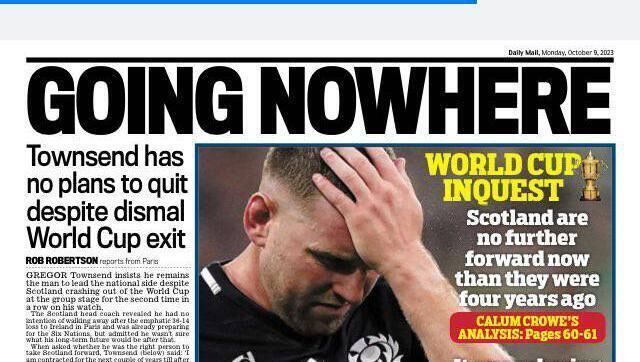
It feels like this Scotland side operate in a bubble, where they try to fuel their performances with extreme levels of self-affirmation, only to find themselves taken aback when the opposition are not equally in awe of their all-round excellence. They don't have the exposure to the outside world to contextualise their own strengths and weaknesses, so end up believing their own hype whilst forgetting that every other team at this tournament has also worked hard to get to peak preparedness.
In an interview a few weeks back, former Scotland back-rower Ross Beattie, who played alongside Townsend at the turn of the century, told a story about the 2000 tour to New Zealand.
“We’d grown up with the coaches telling us that these guys were gods, and by the time we played them we were thinking: ‘These are mythical characters doing a dance [the haka] in front of me … I can’t believe I’m here!’,” he said. “It was really like that, and from what I see, these players don’t have the same feeling of being beaten before they’ve started.”
Reading that, you get a sense of why Townsend might be inclined to encourage his players to talk themselves up, but whether it is really helpful is another matter entirely.
An Irish colleague observed before this weekend’s game that if you listen carefully then Scotland don’t really sound like they believe they are the fifth-ranked team in the world, more like they are trying to convince themselves of that fact. And their pre-match bravado certainly didn’t do them any favours with Peter O’Mahony on Saturday.
“They were in the press beforehand saying they were going to knock us off our winning streak and how they had figured us out, and I don’t think they did tonight,” he pointedly stated immediately after Saturday’s game.
Whatever the thinking was about their pre-match hype, Scotland were left with egg on their face. It is now back to the drawing board with the Six Nations not long off. In truth, the problems run much deeper than the performances of the national team, and until the inadequate player pathway and a listless professional tier is sorted out, history is destined to continue repeating itself.
Ireland, meanwhile, have more immediate business to take care. Next up is New Zealand in the last eight this coming Saturday. Based on the evidence of their South African performance, they have nothing to fear there. They won’t read too much into the Scotland game, when they played well but were never under any real pressure.


CONNECT WITH US TODAY



Be the first to know the latest news and updates