Steward: 'Very easy when you lose a man to hit the panic button but Fordy was ice cool about it'
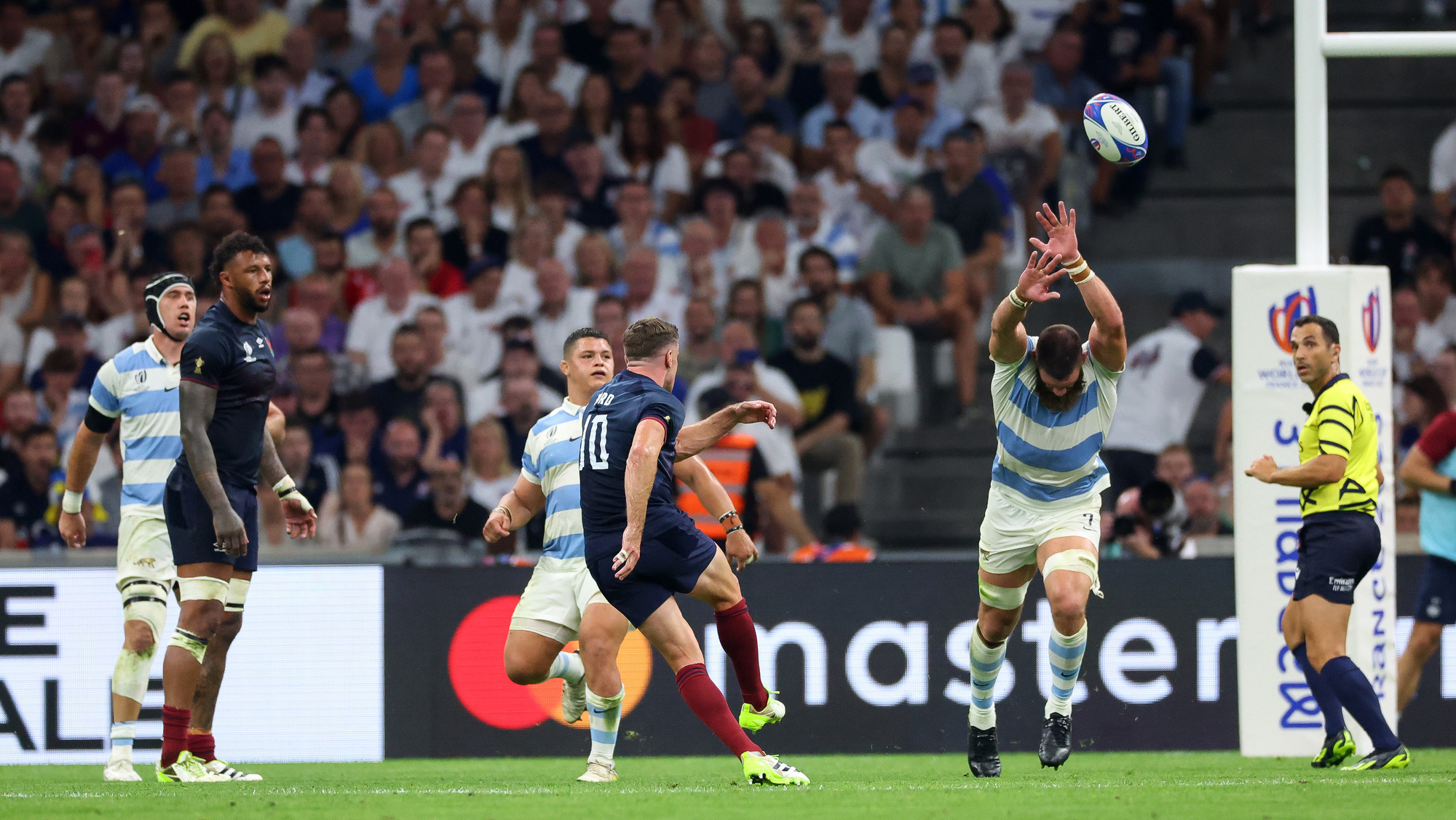
DROP GOALS: England’s George Ford kicks his third drop goal. Pic: ©INPHO/James Crombie
Stick around long enough and everything comes back into fashion. Irish sides were part of the tap penalty revival last season, Murrayfield went weak at the knees for Ben Healy’s spiral kicking just over a month ago, and now drop goals have been rescued from the attic by George Ford’s boot here on Saturday night.
It’s a skill that has tattooed itself into the collective memory through cult efforts from the likes of Jeremy Guscott (for the Lions in 1997), Jonny Wilkinson (in the 2003 World Cup final) and Johnny Sexton (for Ireland against France five years ago), all of which were knockout blows delivered on the razor’s edge of the final whistle.
Ford’s three efforts inside ten first-half minutes were members of a related tribe. Think Jannie de Beer against England in 1999, Wilkinson’s hat-trick against the French in 2003, or Juan Martin Hernandez’s trio against Ireland four years later. These were rugby’s equivalents of death by a thousand cuts.
One among many of the game’s cliches is the point about how forwards love to pick themselves up off the turf and see their ten swishing a clearing kick 60 metres down the field. Forward ball. Momentum. Respite. Think, then, what Ford’s drops did for an England team that was still processing the loss of Tom Curry to a fourth-minute, upgraded red card.
An England team that had lost five of its last six games. An England team that seemed utterly unable to get out of its own way and out of its own head as it absorbed the transition from Eddie Jones to Steve Borthwick. Imagine how it felt to see those three kicks split the posts. And then add it to the fly-half’s six penalties.
“It's very easy when you lose a man to hit the panic button and everyone's like 'argh' and heads are in the air, but Fordy was ice cool about it,” said full-back Freddie Steward. “And when you have one person doing it, it radiates around the team. To have someone like him at ten you just trust him. You trust that he is going to make the right decision.”
England didn’t come within a breeze of the Argentinian try line all night. They didn’t need to. Twice in that first-half they butchered overlaps down their right side but the main thread to their attack was, again, Ford’s boot as he sent ball after ball shooting up towards the huge cantilevered stands like a man releasing a pigeon for a long flight.
Borthwick was asked about this persisting 2D approach afterwards but this was enough for now against an opponent that was as flat as its fans were boisterous pre-game. Against a team that couldn’t take advantage of Curry’s dismissal and the fact that Santiago Carreras escaped similar for his late charge on Ford early on.
He made the point that drop goals are far more visible at World Cups than normal. Ford, a man with a more varied skillset than he is allowed to display with England, spoke to the pragmatism at the heart of this when expanding on the drop goal practise all the squad's tens do, the greasy ball and the distance it seems to be flying at this tournament.
The South Americans will still fancy their chances of making it through this pool – and they grasped at the persistence in claiming a late, converted Rodrigo Bruni try - but this was dreadfully dispiriting for a side that claimed a first win against this same opponent at Twickenham less than ten months ago.
Their form has always pitched and rolled like an angry Atlantic swell. They will look at the review this week and reflect on a performance that was littered with 13 penalties, bad handling errors, two key failures to get over the England line from inches out. But they will mostly ponder a malaise that can’t be pinned on the muggy Mediterranean weather.
“The game was very stop-start, exactly how they wanted it,” said Pumas head coach Michael Cheika. “Ford played the cards nicely. The pitch is a little smaller. The full distance is only 95 [metres] so you can take a shot from further out. Well-managed, you know what I mean? Full credit to them, they played the game really well.”
Both of these sides should still go through given the lopsided nature of the draw. In that, this wasn't a make or break affair for either but the mood music has shifted dramatically in and around both camps. Momentum is everything at these tournaments. England have wind in their sails.
: F Steward; J May, J Marchant, M Tuilagi; G Ford, A Mitchell; E Genge, J George, D Cole; M Itoje, O Chessum; C Lawes, T Curry, B Earl.
: W Stuart for Cole (50); J Marler for Genge (55); D Care for Mitchell and G Martin for Chessum (both 64); L Ludlam for Lawes (65); O Lawrence for Tuilagi (69); T Dan for George (72); M Smith for Ford (76).
: JC Mallia; E Boffelli, L Cinti, S Chocobares, M Carreras; S Carreras, G Bertranou; T Gallo, J Montoya, F Gomez Kadela; M Alemanno, T Lavini; P Matera, M Kremer, JM Gonzalez.
: M Moroni for Mallia (3-9) and for M Carreras (63); GP Pagadizabal for Gomez Kadela (HT); J Sclavi for Gomez Kadela and R Rubialo for Lavini (both 50); R Bruni for Gonzalez (59); E Bello for Gallo (63); T Gallo for Sclavi (68); A Creevy for Montoya and L Bazan Velez for Bertranou (69).
: M Raynal (France).


CONNECT WITH US TODAY



Be the first to know the latest news and updates