Breaking baguettes with the man who could have been Jean-Pierre Rives
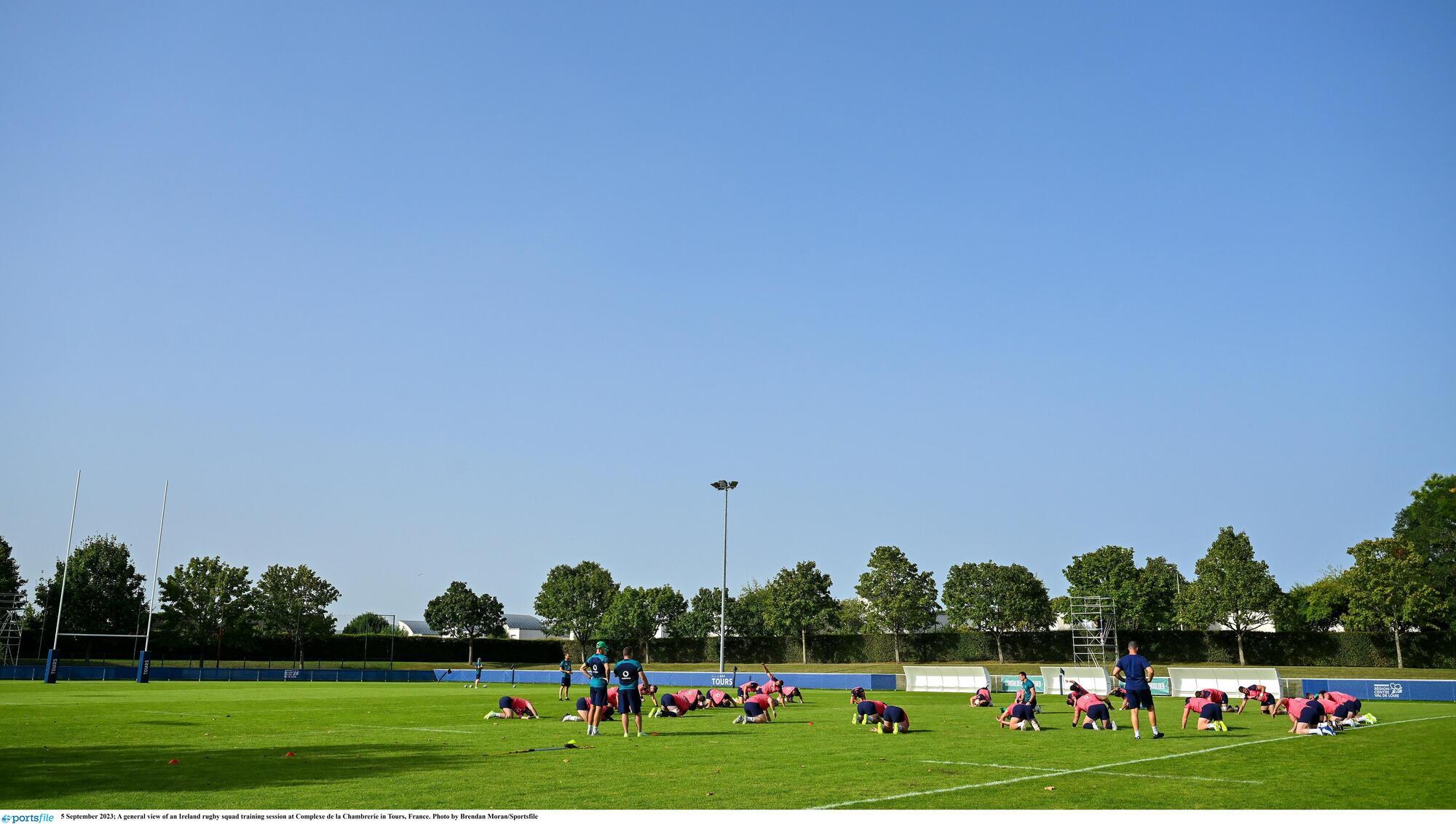
SOARING TEMPERATURES: A general view of an Ireland rugby squad training session at Complexe de la Chambrerie in Tours, France. Pic: Brendan Moran/Sportsfile
Tours, as is the case across the whole of France, is slowly saying goodbye to the customary August national summer shutdown and turning its attention to going back to school, college and work.
Not that the climate gods have received the memo.
Rolling up one’s sleeves and getting back to business in 36C heat, as the citizens of this small city of 130,000 have been reluctantly attempting, is not easy, though the newly arrived Ireland World Cup squad have been ignoring the soaring temperatures at their purpose-built €3.9 million training ground at Stade de la Chambrerie.
For those of us not preparing for a sizzling 80 minutes of Test rugby in Bordeaux on Saturday afternoon, there can be few better places to unwind after an honest day’s toil than by the banks of the river Loire, which runs gracefully through the city.
There is more to life by the Loire than its palatial chateaux and vineyards, as an evening visit to the riverside will reveal. For it is here that you will find an institution as authentically French as the summer grind to a halt – the guinguette.
These are traditional seasonal gathering points, sometimes as simple as a waterfront bar, as at the one just off Tours’ main north-south central artery, Rue Nationale, which is more akin to an Irish riverside pub garden. Yet others are more elaborate, with guinguettes offering dining and dancing venues that are a staple of French summers in the Loire Valley and beyond.
Just outside Tours, a little upriver, sits the biggest guinguette in France and Coline Morisseau, from the family that owns and operates Rochecorbon Guinguette, explained the allure.
"Guinguette is a typical place to hang out in France, especially in Tours. It's a really famous place where everybody wants to go and spend time outside, close to the river.
"It's a place you can feel like you're on holiday even if you're not. So our guinguette at Rochecorbon, it's really close to Tours, five minutes by car, and you can dance and eat traditional dishes and drink. You can play petanque, beach volleyball, crazy golf and so it's a place of leisure and entertainment and that's why so many people love to spend time here in the summertime.
"We don't have the ocean or the beach but we have the guinguette. And don't swim in the Loire, it's a bit dangerous, you can sink in the sand. Just enjoy the views."
Coline works alongside her parents and brother and is in charge of the amusement park at the guinguette, which can attract as many as 2,000 people on Saturday nights.
It does feel like a holiday atmosphere on the midweek evening we visited, as people drink, eat and take to the big dancefloor at the centre of the guinguette as a live band plays to an older crowd and the sound of a singer backed by an accordion drifts along the riverside.
"Every night we have a different type of music, Latin, salsa, country, rock and roll, and DJ on Saturday night for everybody. And during the World Cup we will be showing all the games,” Coline continues.
"My dad is a big rugby fan so we have to show all the matches. He used to be a player when he was young.
"He was supposed to play in the young France team, the Espoirs, but he broke his leg. I'm sure he will tell you all about it."
Indeed he does. Coline's father Gérard Morisseau is a rugby nut, a frequent visitor to Dublin to support France and apparently a former player of some promise from Troyes, with an intriguingly delicious yarn about his part in the launching of a much more celebrated career.
"I was a rugby player a long time ago in Troyes. When I was 18 years old I was picked for the junior French team against Wales. But I broke my leg in training and that was it, it finished for me. My replacement on the team was Jean-Pierre Rives. Have you heard of him?! Really, it's true. I was finished and he was just starting." Coline interrupts: "He's proud of that."
To which Gérard replies, "Of course, it's a good story! He became a great player."
Gérard has one parting observation.
"The Irish are the best, no?” he suggests before adding: “The best after France.”
CONNECT WITH US TODAY



Be the first to know the latest news and updates