Purring South Africa have timed run to form perfectly with detailed planning
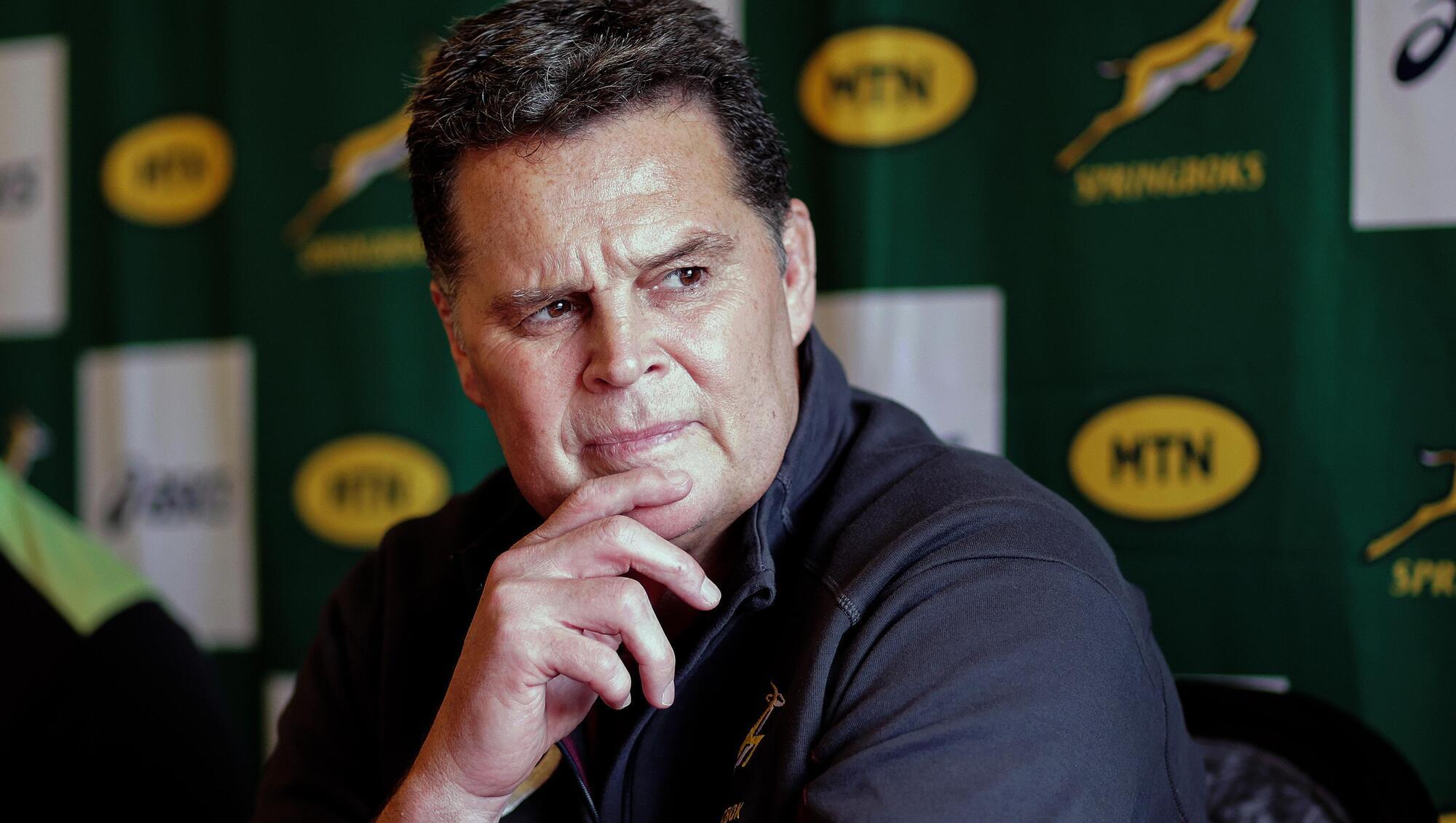
DETAILED PLAN: South Africa Director of Rugby Rassie Erasmus. Pic: INPHO/Laszlo Geczo
Not long after Rassie Erasmus and Jacques Nienaber returned to South Africa in late 2017 with the understanding they would assist Allister Coetzee with the Springboks, things changed dramatically.
Coetzee, who had overseen two disastrous seasons, believed he was going to be nothing more than a “ceremonial coach”, with Erasmus actually running the show. Although this has been denied, it was probably a fair assumption because Erasmus and Nienaber certainly didn’t return simply to ‘help’.
They had a short-term and long-term plan and it was highly unlikely it genuinely included Coetzee. And that was a good thing because when Coetzee resigned in early 2018 knowing that he would no longer have complete control, Erasmus stepped in.
Almost immediately Erasmus showed how much work he’d already done. He revealed the long-term plan was to win Rugby World Cup 2023, he had players in mind, a strategy and a style of play.
Erasmus made no bones that there would be short-term pain in the form of defeats. But on his watch, the Boks would not be humiliated, It was bold and realistic. The Boks had fallen to seventh in the world rankings, had endured a first loss to Italy and a record defeat (57-0) against the All Blacks.
Erasmus and Nienaber were clear in their thinking and communication to fans via the media.
There would be losses in 2018 as they implemented a new gameplan, fixed the defence and fast-tracked new players into a system. They asked to be trusted because they knew what they were doing, but needed time to undo the damage.
The immediate task was simply to become competitive again. The hope was that by RWC 2019 in Japan they might be good enough to make the semis, but the real goal was winning four years later in France.
We all know what happened.
The first masterstroke was making Siya Kolisi captain. That immediately made people sit up and notice the Boks again. Kolisi, admittedly still unsure of himself as skipper, guided the Boks to a 2-1 home series win over an England side who were much better than they are now.
The Boks then beat the All Blacks in Wellington during the Rugby Championship, 12 months after losing 57-0 in Albany. The foundations were laid. Belief from fans and players soared. The Boks were back.
Winning the World Cup in Japan in 2019, came earlier than planned. It was glorious and deserved, and if anything, has added pressure four years on.
Erasmus, no longer the coach but still director of rugby with Nienaber as coach, remain steadfast that winning in 2023 was the goal they set out to achieve in 2018. And therefore it’s the standard they must meet.
And it’s fair to say that even after losing the entire 2020 season to the pandemic, and limping through a covid-affected 2021, the plan remains on track.
Until recent injuries to centre Lukhanyo Am and flyhalf Handre Pollard, and a worrying heart issue for lock Lood de Jager, the Boks had at least two world-class players in every position. In some positions, they have more. Their strength in depth is simply frightening.
That was one huge pillar of the plan – building depth – and RasNaber (as they have become collectively known) have succeeded.
Take the wings for example – two of Cheslin Kolbe, Makazole Mapimpi, Kurt-Lee Arendse and Canan Moodie – are going to miss out on selection in the big games. Can you imagine Kolbe being omitted from a Bok match-day squad for a crucial RWC match? It’s a strong possibility. Ditto for Mapimpi.
Either Andre Esterhuizen or Damian de Allende won’t make the match-day squad as inside centre and scrum-halves Cobus Reinach and Grant Williams might only play in the ‘lesser’ games.
In the back row, either Jasper Wiese or Duane Vermeulen are likely to miss out while in the front row one of Trevor Nyakane or Vincent Koch will be overlooked. That’s not even taking into consideration players who missed the final 33-man cut, such as RWC 2019 winner Thomas du Toit.
If there is one potential weakness, it’s at fly-half. Manie Libbok, one of a handful of players to have emerged in the four years between World Cups, remains the only fit pivot in the squad.
Libbok, who has been leading points scorer in each of the first two seasons of the United Rugby Championship, has now established himself as the first choice out-half. But if he is injured on the eve of a big match in France, the Boks will have to come up with a creative solution.
Pollard is expected to be fit soon, but he hasn’t played for months and is not with the squad. An injury in the warm-up to a big match means that Damian Willemse would be the most likely fly-half substitute.
Am’s absence will be felt. He is a special player who comes along rarely. But Jesse Kriel has been a regular in the RasNaber era and Moodie, who started against the All Blacks at Twickenham last week, allayed fears about depth in the position.
Kriel is likely to start at No 13 against Scotland in Marseille on September 10 and Ireland in Paris on September 23, but Moodie can comfortably slot into the midfield if needed.
South Africa have the players, the coaches, the gameplan and the depth required to win. What they no longer have is the element of surprise.
Until they dismantled the All Blacks 35-7 at Twickenham, the Boks were happily flying under the radar. They were certainly considered a dangerous side, but France, Ireland and New Zealand were seen as the three to beat.
But then came a five try to one thrashing with a demonstration of forward power so brutal every coach in the tournament was put on notice.
The performance at Twickenham wasn’t so much a statement of intent as it was an 80-minute trailer previewing the blockbuster main feature to come.
Sure the All Blacks were down to 14 men for half the game but that came about because of the relentless pressure New Zealand were under. Pressure does odd things.
Richie Mo’unga missed a sitter penalty kick in front of the posts, the All Blacks’ discipline fell apart and Scott Barrett lost his head with a cheap shot on Malcolm Marx. That’s what the Boks do. They turn the screw and if opponents don’t make a fast start and transfer the pressure, it usually ends badly.
The Boks are polished and purring. They have enough depth to absorb even more casualties without upsetting their style or performance.
The vagaries of the draw mean that like Ireland, France and New Zealand, they could stumble at the quarter-final stage in France – assuming they make it there.
But if they advance to the semis, they will take some stopping. RasNaber set their goal as glory in France. They have seldom, if ever, over- promised and underdelivered

CONNECT WITH US TODAY



Be the first to know the latest news and updates