The importance of Finn Russell to Scotland can't be overstated
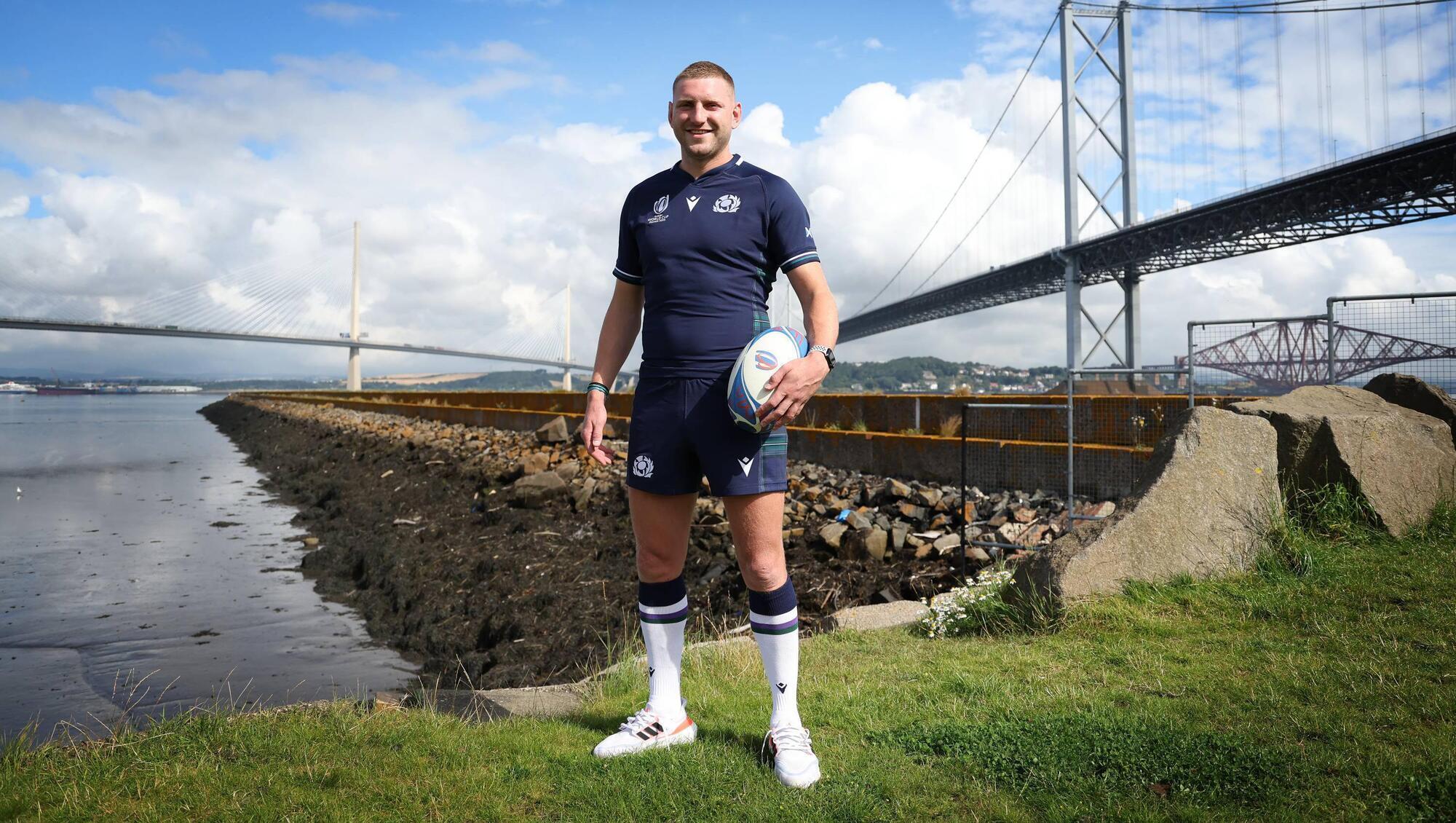
MATURING: Finn Russel at the Scotland World Cup squad announcement in South Queensferry. Pic: Ian MacNicol/Getty Images
Given the wild disparity between Scotland’s expectations going into the last World Cup and the reality of their performances at that tournament, it is rather surprising that Gregor Townsend is the only current head coach of a top 10 nation to have stayed in post throughout the last four years.
In some cases – such as with Ireland, New Zealand and Argentina – the change at the top was achieved in an orderly and timely manner, while in others – such as England, Australia and Fiji – it was more frantic due to either a worrying performance trajectory or an undisclosed personal matter which led to an abrupt resignation.
In the other cases, the story is not clear cut at all. For example, when the irascible Rassie Erasmus returned to his director of rugby role in South Africa following his nation’s 2019 triumph, he handed the head coach role – but not centre stage – to his long-time side-kick Jacques Nienebar.
Fabien Galthie was embedded as ‘vice-head coach’ for France ahead of the 2019 tournament, which presumably meant he wielded significant influence from below the parapet throughout that campaign as he prepared to replace the lame-duck head coach, Jacques Brunel, for the 2020 Six Nations.
Meanwhile, poor old Wales waved goodbye to the great Warren Gatland – who went on to combine an unimpressive stint with the Chiefs in Super Rugby Aotearoa with coaching the 2021 Lions – but have since welcomed the New Zealander back after the Wayne Pivac era fell flat.
All things considered, Townsend can consider himself lucky to be having another bite at the cherry, and you suspect that if the Scottish Rugby Union had broken with recent tradition and conducted a proper review of their Japanese farrago, then he might have been working somewhere else by now.
Instead, the former Scotland and Lions playmaker was allowed to mark his own homework, leading to the sacrifice of forwards coach Danny Wilson and defence coach Matt Taylor, and a promise that lessons had, indeed, been learned.
However, fears that the issues that undermined 2019 had not been properly addressed were reinforced during the following Six Nations when Scotland's head coach and the talismanic Finn Russell conducted a very public spat which deprived the team of their lynchpin playmaker for the first four games of the championship before covid intervened.
Even after Russell returned for the postponed final match of the campaign against Wales in October 2020, it felt like an uneasy truce – of the sort which could eat away at the team’s unity.
Sure enough, the fall-out from an unsanctioned late-night visit to an Edinburgh bar by six players – which also involved then captain Stuart Hogg – preceded Russell being dropped to the bench for Scotland’s defeat in Ireland on the final weekend of the 2022 Six Nations.
And when Townsend – to mass incredulity – claimed that he had left Russell out of his 2022 November Test Series squad because three other Scottish stand-offs were in better form, it confirmed in almost all minds that the head coach was desperately trying to find a route into and through this World Cup which was not completely dependent on his erstwhile protégé.
Russell continued tearing it up for Racing 92, as he had done all season, and when an injury to Adam Hastings midway through that autumn opened the door for the prodigal son’s return, it was a sliding doors moment for the coach, the player and the team.
Whether by accident or design, Townsend had manipulated his relationship with Russell into a place where their mutual reliance on one another in a rugby sense trumped any personal tension.
To his credit, Townsend appears to have found a balance between his natural instinct to micro-manage with the need to give a free spirit such as Russell the room to be himself. For his part, Russell – who recently became a father for the first time – has shown a previously hidden level of maturity by recognising that he is more likely to be taken seriously if he rubs along with rather than grates against the head coach.
The net result is that Russell has emerged as a genuine leader within the squad, skippering the side against France at Murrayfield last month – he claimed it was the first time he had captained any team at any level – and striking an excellent balance between flair and control in recent outings. The wild gambles have not disappeared completely, but there is a shrewdness now as to when he twists and when he sticks.
It is hard to overstate just how important Russell will be to Scotland’s chances of progressing from this toughest of World Cup pools, which is why it raised some eyebrows when he was selected to start his third consecutive warm-up Test against Georgia last weekend.
Townsend reasoned that he needs his best players match-sharp and ‘connecting’ ahead of facing South Africa in Marseilles this Sunday – a lesson learned from being left rooted on the start line by Ireland on the opening weekend of the 2019 tournament – but the flip side is the threat of injury, and the fact that it leaves understudy Ben Healy desperately short of minutes on the pitch at international level.
The Tipperary man took his Scotland bow with 13 minutes against Italy at the end of the 2023 Six Nations, was man-of-the-match when he played the full 80 against the Azzuri earlier this summer and was named on the bench against Georgia at the weekend.
Townsend reckons Healy is a confident and competent enough character to take any unexpected plunge into the deep end in his stride – although he and the rest of Scotland are desperately hoping it doesn’t come to that.
As painful as it is to admit for anyone who remembers the revolutionary effect he had on Scotland’s once painfully turgid back play after bursting onto the scene 11 years ago, the abrupt retirement of Stuart Hogg back in June has been a blessing in disguise.
The full-back had only just turned 31, but his years in the fast lane had demanded a heavy toll on his body and his mind, which was beginning to cast a dark shadow over the squad.
The time was right for Blair Kinghorn to inherit the No 15 mantle.
As golden generations go, this lot’s achievements of two third-place finishes in the Six Nations (in 2018 and 2023) and World Cup quarter-final appearance (in 2015) hardly stands out compared to their Celtic cousins in Ireland and France.
But there is a deep anxiety in Scotland that once the elder statemen of the current crop follow Hogg into retirement — 11 of this squad are aged 30 or over — the flow of replacements is more of a dribble than a stream.
Rory Darge is the beacon for the next generation, while Ollie Smith, Ewan Ashman and Cam Redpath (all 23) can make another two World Cups, but the plight of the national U20s team in recent seasons spells danger to Scotland’s aspirations of remaining a tier one force — especially when compared to the recent successes of the likes of Georgia, Uruguay and Spain at age-grade level.
Let’s face it, behind Owen Farrell, Scotland prop Zander Fagerson is the next most likely player to be suspended for repeating a crime he has already been recently punished for.
And if the tight-head does commit another dangerous clear-out, or indeed picks up an injury, then the next cab off the rank is expected to be 37-year-old WP Nel — but don’t discount Welshman Javan Sebastian, who has momentum on his side.
The 28-year-old, whose father is from Edinburgh, was working 12-hour shifts picking meat off a butchery conveyer belt in Carmarthen not so long ago, and was an unheralded back-up option at Scarlets when Gregor Townsend first called him up in 2021.
Even at the start of this summer, he was an outside bet to make the final 33 ahead of up-and-coming Murphy Walker, but he has grabbed his opportunity with both hands and barged his way onto the flight to the French Riviera with a couple of powerful showings off the bench this summer against Italy at home and France away.
Rarely does a press meeting go by without head coach Gregor Townsend revealing how pleased he is with the way his squad are all singing from the same hymn sheet, and his players have followed suit by also dropping the word into almost every second sentence.
It’s important because there is a recognition that this was not the case in 2019 when Scotland arrived in Japan with high expectations of themselves but without unity of purpose, leading to an early exit with tails tucked between legs following humbling defeats against both Ireland and the host nation.
If Scotland are to have any chance this time, then they are going to have to be ‘connected’ by bonds and strong as Clyde-built girders.
All eyes will be on Russell, but his midfield amigo, Sione Tuipolotu, plays a crucial role as the No 10’s enabler who, often as not, acts as first receiver with the fly-half then looping behind his inside-centre to create confusion in opposition ranks.
This is the best squad Townsend has ever assembled but some of the seals are less than watertight even if it’s tricky to pinpoint exactly which one may spring a leak.
The line-out lost Scotland the game against Ireland in the Six Nations.
A late scrum penalty gifted France a win in St Etienne more recently, and goal-line defence against the bigger beasts remains a problem.
Scotland make rather too many mistakes for a side that needs to play keep-ball and skipper Jamie Richie still gets overly emotional with the referee.
An unnerving number of fans believe that Scotland not only can beat South Africa in the opening game but will do so!
It’s not impossible but it’s a big ask given the Springboks’ strength and depth. While Townsend’s record against Ireland, one win in 10 outings, is woeful.
They are capable of excellent one-off results, but they have never beaten a team ranked higher than them at a World Cup, and exit after the pool matches remains the most likely outcome.
CONNECT WITH US TODAY



Be the first to know the latest news and updates