Big focus on tackling technique for World Cup
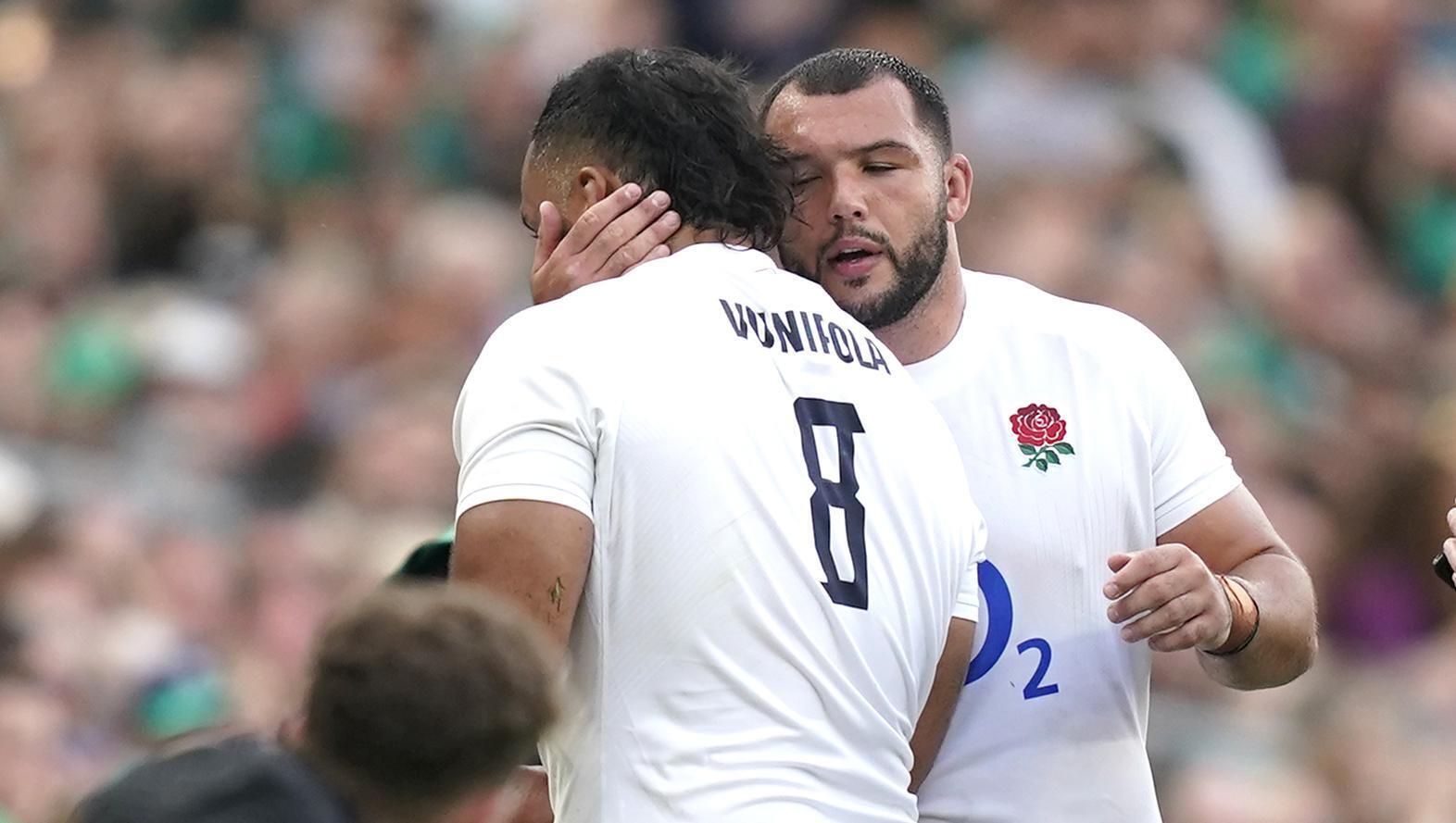
NERVOUS WAIT: England's Billy Vunipola is consoled after seeing his yellow card upgraded to a red card for a high tackle against Ireland. Pic: Niall Carson/PA Wire
Just over 52 minutes on the game clock and the moment everyone knew was a possibility became reality.
It wasn’t immediately apparent that Billy Vunipola had caught Andrew Porter high with a no-arms tackle on Saturday but the first replay sent a knowing ‘ooh’ around the Aviva Stadium.
That referee Paul Williams opted to show a yellow card and refer the incident to rugby’s new ‘bunker’ system was further proof that officials will offload the responsibility to show red cards all too quickly but the end result for England is the same.
That’s three red cards in their last three meetings with Ireland – even if the one shown to Freddie Steward last March was rescinded – and two in as many games for the same type of indiscretion after Owen Farrell’s effort against Wales the week before.
The Vunipola incident has been met with no little chagrin across the Irish Sea, and no little mirth elsewhere, but take a wider lens to all this and the helter-skelter, car-crash nature of rugby means that players are all walking a thin line.
The margins are all the smaller as the calendar funnels in towards a World Cup that is now less than three weeks away. The potential cost for anyone found to be guilty of a similar misdemeanour will only multiply from here on in.
Go back to 2019 and Bundee Aki missed out on Ireland’s quarter-final against New Zealand after a high tackle on Samoa’s Ulupano Seuteni in Fukuoka that earned a red card and a dismissal for the abrasive centre.
What people tend to forget is that Samoa’s Seilala Lam had been shown a yellow for a similar effort but he escaped with ten minutes in the sinbin when referee Nic Berry decided that the hooker had, unlike Aki, tried to lower the point of contact.
Small margins.
“We’ve touched on these different incidents in the past,” said James Ryan when asked about the importance of players getting their tackle technique just right in the modern game. “You just have to be so careful. It’s something that Simon (Easterby, Ireland forwards coach) would speak about.
“The ramifications of just being a little bit sloppy or not getting your technique quite right are massive so we’re definitely conscious of it so we’d do a lot of tackle technique as a team during the week just to mitigate against that risk, because as you said, if you just get it not quite right, you might lose a few weeks or a few games.”
Major tournaments tend to kick off with a heavy focus on one or more particular rules and there is little doubt but that World Rugby and its departments with responsibility for the relevant areas will be zeroing in on these high and dangerous tackles.
What else tickles their fancy remains to be seen ahead of a tournament that remains the chief means of attracting people to the sport but any repeat of the mess around the scrums on Saturday night is not what is required.
If the new ‘bunker’ system speeds up the game then the constant resets around scrums in some games is another blight that needs addressing. Ryan, at least, sounds confident that those frustrating scenes around the setpiece against England aren’t a sign of things to come.
“Yeah, a one off. I think refs would probably lose their patience so hopefully we won’t see that.”
CONNECT WITH US TODAY



Be the first to know the latest news and updates