World Cup history shows Ireland need to go all out for Six Nations
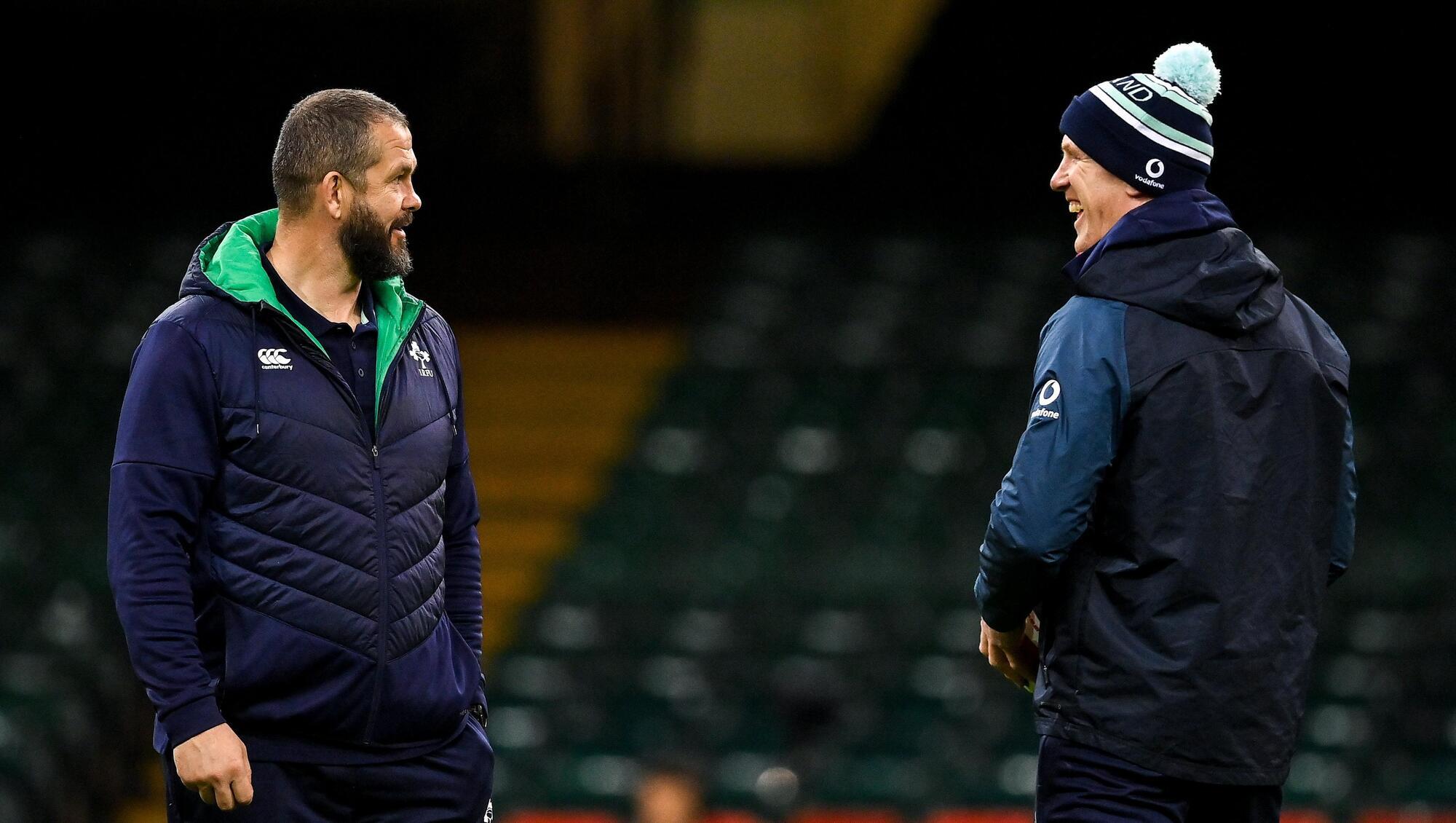
ALL SMILES: Ireland head coach Andy Farrell, left, and forwards coach Paul O'Connell during the Ireland rugby captain's run at Principality Stadium in Cardiff, Wales. Pic: Brendan Moran/Sportsfile
Because we tend to view the Six Nations in a World Cup year solely through green-and-white lenses and with all tentativeness that prism at this stage entails – to go for it or not to go for it, that is the question – it’s worth taking up a different vantage point and trying on a different colour of specs.
SIX NATIONS CHAMPIONSHIP
Your home for the latest news, views and analysis of this year's Six Nations Championship from our award winning sports team.
SIX NATIONS CHAMPIONSHIP
Your home for the latest news, views and analysis of this year's Six Nations Championship from our award winning sports team.
In the opening game of the 2019 Six Nations, and the night before the Robbie Henshaw at full back experiment blew up in Joe Schmidt’s face against a rampant England in the Aviva, Wales kicked off their campaign in the Stade de France.
The match started disastrously for Warren Gatland’s men; at half-time they trailed 16-0. But then through a combination of Welsh perseverance and French dim-wittedness, the away side stormed back to triumph 24-19. For Gatland the key to Wales retaining their belief at half-time was the comfort of knowing they had found a way to win their previous nine test matches.
“The big difference between the two [teams],” he’d say afterwards, “is that we’ve become a side that have forgotten how to lose and France are a side still looking for confidence.”
Before the game he had made another frank statement: if Wales won in Paris they’d go on to win the Six Nations. As it happened, they did more than that; by virtue of hammering Ireland 25-7 in their final game, the Welsh completed the Grand Slam.
Eight months after their Parisian comeback, Wales again encountered the French, this time with the stakes even higher: a World Cup quarter-final. Again the French made the better start, but again the Welsh would charge back to reel off the game’s last 10 points to edge it, 20-19.
It had been just the latest demonstration from his team that winning begets winning; three weeks earlier in their group they had also pipped Australia in a one-score game. Eventually they would finish on the wrong side of a nail-biter, losing 19-16 in the semi-final to eventual champions South Africa, but by making the last four they had at least kept one record intact which should be particularly noted by Ireland: Any team that has won a Grand Slam in a World Cup year has gone on to reach at least the semi-final of that World Cup.
It’s a pattern the French themselves established at the inaugural World Cup. A few months before Serge Blanco famously went over in the corner against the Wallabies, his team secured the 1987 Grand Slam in Lansdowne Road.
Four years later England also progressed to the final, having overcome the French in Paris in the quarter-final and the Scots in Edinburgh in an edgy, low-scoring semi-final, possibly steeled by the knowledge they had beaten the same two teams in the spring en route to a Grand Slam.
In 1995 Will Carling led them to a third Grand Slam under his captaincy, and that summer at the World Cup they would take out reigning champions Australia before they themselves became roadkill in the wake of a human juggernaut called Lomu.
Neither of those English teams managed to get their hands on the Webb Ellis Cup, of course, just like the French came short to the All Blacks in ’87. But when assuming the English post for the following World Cup, Clive Woodward certainly wasn’t going to attribute their shortcomings to how they had gone about the then Five Nations.
“[Those] Grand Slam victories were a great achievement,” he’d write in Winning!, his memoir-manual that is worth revisiting at this remove long after we’d reached our saturation point with it around about the time of his ill-fated tenure over the Lions.
“In 1991 though England lost to Australia in the final because they mistakenly changed to a completely new-playing style a few days before the match, hoping to wrong-foot the Wallabies. They had dominated with their ten-man game and would have won the final had they stuck to their proven tactics. [In 1995] England seemed to me to be still celebrating their epic quarter-final win over Australia. After that New Zealand just took them apart.”
Following how England didn’t get to party like it was 1999 (first blowing the Slam by conceding a last-minute try to Wales, then being drop-kicked out of the World Cup by Jannie de Beer in the quarter-finals), Woodward became even more resolute in his conviction that every game mattered, and especially every Test game in the spring.
“When I got the players together [before the 2003 Six Nations], I told them that if we were serious about the World Cup we would have to win the Grand Slam that year. We had just beaten all the southern-hemisphere teams [in the 2002 autumn internationals] and now had a good chance to win the World Cup.
"I consciously put as much pressure on the players as I could, which is different from the way most coaches set about it. I kept telling them in meetings, ‘If you’re serious about the World Cup you have to win these games.’ I believed that the team played better under pressure, because that’s what we would meet in the World Cup.”
The rest is history. The only northern-hemisphere team that has gone on to win a World Cup did so on the back of a Grand Slam won that spring, their ultimate marker being made on a red carpet in the old Lansdowne Road.
Since then a series of northern hemisphere teams have reached a World Cup decider without lifting any silverware the previous spring: England in 2007 and 2019, either side of the French in 2011, a campaign not unlike their escapades in 1999. Yet though there was something whimsical and surprising about how far those teams advanced in those respective World Cups, even they offer Andy Farrell the hint that he and his team should go out to win every game they can in this Six Nations.
While the only game the French won in the last-ever Five Nations of 1999 was a one-point game in Lansdowne Road best remembered for a late David Humphries missed penalty, they still had in their confidence bank the Grand Slam titles of 1997 and 1998. Similarly the 2011 team had won a Slam in 2010 (not to mention a huge win in the Aviva in early 2011). The England team of 2019 had also won a couple of Slams in that World Cup cycle and in the spring of 2019 had lost only the one game – to eventual fellow semi-finalists Wales. This Irish team hasn’t won a championship, let alone a Slam, in this World Cup cycle.
Ireland, of course, have won championships, even Grand Slams, before. Without the memory of 2009 and Cardiff, Declan Kidney’s side possibly would not have had the belief to beat Australia in 2011 and finally top a World Cup group. Crucially though in 2011 itself Ireland had lost to Wales in Cardiff seven months before losing to them in a similar manner again in the World Cup quarter-final. When any of the old Five Nations teams clash in a World Cup, the winner of their spring encounter has won 17 of the 23 World Cup ties (in knockout it’s 10 out of 12).
In 2015 that trend worked in Ireland’s favour, defeating France in both the championship and the World Cup; again Ireland had failed, but failed better, beating a fellow big gun in the group before injuries took their toll. Whenever Ireland have spectacularly flopped in a World Cup it’s been down more to logistics and over-training (think 2007) or an underwhelming Six Nations (think 2019) rather than having had too good a one.
“The World Cup is very difficult to predict and just as difficult to prepare for,” Joe Schmidt would write in his own book at the end of 2019. “On reflection I don’t believe that you can afford to taper and peak; you have to be building all the time, and that is done training by training, and performance by performance… Our performances [in 2019] did not have the consistency of 2018: our levels of accuracy and cohesion fluctuated from game to game, and during games.
“Our level of performance slipped as we started to look too far ahead. I think there’s a danger in becoming too focused on delivering one-off performances at the end of four-year cycles.”
Chances are that Andy Farrell, having been Schmidt’s lieutenant, is similarly the wiser from and for that experience. Heading into this Six Nations, he’ll be taking a leaf from Schmidt’s book, and very possibly Woodward’s too.
Like Ireland in 2022, England in 2002 lost only one game in the Six Nations and beat a string of southern-hemisphere teams in a manner and at a rate unprecedented for their country.
“It amazed me so many experts at home were saying we shouldn’t be exposing ourselves just before the World Cup,” Woodward noted. “In my opinion you want to know where you are. The fact we were routinely beating those southern-hemisphere giants was testimony that rugby history had been turned on its head. My driving aim was to ensure that England arrived at the World Cup as favourites to win and the highest-ranked and best-prepared team.”
Being favourites might not be a mindset Irish teams seek out but then this team is and wants to be different. Its performance coach is Gary Keegan who worked with Jim Gavin. During four of Gavin’s years at the helm Dublin won both the league and the All Ireland. They had no problem being favourites; to do so would imply they had a problem with winning.
Besides, in rugby union, there is no league. This isn’t like the hurling also starting up this weekend in which the league is just the league and then you have championship. The Six Nations IS championship. Woodward and now Schmidt can tell you and Farrell that.


CONNECT WITH US TODAY



Be the first to know the latest news and updates