Bundee Aki and James Lowe's Irish status cited in Spanish appeal against World Cup exclusion

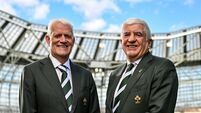
Ireland's Bundee Aki and James Lowe celebrate
IRELAND, Scotland, and New Zealand's use of foreign-born players has been used as evidence of inconsistency in World Rugby's eligibility regulations as part of Spain's appeal against a second consecutive World Cup exclusion for fielding an unqualified player.
The Daily Telegraph reports that James Lowe and Bundee Aki plus Scottish prop Pierre Schoeman and the Tongan-born scrum-half on the cusp of a first All Blacks cap, Folau Fakatava, have all been cited as evidence in Spain’s appeal against their World Cup disqualification for fielding an ineligible player, Gavin van den Berg. The Federación Española de Rugby submitted its appeal to World Rugby last week.
The Spanish Federation is challenging the decision of a judicial committee to disqualify it from the 2023 World Cup for fielding an ineligible player who was deemed to have represented Spain without fulfilling the requisite residency criteria. Van den Berg's passport was found to have been tampered without his knowledge by his club, Alcobendas, who were relegated out of the Spanish top division and fined €30,000, the report says.
The committee cited "the FER’s failures in its responsibilities, by not informing, educating and interrogating the player". Both of these conclusions are contested by the FER as is the severity of the punishment. Spanish officials expect an appeal hearing to take place in mid-June.
Spain’s punishment was a 10-point deduction, five for each of Van den Berg’s appearances against the Netherlands in consecutive years of the Rugby Europe Championship. They were also fined over €30,000 but the points deduction allowed Romania and Portugal to overtake them in the Rugby Europe Championship standings, therefore ending Spain’s World Cup involvement.
A central plank of Spain's sanction focused on Guideline 15 where the judicial committee stated that international teams “must be able to demonstrate the country in which [a player] has been resident was, genuinely, the country that the player treated as his home and is clearly the country in which the player has his primary and permanent home”.
During his World Rugby hearing, Van den Berg was asked how long he had considered Spain as his “permanent primary home”. Despite having played there for three years, he admitted that he had only felt at home in the country for two. The judiciary committee noted Van den Berg's "refreshing honesty in [admitting] it was not until the end of the 2019 year and then to the start of 2020 that he came to regard and decided that Spain was to be his permanent home."
Telegraph Sport reported that the presence of the sentimental, subjective concept of "home" in World Rugby's official verdict irked Spanish officials, leading them to present what they feel are valid eligibility inconsistencies to the sport's governing body.
A 2016 interview with Ireland centre Bundee Aki from the Irish Times was used in evidence by the Spanish, with Aki quoted: “I actually do not know [who I’ll play for]. I don’t think about it in terms of countries...Yes, my ambition is still to play international rugby. When the time comes, when the time is right for me, the coaches and the international team will come I hope.
“I have enjoyed Irish culture and stuff but it is wrong for me to say I am Irish."
In a 2019 interview with The42, James Lowe said that it was "weird that [he] could be Irish, isn’t it?", saying World Rugby’s eligibility laws were “stupid” and “weird”. Lowe qualified after completing a three-year residency period and his testimony has also been cited in the Spanish appeal.

CONNECT WITH US TODAY



Be the first to know the latest news and updates