They don't suit everybody but Ronan O'Gara's methods are working
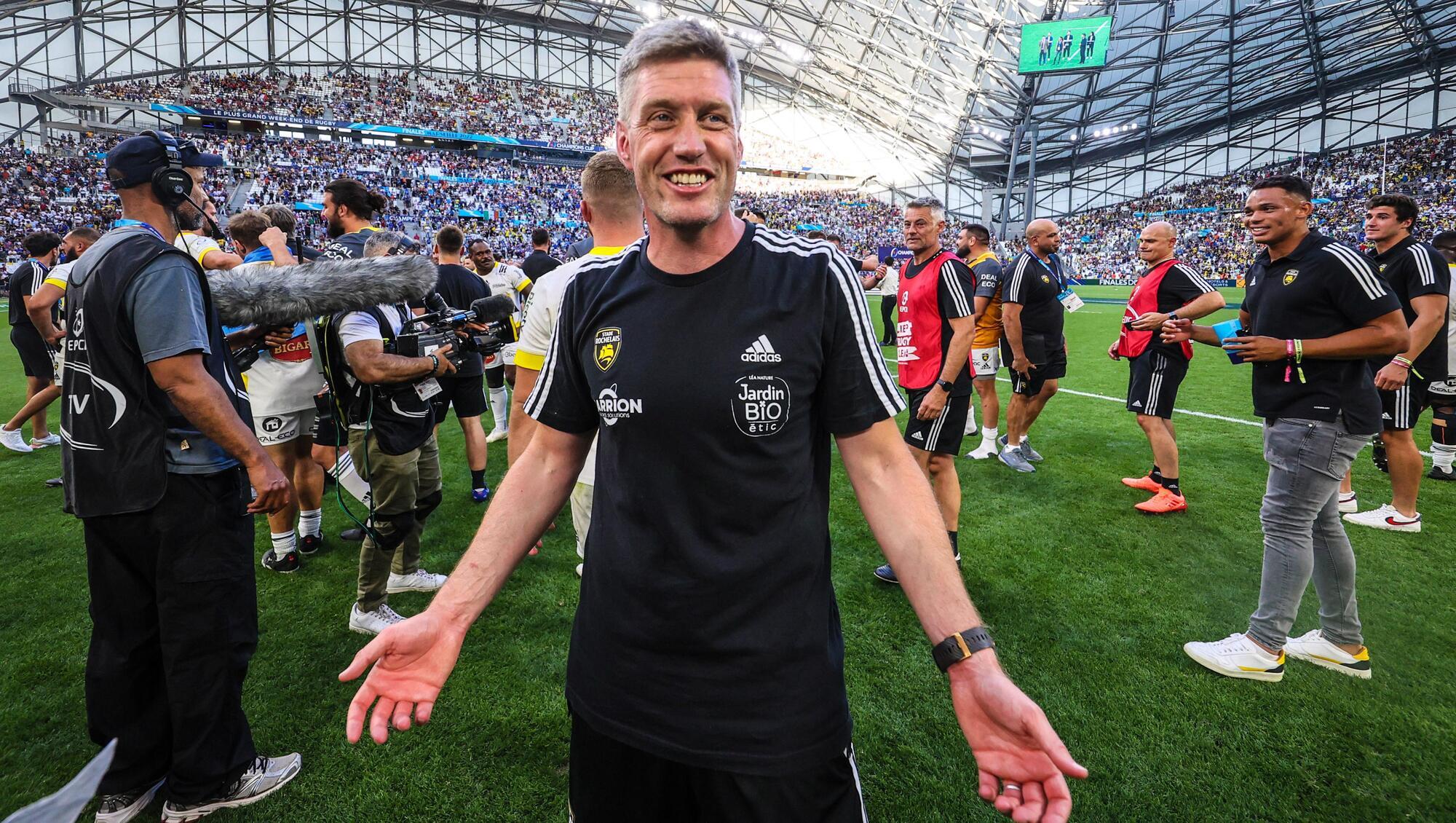
La Rochelle Head Coach Ronan O'Gara celebrates. Mandatory Credit ©INPHO/Billy Stickland
The legend of Ronan O’Gara is assured in La Rochelle after he guided the club to their first-ever Champions Cup.
As you’d expect of someone who has a Top 14, two Super Rugby crowns and - now - a European title on his young coaching CV, O’Gara has no intention of believing that Saturday’s win over Leinster in Marseille is the end of the matter. Rather, he sees it, as he said after the match, as a “great starting point”. That should come as bad news to rivals in France and further afield already coming to terms with the inconvenient truth that La Rochelle aren't easily overawed anymore.

Prior to Saturday, an Irish side had won every one of the four European finals played against French opposition. It took a self-proclaimed ‘crazy Irishman’ to break that duck.
And he did it in his first full season in charge.
With the Champions Cup at his side in the post-final press conference, O’Gara recalled the times his La Rochelle charges, “asked themselves ‘who was this crazy Irishman’ who kept telling them they too had it in them sew a European star on their shirts”.
On Sunday, they travel to Challenge Cup winners Lyon in the final round of the Top 14 season determined to hold on to fourth place in the table, and its pass to the play-offs.
In 2014, the new champions of Europe were in the ProD2. Three seasons later, under Patrice Collazo, they finished at the head of the Top 14 - but lost the play-off semi-final, in Marseille, against Toulon.
They played eye-catching rugby that season - and in the following Champions Cup campaign, their first, in which they raced to the quarter-finals where they were easily beaten by Scarlets. But, unable to compete on two fronts, they finished seventh in the French league. Then Collazo left to join Toulon, and Jono Gibbes arrived - O’Gara came on board a season later.
La Rochelle have been in the upper reaches of the table every season since, reaching both the Top 14 and Champions Cup finals last year, losing both to Toulouse.
It’s easy to see O’Gara as the missing link in a club that has become as hard to beat as it can be attractive to watch. He’ll deny it - pointing to Gibbes’ influence in his early days, and that of Scott Robinson in New Zealand and Laurent Labit and Travers at Racing. He’ll also point to his predecessors who created the squad he has inherited, as well as his staff.
It was Collazo who brought in Uini Atonio, Romain Sazy, Gregory Alldritt, Pierre Bourgarit, Victor Vito, Jeremy Sinzelle, and Kevin Gourdon, now retired for health reasons but who remains such a part of the club that he helped Alldritt and Sazy lift the Champions Cup up for those fans who travelled to the airport to welcome their heroes home.
But it took first Gibbes and then O’Gara to add the dog that turned the club from plucky, exciting-to-watch losers to ferocious winners. It was Gibbes and O’Gara that took them to their first finals last season. It was O’Gara who guided them to European glory this season.
His coaching style does not suit everyone. Sinzelle and Jules Plisson are among those who have failed to come to terms with his sometimes sledgehammer-blunt approach, born of a playing career in Munster. Both will leave the club at the end of the season.
For others, O’Gara’s method works. “Ronan knows how to sting me to get the best out of me,” Brice Dulin - who has played under the coach at Racing and La Rochelle - told Midi Olympique, “It's healthy, I like it.”
Dulin’s opinion is backed by former teammate Marc Andreu. “As a player, [O’Gara ] was very demanding. He is even more so as a coach,” he told regional newspaper Ouest France last year. “If he has something to tell you, he won’t cut corners. But that doesn't stop him having a coffee with you afterwards. He knows how to put people at ease. It is a strength.”
And La Rochelle-bound Teddy Thomas, a player whose talents no coach has yet managed to fully unlock, believes O’Gara may be the one with the keys. “Ronan made me progress a lot even if he tore his hair with me, at the start,” the Racing and France winger told Midi Olympique.
As with players, so with coaches. O’Gara has put a few French coaching noses out of joint in his time in France - notably Toulouse’s Ugo Mola and Bordeaux’s Christophe Urios, with whom he had a notorious pitchside contretemps earlier this season during the first of three matches in a row between the two clubs.
While the Munster man played down the incident - “it’s just rugby” he said shortly after the final whistle - Urios described his opposite number as ‘unbearable’. Both received formal warnings from the LNR.
That won't stop O'Gara being O'Gara. Laurent Labit, now attack coach with France, remembered being surprised by O’Gara’s direct approach in his early days at Racing 92. “He can be very hard on players. [In anglophone clubs], the language in meetings can be strong, sometimes there are even insults. [In France], it's different.”
O’Gara found the transition from player in Munster to coach in France tough, Labit said. “He sometimes had trouble passing on his knowledge. He took a long time to understand how a club coach should talk to players [in France].”
Despite this, Labit credits O'Gara with improving Racing 92. "He told us he did not want to be confined to coaching kicking. So he was entrusted with defence and he excelled. In a few months he made Racing one of the best defences in France and Europe."
Over the years, some of those rough coaching edges have been smoothed, but they’re not completely gone. Sazy, club captain at La Rochelle, recalled O’Gara’s first meeting with the players in 2019. “There was no presentation,” he said. “He got straight to the heart of the matter. He was straight and direct. He just said hello and started talking about the game. It was surprising.”
What Sazy and La Rochelle understand now is that O’Gara knows exactly what he wants. He’s said it before: “I’m here to win medals. I’m not here to win matches.” That’s the difference between La Rochelle in O’Gara years and La Rochelle before he arrived. He’s baked in a will to win that didn’t exist before. Whether rivals like it or not, they’re plucky losers no more.