Noel McNamara: 'I am very much an accidental rugby coach'
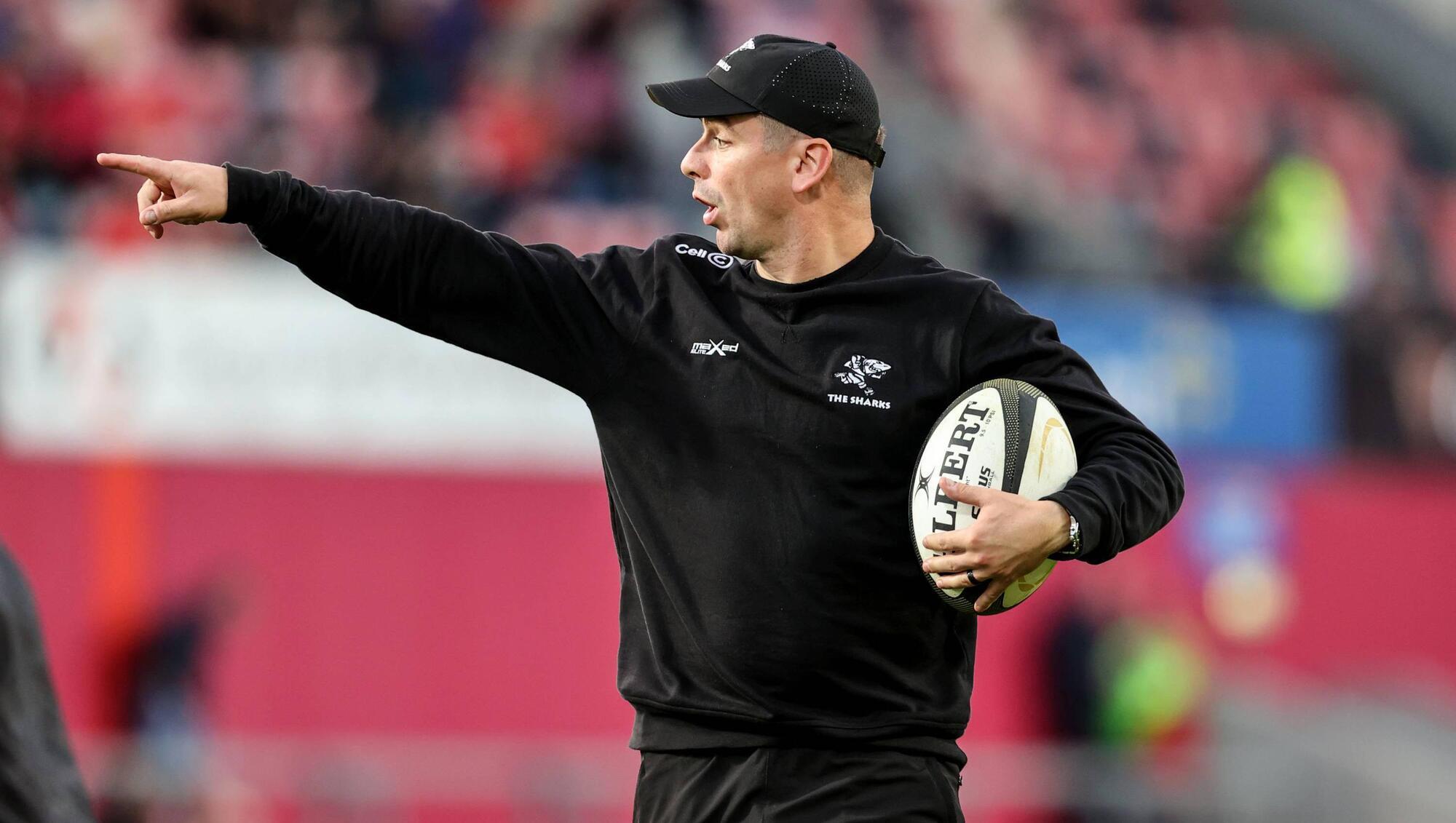
Former Ireland U20 coach and now Sharks Assistant Coach Noel McNamara
Due to unforeseen circumstances, former Ireland U20 coach Noel McNamara could have been forgiven for initially having second thoughts about his decision to join up with South African rugby team the Sharks last year.
To put this in context, it was not long after McNamara had signed a two-year contract as an assistant coach that a groundswell of political unrest broke out across the province of KwaZulu-Natal, where the Sharks are based.
The unrest - which was sparked by the decision to hand down a prison sentence to former South African president Jacob Zuma - led to protests that escalated into frenzied incidents of widespread looting and arson in what was described as “Durban’s week of anarchy”. It was one of the most turbulent times for the country since the advent of democracy in 1994, and most particularly in the Zuma-supporters stronghold of KwaZulu-Natal. The protests were eventually quelled, albeit not before the South African army was deployed to defuse the violence.
Ultimately, this was the dramatic backdrop that preceded the arrival of McNamara at the Sharks as he took up a role as their backs and attack coach ahead of the start of the United Rugby Championship last September.
Several months later, though, McNamara has happily settled in at the Durban franchise, and reflects on that period with a serene sense of understanding and perspective.
“I guess, initially, it was a big shock to the system. When I had agreed to the deal with the Sharks it was around the time of the unrest and riots in Durban, and Covid was still very prevalent, so it was quite an uncertain period generally.
“I did get an interesting phone call from my parents asking, ‘what club did you say you’d signed for?’
"Obviously they’d been watching the news. I told them ‘it’s the Sharks’, and they said, ‘is that in Durban?’”
McNamara now whimsically reflects. “That was certainly an interesting conversation. But it gave me an insight into the South African people and how resilient they are. When I came over, people just got on with what they were doing. It was very much a case of saying ‘this won’t happen again’. How something is portrayed globally and in the news can also be very different to reality.”
McNamara’s arrival was slightly postponed in the end, before heading to South Africa on his own while his wife Sinead and their three young daughters initially remained in Ireland.
“It was difficult to first come over without them, but from another perspective I got to fully immerse myself fully in the club and settle into my work,” he comments. “Thankfully, they're all over here now. The girls are in school and really enjoying it. "We talk to people at home in Ireland on video calls, and they’re in hats and scarves and jackets, and we’re here in singlets and swimming shorts. So from that point of view, it's a real positive, and really for the whole family this is a great adventure. It’s something very, very different, but they've certainly embraced it.”
Although McNamara fondly references the summer weather in Durban, the typically hot and humid climate of the coastal city has also taken some getting used to.
“I feel like I’ve just come out of an oven,” the former Leinster academy manager says with a laugh after stepping aside for a chat after a Sharks training session. “In the past, a lot of teams have struggled when they come to Durban, particularly with the humidity and the impact that can have on your handling and ability to play with ball in hand. As coaches and players, you have to be adaptable and realise there is more than one way to play.
“It’s a great thing about the URC though. You can play in the humidity of Durban one weekend, and then you can be off to Johannesburg or Pretoria to play at altitude, while later this month we’ll be heading to Benetton where there could be close to sub-zero temperatures.”
There is certainly a novelty factor to the inaugural season of the URC, but that’s not to suggest a cross-hemisphere competition hasn’t been beset by different challenges. The tournament initially overlapped with the Springboks’ 2021 end-of-year tour, as is also the case with the current Six Nations competition, depriving the URC of some serious star power.
Then there have been Covid-19 disruptions, which have forced match suspensions, re-scheduling and of course led to the dramatic scenes in South Africa last year when touring teams such as Munster were left stranded when the Omicron variant was first detected, leading to border closures and travel disruptions.
Nevertheless, McNamara believes the competition holds great potential.
“I think it would be very difficult to judge the URC in this first year alone. It’s been so impacted by Covid and it was really unfortunate how things panned out with the teams that originally came to South Africa. That was such a shame, albeit a sign of the times in this current world, but hopefully things are now heading in the right direction with regards to the pandemic.
“With the favourable time zones, and the quality of players in the URC, I think we will see this becoming a really competitive tournament that has high quality rugby on show. When people start seeing Siya Kolisi against Peter O’Mahony or Lukhanyo Am against Garry Ringrose or Johnny Sexton against Mone Steyn, that will get them really excited about the competition. So I think the URC is only going to go from strength to strength.”
With first-hand experience of SA rugby over the better part of the last six months, McNamara is well-placed to share what teams from the northern hemisphere can expect when they come up against those from South Africa once again.
Munster, for example, are scheduled to return to Pretoria to play the Bulls on March 12, and then the Lions in Johannesburg a week later.
“You certainly won’t be disappointed from a physicality perspective if we’re talking about the South African teams. It’s been incredibly physical in all the games I’ve seen. But I think that the skill level is also underestimated. I’ve seen very skilful players, both backs and forwards. For example, in one of the Sharks' recent games the forwards made 30 passes and something like 16 offloads. There’s no question that the boys can play.
“Sometimes, the conditions make it more challenging, as does the nature of the contest, and that is one of the big things - how aggressively the South African teams contest everything: every maul, every ruck, every lineout. Sure, that is the essence of rugby, but I think it's certainly something that is taken very seriously here. However, I wouldn't pigeonhole the South Africa teams as just being physical, because their players do have pace and skill as well.”
Notably, though, the likes of Ulster, Leinster and Munster have clearly flexed their metaphorical muscles at the start of the URC. Despite the fact that Ireland has a dramatically smaller pool of professional players compared to South Africa, McNamara points to the healthy “development pathways” and holistic work conducted by IRFU performance director David Nucifora as key to the success of the Irish provinces.
“You’ve got an ecosystem that is well resourced, it’s coherent, and there is a clear strategy in terms of the end point. From a club like Leinster to Munster and all the provinces, the philosophy is for their own, home-grown talent to thrive. They aren’t going to change the model – you won’t hear that a private benefactor has come in and is going to sign 20 overseas players – that just won’t happen. The model is for home-grown talent supplemented by maybe two or three overseas players, but it has to be clear what they are there for because obviously there are already local players vying for those positions.”
McNamara points to Ulster’s signing of Springbok No 8 Duane Vermeulen as a prime example.
“I think that’s something that the Irish provinces have really got right in not just signing overseas players based on their talent or rugby abilities alone. I think there’s been a clear understanding and coherence to the strategy. Look at Ulster and Duane Vermeulen now. He’s going to add massively to that environment and someone like David McCann – a fantastic young player who captained Ireland U20s in 2020. I’ve no doubt that David will learn massively from Duane about how he goes about his business and maybe some of the nuances of the game. So when Duane eventually moves on from Ulster, David will have had the benefit of that experience and will hopefully be in a position to progress significantly and contribute to the Irish national team and Ulster.”
For McNamara himself - who was progressing rapidly through the coaching pathways in Ireland - his time in Durban is seen as a crucial learning curve as he looks to take the next step in his career after arriving at the Sharks with the blessing of the IRFU.
“I am very much an accidental rugby coach,” he laughs. “Soccer was my first love growing up, but a confluence of events saw me eventually get my first job out of university working at Clongowes Wood College as a PE and Maths teacher, and one of the roles was coaching the U13 rugby team. Things progressed from there, believe it or not, and I’m really grateful for the opportunities I had with the Ireland U20s, at the Leinster Academy and even when I took up a three three-month placement with North Harbour in New Zealand.
“But it kind of got to the stage where I wanted to coach a senior team full-time. My major motivation was to get back to day-to-day coaching, and so when the Sharks offer came along, it just felt like the right job opportunity at the right time. I’ve been made to feel at home at the Sharks, where there are so many incredible players, coaches and lots of great people.
“I’m not sure what the future will hold after my two-year contract comes to an end. Those decisions will ultimately be out of my hands. You might want to do X, Y and Z, but there is always someone else who will have a big say on that. So my philosophy is just to do the best possible job at the Sharks. I am really enjoying it here and I want to play my part in hopefully contributing towards a winning team.”
CONNECT WITH US TODAY



Be the first to know the latest news and updates