Looking up: How Andy Farrell is playing the long game
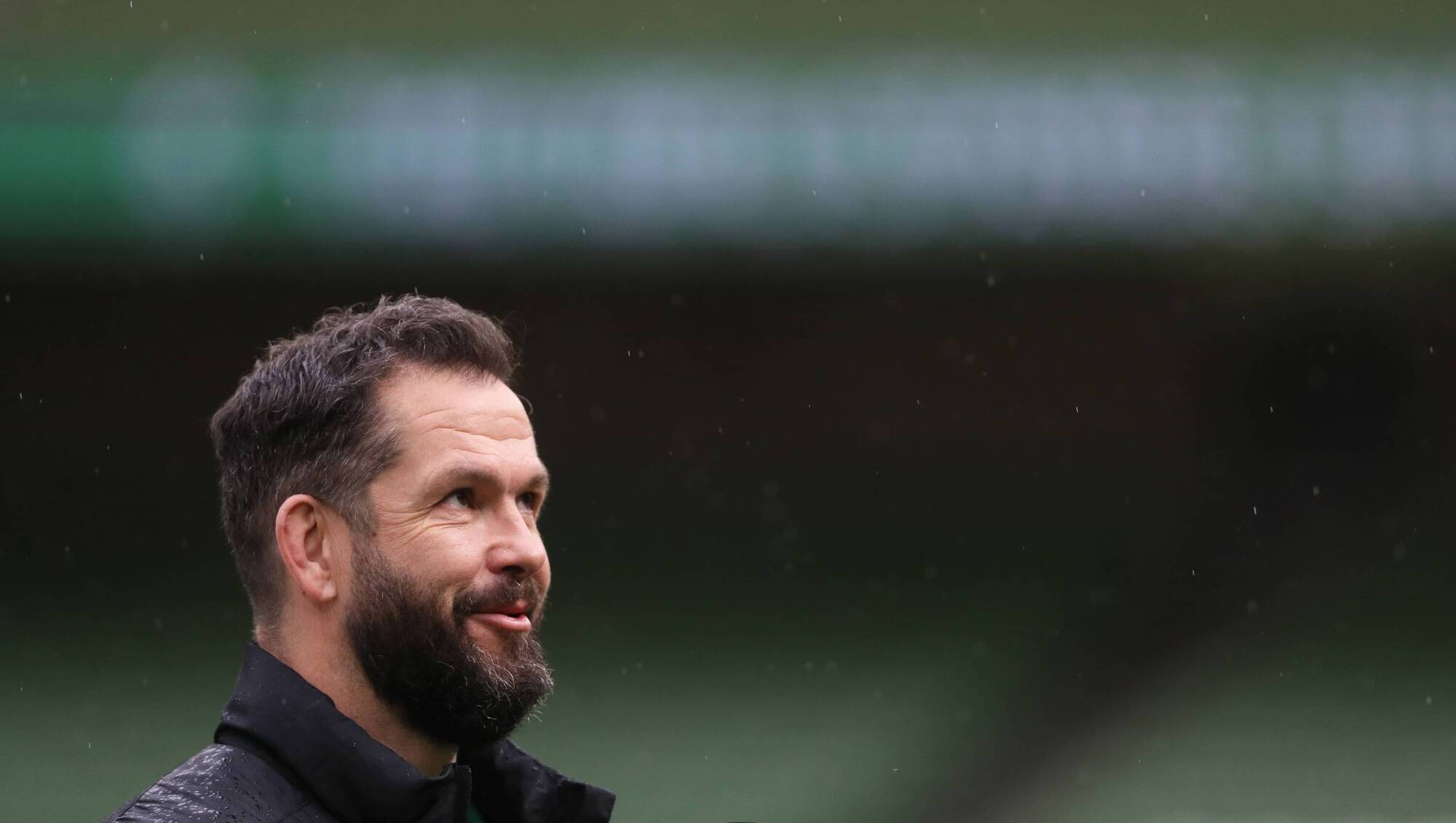
Andy Farrell said in his first pres conference as Ireland head coach: ‘We’ve got skilful players, we’ve got smart rugby players, we’ve got players who have got a lot more in them to give and we want to be able to adapt to the game in front of us.’
It was two years ago, on the eve of his first game and Six Nations campaign as Ireland head coach, that Andy Farrell referred to “paralysis by analysis”.
As Joe Schmidt’s former defence coach, Farrell had seen the wheels come off his predecessor’s best-laid plans that had sent Ireland to a Grand Slam, a series win in Australia, and a home victory over New Zealand in 2018 to a busted flush just 10 months later, World Cup roadkill for the All Blacks in yet another quarter-final exit.

Ireland were in need of a reboot and Farrell was the man who had to set the national team in a new and different direction.
“There is a little bit of paralysis through analysis,” Farrell said in his press conference that day at the Campus at Quinta do Lago on Portugal’s Algarve coast. It was in reference to his decision to break from the norm established by Schmidt and name his team for the 2020 championship opener at home to Scotland on a Tuesday rather than Thursday.
It was a minor change in the scheme of things and has since been rowed back on, but otherwise, Farrell’s Ireland have moved forward quite considerably in other, more meaningful ways on the same premise.
The Ireland team that kicks off the 2022 campaign at Aviva Stadium against Wales this afternoon contains just five players who started Schmidt’s final game in Tokyo, when the All Blacks surgically dismantled the outgoing coach’s team and gameplan in a 46-14 masterclass.
And it is a team that comes into this year’s championship on the crest of an eight-test winning streak that has claimed New Zealand as one of its victims, playing a style of rugby that has impressed supporters and opposition coaches alike.
Take Ian Foster, whose All Blacks side had been slightly flattered by the 29-20 scoreline in Dublin last November as Ireland avenged that quarter-final loss of three years earlier.
He had seen the transformation in Ireland’s comprehensive defeat of England last March and the 60-5 hammering of Japan the previous week. Before their clash with Ireland, Foster said: “I think what we are seeing is probably an expansion in ambition of what they want to do with the ball. They seem to be more at ease about taking opportunities wider and being comfortable playing like that. Credit to them, it just means you’ve got to open your eyes and be aware that they’ve got more threats in attack then perhaps they would have had 24 months ago.”
After the final whistle sounded, Foster added that Ireland had put in “probably the best performance I have come up against in my time”.
Many will feel it had been a long time coming and it is worth remembering that the vultures had been circling around Farrell less than a year ago, when Ireland had slumped to successive defeats in the opening two rounds, for the first time, in the Six Nations.
Yet the Englishman, who moved to Ireland to join Schmidt’s backroom in 2016, had set his stall out from day one, in his first media conference since succeeding his former boss at the end of the 2019 World Cup.
“We’ve got to make sure we stand for something,” Farrell said two months after the quarter-final. “We’ll evolve our attack along the way, and that will probably be a longer process, we’ll keep adding towards that… Our attacking kicking game is something that can be improved, our set-piece… there isn’t just one aspect of our game, we’ve got to make sure we get across most things.”
Farrell, who recruited fellow former England assistant coach Mike Catt to oversee the attack, appeared to empower his players to break away from the more prescriptive aspects of Schmidt’s gameplan.
“We’ve got to be good in the ‘what if’ scenarios, we’ve got to be able to adapt in many ways.
“We want to be able to play physical and abrasive, we want to be able to take it to the opposition physically, that’s what Irish teams have been very good at in the past.
“But,” he added, tellingly, “we’ve got skilful players, we’ve got smart rugby players, we’ve got players who have got a lot more in them to give and we want to be able to adapt to the game in front of us.”
So the intent was always there even if the execution did not click into gear on a consistent level until midway through last year’s Six Nations. What we are seeing now is a team playing in a manner that makes them many people’s favourites to win this year’s championship, albeit with difficult trips to Paris and Twickenham ahead.
Prolonged periods of ball retention are no longer the non-negotiable they once were, with players encouraged to play what is in front of them and stray from the script if circumstances present themselves to keep the ball alive with an offload out of contact.
Having forwards with soft hands and a willingness to upskill, or even switch positions in Andrew Porter’s case from tighthead to starting loosehead, has been instrumental in this transition. While Johnny Sexton remains the linchpin, he is no longer the sole outlet for creativity, with any number of players making themselves available as potential first receivers.
“We’re a lot more comfortable and familiar with it,” centre Garry Ringrose said on Thursday. “You have to go through the tougher days as a group to come out the other end, grow, and be better. We did that and we’ve had a few successful days that we’ve grown from as a result.”
Yet Ireland have not finished yet. That was clear when both Farrell and Sexton insisted, before the dust had settled on that win over the All Blacks, that the performance was a starting point, not the high watermark the 2018 win had represented, 11 months ahead of schedule. Analysts will have worked Ireland out by now and Farrell’s brains trust has identified the improvements to implement, take the evolution further, and, in the head coach’s frequently repeated phrase, keep pushing the boundaries.