Lions braced to defuse South Africa's kicking game
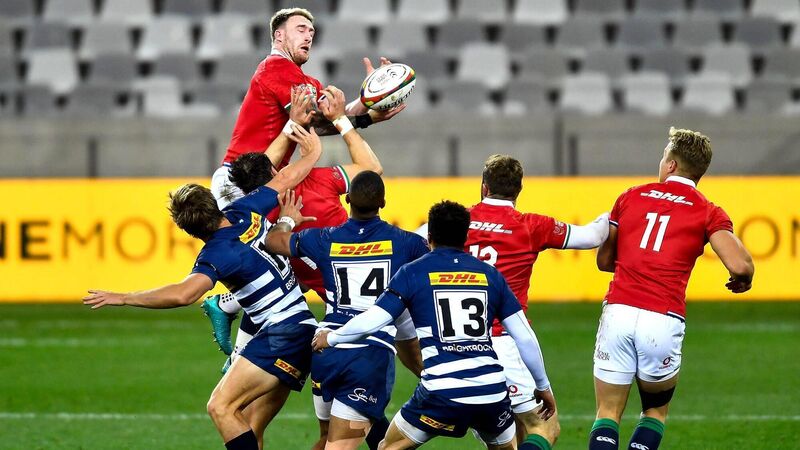
Stuart Hogg of British and Irish Lions catches a high kick during the British and Irish Lions Tour match between DHL Stormers and The British & Irish Lions at Cape Town Stadium in Cape Town, South Africa. Photo by Ashley Vlotman/Sportsfile
One of Warren Gatland’s safest predictions for the Lions’ forthcoming series against South Africa is to expect the world champions to put boot to ball at every opportunity. For if there is one certainty in Test rugby it is that there is a big difference between box-kicking and Boks-kicking.
The statistics from South Africa’s successful 2019 World Cup campaign back up the perception with the Springboks not only outkicking all but one of their opponents in their seven-game march to the Webb Ellis Cup but being more successful at regaining possession.
New Zealand were the only side to kick more than the Springboks in a game against Rassie Erasmus’s side in Japan, when the All Blacks won their opening pool game, although the victor’s success rate for regathered balls was only marginally better, 64 per cent from 30 kicks compared to the South Africans’ 63 per cent from 24 kicks.
From then on, the half-back tandem of Faf de Klerk and fly-half Handré Pollard outkicked their opposite numbers every time, launching 30 or more kicks in three of six of their remaining games and peaking at 37 kicks against Wales, then coached by Gatland, in the semi-final.
In the final against England, the Boks went to the air 24 times and regathered a remarkable 22 times, a 92 per cent success rate. With those performances fresh in the memory, the Lions head coach is not expecting a change in approach from a side now coached by Jacques Nienaber.
“Definitely they’ll kick a lot,” Gatland said on Wednesday. “In a normal Test match there’s possibly 20-odd kicks for each side, with South Africa we expect up to 40 kicks in a game. That aerial battle is going to be key.
"At times we need to make sure if those kicks are from them or from us on the money we get the ball back and make the most of the opportunities but we also have to be in a situation where you don't force things and lose patience.
"Maybe put them under pressure and put the ball back and wait for the chance. It's about being smart in how we approach and being aware when we get the opportunities to counter-attack. Those are the sorts of things we have been working on this week.”
Starting full-back Stuart Hogg knows exactly what is being asked of him in his mission to deal with the expected aerial onslaught.
“It’s been part of the South African gameplan for a long time, it works for them. They are world champions for a reason. They have a very planned game in terms of, if there is anything in their half, they’re going to get the hell out of there and try to squeeze you as much as they can.
“They’ve got a pair of half-backs who are up there with the best combination in world rugby. It poses another challenge in that one of them is left-footed and one is right-footed. That’s two weapons they’ve got in their armoury straight away.
“So, as a back three, the boys have been working hard on different triggers we’re going to come up against and we’ll have to be on the money for a complete 80-minute performance because if we get that, we’ll give ourselves every opportunity of winning.”
Preparing for that challenge in training does not stray from Hogg’s pre-match routine for every game he plays, the Scotland captain said, although he added there was more to it than simply catching a ball in the air.
“It’s a part of a full-back’s game. You have to defuse a kicking game in pretty much every game you play. It’s something you work hard on. We’ve done a lot of high ball catching in training. We’ve worked hard to ensure we’re the ones who come up with the ball. It is a strength in the South Africans’ game, but it is not just on the back three, everybody has a role to play.
“One of the main parts of defusing a kicking game is making sure we get the first breakdown sorted. That is a breakdown they come after quite a bit. One to 15 has a role in the kick cycle; we need everyone to be switched on and focused the whole time the ball is in the air.”
So too, is there more to stopping Sale’s de Klerk and Montpellier’s Pollard, as Lions defence coach Steve Tandy and fly-half Dan Biggar explained.
"There's that unique nature,” Tandy said of de Klerk, “that off-the-cuff stuff and you look at Faf and his kicking game, he can run, he puts loopy passes in or can pick a kick from anywhere.
"You have to trust your own system and you know you can't cater for everything in specific detail, but you've got to have belief in your set-up that you will work it out.
"We've got world-class players who read those pictures, plus we've got players who have played with and against him in England.
"He's a super-talented player but within our system, we believe that we'll be able to cater for all of that."
Biggar believes the Springboks are different gravy with Pollard at 10.
“With him in the side, they offer a real running threat from 10,” the Welshman said. “Solid defensively and a brilliant kicking game. All in all an extremely good player. There’s no doubt South Africa will be a better team with him in the 10 shirt than without."
CONNECT WITH US TODAY



Be the first to know the latest news and updates