French neurosurgeon alarmed by suggestions Johnny Sexton 'on track' to start for Ireland
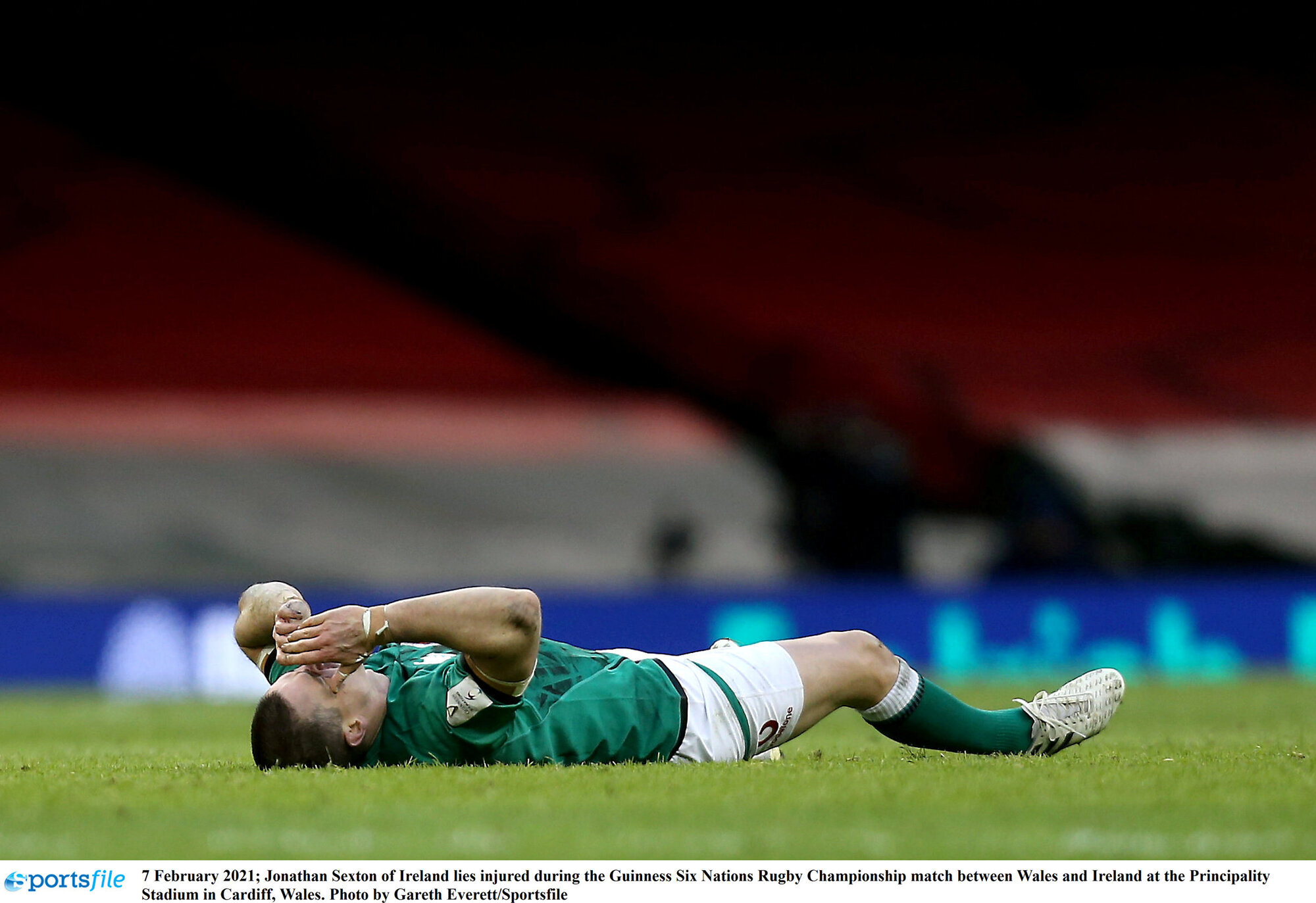
Johnny Sexton was injured by a knee to the head against Wales. Photo by Gareth Everett/Sportsfile
The prospect of Johnny Sexton starting for Ireland against France on Sunday, seven days after what he described as an 'obvious' concussion, has alarmed a respected French neurosurgeon.
Ireland captain Sexton and second row James Ryan are going through return to play protocols following head blows sustained in the defeat to Wales and are 'on track' to play again this weekend, according to defence coach Simon Easterby.
But Jean Chazal, who worked with the FFR and LNR in France until 2018, said in an interview with Midi Olympique that Sexton's collapse, after taking a knee to the head in the second half of the match, was similar to that of "a boxer who has received a violent uppercut".
His concerns follow those voiced by a colleague in the field, Jean-François Chermann, who stood Sexton down for 12 weeks in 2014 after he had suffered repeated concussions while playing for Racing 92.
Chermann had told RMC Radio, "if there are symptoms, if his tests are disturbed, the doctor must prevent him from playing on Sunday".
Yes, I saw them live as I saw the entire game. Overall, it was an extremely manly encounter, with several injuries and concussions. It hit hard, as they say.
For Sexton's clash, it is quite clear: it is an involuntary but violent knee strike in the parietal region, with a classic acceleration-deceleration effect in phenomena generating concussions. This was amplified by the fact that there is no sheathing of the cervical region.
Sexton collapsed as a boxer who has received a violent uppercut.
He remained on the ground, then sat up, and his gaze was vague. It lasted a long time, maybe a minute. His movements are jerky, with his arms quite stiff. He then left the pitch surrounded by several people, with a slight ataxia. Clearly, he was not very stable. So there is every reason to believe he actually suffered a concussion. In any case, he had all the signs.
Being 100% assertive in medicine is difficult. But all the arguments, all the signs, are there to think so.
I made the comparison with boxing: when a boxer takes a blow, falls and then gets up, he immediately jumps to show that he does not have this ataxia, that he is stable and in a normal state.
It seemed to me that Sexton was not skipping. He left the field with difficulty, with his legs spread wide, which is another sign of ataxia. So, something happened neurologically - it's undeniable.
It's a common reaction among players. He is a professional, a competitor, and the importance of the moment is immense with the desire to win the tournament. So he had better say that he is doing well.
As long as there is no objective outward sign, such as vomiting or a major disturbance in balance, he can be confident that he is fine.
That doesn't mean he doesn't have headaches, or mild dizziness. These signs, he can keep them to himself. He can feel them but they are not visible so he can hide them.
I've seen a lot of players do this. This is all the more possible since Sexton is used to concussions. The first very significant images concerning him, on the subject, go back seven years ago. He learned to handle it all.
Surprised, is the wrong word. It worries me. He has suffered several concussions in his career.
Sunday's seems pretty obvious to me. He comes out ataxic, I repeat, and we are told that seven days later he will play again? But did he pass all the HIA tests? Did he have an MRI, the only test that can show micro-lesions in the brain?
I understand the high stakes of the tournament and of this match. But that is not enough to justify taking this type of risk.
The danger is serious. Symptomatic concussions, added to each other, create micro-lesions on the brain. It is a very favorable ground for the development of Charcot's (also known as Lou Gehrig's disease) and Parkinson's disease or Alzheimer's.
This is not speculation: it is now well known to specialists in the field, since the studies at Boston University on the subject, in 2013. Is Sexton well informed of all the risks?
He's a professional, paid to do this. He actually accepts to take this risk, just like his employer. But on a human level, it's quite staggering to see this.
If Sexton plays on Sunday, it's sad for him. This is what really inspires me: sadness. And then, is he fully informed? Does he make these choices with full awareness of the consequences? Does he assume these risks in all objectivity?
Yes, it would. World Rugby should have a committee of experts in neuro-trauma. Independent doctors who control all these risks, control them perfectly, follow all the protocols, MRIs, blood tests and all markers of concussions.
Ultimately, they would have the power to prohibit a player from playing a match. Today, this is not the case.
- Ireland head coach Andy Farrell is set to unveil the Ireland matchday 23 on Thursday.
CONNECT WITH US TODAY



Be the first to know the latest news and updates