Hansen redefines all we knew about experience
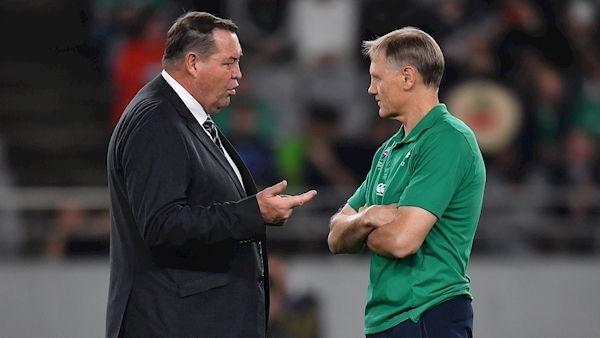
As ever, it fell to Steve Hansen to neatly encapsulate the situation. The All Blacks head coach is the master of all he surveys and that includes the press conference room, whether in victory or defeat.
The latter, to Ireland last November, seemed like a lifetime away on Saturday night at Tokyo Stadium as New Zealand once again lived up to their top billing as this World Cup’s defending champions and number-one-ranked side. The opposition, in stark contrast, served themselves up as cannon fodder for the marauding back-to-back winners.
Much had been made of the relative inexperience of the All Blacks backline, revamped and remodelled since that tryless 16-9 defeat in Dublin 11 months ago. Book-ended by the wealth of experience at scrum-half in Aaron Smith and at full-back by Beauden Barrett, there was a fly-half, outside centre and two wings with just 37 caps between them.
In Richie Mo’unga, Jack Goodhue, Sevu Reece and George Bridge, there was an exuberance and cutting edge that may have proved too much for an Ireland team at the peak of its powers. Sadly, with this tournament coming 11 months too late for that, the Crusaders quartet’s X-factor and confidence to go out and play the game as they saw fit, allied to an alarmingly sloppy performance from Joe Schmidt’s players, contributed to a seven-try mauling that represents an emphatically depressing final act for the Ireland head coach’s otherwise glittering tenure.
And to make matters even more uncomfortable for Schmidt there was an exposition from his opposite number Hansen on the questionable value of experience that was as devastatingly clinical from an Irish standpoint as the All Blacks performance witnessed an hour earlier.
As Ireland’s big guns and old warhorses racked up the errors with sloppy kicking and dropped ball after dropped ball, New Zealand’s young thoroughbreds took full advantage of the numerous invitations to take the game back into the Irish 22, and beyond.
It was game over after Smith’s two tries in the first 19 minutes, built on the back of excellent work by his half-back partner Mo’unga and the incisive breaks of Bridge and Reece, had helped the All Blacks climb into a 17-0 lead that put the game beyond Ireland before they had thrown a punch.
“Experience is a funny thing,” Hansen reflected later after Beauden Barrett’s try had handed the champions a 22-0 half-time lead, followed by a four-try second-half barrage that doubled down on the All Blacks’ dominance. “What is it they’ve experienced? That’s the test.
“A lot of our young guys have been involved in championship-winning teams in Super Rugby, big moments, and that’s why you select them. They have played well in Test matches too.
Their enthusiasm, excitement, and ability to play the game in a formula is really important, but so is the leadership and experience of the guys who have been through the tough moments.
“It was interesting, everyone was talking about how many (experienced players) Ireland had — but half of our 23 had played in [World Cup] a knock-out match and won it. And that was the difference wasn’t it?
“I don’t mean any disrespect in saying this but Ireland’s experience was not to win. We had 11 guys with experience of actually winning. That’s why you’ve got to be careful when you talk about experience.
“Just because you’ve played for a long time, you might have learned things you don’t want to learn or you might have learned nothing along the way.”
Ouch. It should be said that Hansen, for whom this also his final World Cup campaign before stepping down as head coach, had paid a warm tribute to both Rory Best, who will now retire from professional rugby after a 124-cap Ireland career at the age of 37, and Schmidt, whose Ireland career he helped bring to a shuddering halt.
The Ireland management had not blindly walked into this tournament without considering that form versus experience conundrum. Forwards coach Simon Easterby had spoken about it only last Tuesday when he said:
“A World Cup is a lot about form. Very quickly it starts and very quickly it can be over. We have to look at it and balance selection experience but also form at the time. It’s a short window to get things right and if you don’t get it quite right you can be on the way home.”

Well, Ireland went with experience, a word that can never be taken at face value again thanks to Hansen, and they are now preparing to fly back to Dublin.
Those of us who believed there was still a great performance in this side to match the heights of 2018 were given a rude awakening on Saturday as Ireland did not lack for work-rate, endeavour or even possession, which was an even split through both halves.
But crucially they lacked the accuracy and ability to execute the possession effectively, save for a period late on when the game was over and all that was left was to avoid a blank scorecard.
It had been the same in Cardiff last March when Wales trampled Ireland underfoot on the way to the Grand Slam and it needed a last-minute try from Jordan Larmour to save a complete wipeout and it was too little, too late this time around as Robbie Henshaw and then a penalty try limited the damage of what was still a record World Cup defeat, eclipsing the 43-19 loss to final-bound New Zealand in Johannesburg 24 years ago.
That Welsh defeat, hot on the heels of a chastening loss to England in the opening round of this year’s Six Nations was an ominous sign of the disappointments to come — a summer trouncing at Twickenham, pool defeat to Japan and now this. Schmidt admitted: “Right after the November series when we played the All Blacks last year, we decided to make sure that this was our target.
“Maybe it consumed us a little bit and we got distracted from our game to game focus.”
He said: “One of the things we tried to do was experiment a little bit in the Six Nations, give some responsibility to a few younger players, try to build the group. We tried to use the Six Nations as a platform for that because we had won three of the last five of them, this is really what we wanted.
And so that’s why it’s so devastating, that what we really wanted, we didn’t produce the performance that we needed on the night and while there might be reasons for that with the short week that we had and the niggles that we had so that we weren’t quite as re-generated as we would have liked to have been.
Schmidt was at a loss to explain the number of mistakes that led to his side’s inability to stay on the front foot.
“That error count does make it incredibly tough. I don’t really have a reason for that, other than on the night there was always anxiety, there’s always guys who might over-reach and as a result, you don’t get the performances that you’re looking for.”
IRELAND: R Kearney (J Larmour, 52); K Earls, G Ringrose (J Larmour, 6-9), R Henshaw (J Larmour, 21-26), J Stockdale; J Sexton (J Carbery, 63), C Murray (L McGrath, 74); C Healy (D Kilcoyne, 49), R Best - captain (N Scannell, 63), T Furlong (A Porter, 60); I Henderson (T Beirne, 49), James Ryan; P O’Mahony (R Ruddock, 57), J van der Flier, CJ Stander.
NEW ZEALAND: B Barrett; S Reece (J Barrett, 63), J Goodhue (S B Williams, 52), A Lienert-Brown, G Bridge; R Mo’unga, A Smith (TJ Perenara, 60); J Moody (O Tuungafasi, 49), C Taylor (D Coles, 60), N Laulala (A Ta’avao, 49); B Retallick (M Todd, 57), S Whitelock; A Savea, S Cane (S Barrett, h-t), K Read - captain.
Yellow Card: M Todd 76.
Referee: Nigel Owens (Wales).
CONNECT WITH US TODAY



Be the first to know the latest news and updates