Eye on Japan: How small stones became one big rock
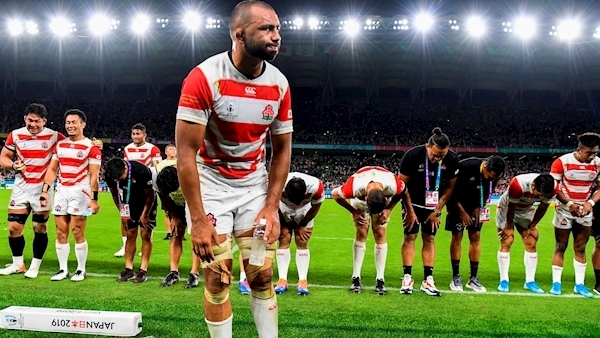
‘The Shock of Shizuoka’, as it became known around the world, was alluded to by a number of Japanese media outlets in the build up to last Saturday.
This is the kind of victory Japan rugby had been dreaming of, echoing the famed South Africa game of 2015. The result is not only the talk of the commuters, it has spread like a swarm to outposts well beyond the major cities.
On the surface, the World Cup had seemed a success prior to this point anyhow, with an estimate of over 150,000 fans having purchased tickets through Official Travel Agents – surpassing the total sold for England last time out.
Talking about the average Japanese person’s awareness of the tournament, however, proves that the RWC as a brand is still nowhere as potent as the forthcoming 2020 Olympics. The city of Tokyo is so huge (pop: 37m) that life had been seen to go on as normal without much of an impact, despite the number of tourists now present here for almost two months.
The Japanese team had initially been quite hyped about and talked up as the first Asian hosts of a Rugby World Cup, even if a laboured victory over Russia in the opener slowed that excitement.
New Zealand-born Japanese captain Michael Leitch was a surprise starting omission for the Ireland game, but went on to have a massive influence in the match, franking one of many excellent calls by coach Jamie Joseph.
The squad and also the press, for their part, had been questioning if Johnny Sexton would be 100% fit for the match-up and his absence was seen as a psychological boost for Japan, even in the build-up.
The team clearly had a game plan for the weekend and in hindsight, may even have been underestimated by the Irish side. There had been a lot of focus on quarter-finals after the Scotland result.
As Asako Yamazaki of the Japan Rugby Federation noted: ‘This game was crucial for us as hosts, and everything went to plan so dramatically in the end that we have seen a massive spike in interaction over the weekend.’
The Cherry Blossoms themselves were feeling the pressure beforehand. It is worth remembering how much is seen to be at stake for Japan, with their back-to-back hosting of major sporting events, Yamazaki points at the ‘potential for burnout’ in Japanese sport, and ‘a notable decline’ in the rugby player population in general. In fact, of the 31- man squad, a record 16 players are ‘foreign born’.
This is a particularly interesting statistic as Japan as a country is one of the least ethnically diverse, with an estimated 97.5% of the population being recognised as fully Japanese. This is a figure that is about to radically change in other aspects of the country’s outlook, but the rugby team as a whole has certainly been the first to bear fruit from New Zealanders, South Africans and Koreans being eligible to participate for the squad.
New Zealand-born head coach Jamie Joseph, who played for Japan in the 1999 World Cup, has said they help make up for the physicality the Japanese players lack. But the diversified team has not always been welcomed in the country, especially when Japan failed to deliver results. When the Brave Blossoms finished winless with a draw and three defeats at the 2011 World Cup, the team’s dependence on foreign-born players was questioned in some circles.
Ahead of the 2015 World Cup, Leitch said he had second thoughts about captaining because he was foreign-born, while New Zealand’s Luke Thompson also said he was hurt by the criticism of there being too many foreign-born players on the squad.
But when Japan, amid low expectations, achieved a historic three-win run at the World Cup in England in 2015, the contributions of the foreign-born players drew renewed attention.
Star full-back Ayumu Goromaru wrote on Twitter shortly after Japan’s famous win over South Africa, “Let the spotlight shine on foreign-born players on the Japan team especially now when it is gaining attention. They are the best teammates who have made a choice to compete for Japan rather than their home country,” he wrote.
Leitch, born in New Zealand from a Fijian mother, has become a symbol of diversity for the Japan team since coming to Hokkaido at age 15 and later joining Top League side Toshiba Brave Lupus.
He has said he made a choice to play for Japan as a “way to repay for the kindness” in making him one of Japanese rugby’s competitive players.
“The three years at Sapporo have laid the foundation, and I could go to the World Cup because of hard work at Tokai (University),” said Leitch, who only weighed 75kg when he first came to Japan, surprising the coaches at his high school.
The Japan team seeks unity by using the word “glocal,” a mix of global and local. Foreign-born players are asked to introduce their mother countries to teammates while being taught to sing the Japanese national anthem by domestic-born players.
Regarding “Kimigayo,” the national anthem, Pretoria-born flanker Labuschagne, who became eligible to play for Japan in June, said, “It’s about how small stones become one big rock and in a sense that is what we are doing on the field, 23 different men all working together for the same goal.”
With a victory Saturday against the Samoans, progress to the last eight will seem tantalisingly close but everyone is looking at the Scotland game Sunday week as an absolute decider of qualification.
By and large, the reception has been positive from travelling fans and for most of the interactions with Japanese people thus far.
As always, there have been reports of isolated incidents and the occasional breakdown in communication between the non-English speaking stewards and fans inside the stadiums, but little in the way of real concern or trouble.
The anticipated (feared?) consumption of alcohol is less of an issue to the locals than the boisterous, loud nature of the rugby fans on trains and other forms of public transport. In Tokyo and the rest of Japan, silence is a real virtue that can be regularly witnessed on the daily work commute and a lot of life in the country in general.
Even in the aftermath of Shizuoka, supporters were incredibly good natured; Japanese sports fans and players alike are known for their humility, and to their credit the Irish fans responded in kind.
Yamazaki notes that “there seemed to be a lot of singing, dancing and jersey swapping from both Japan and Ireland fans. Which is great to see for both our country and the sport! Maybe Ireland and Japan will advance to the quarter-finals together.”
One thing is for certain, Pool A has been anything but predictable thus far.
(additional reporting by agencies)


CONNECT WITH US TODAY



Be the first to know the latest news and updates