Relaxed Eddie and the Jones gang hit Kobe
In the kaleidoscopic mind of Eddie Jones, the USA’s rugby players have spent a few baking days in the old battle grounds of Okinawa taking Full Metal Jacket orders from the American marines in order to prepare them for meeting England. Jones doesn’t know this for sure. But he likes to imagine it.

Relaxed Eddie and the Jones gang hit Kobe

In the kaleidoscopic mind of Eddie Jones, the USA’s rugby players have spent a few baking days in the old battle grounds of Okinawa taking Full Metal Jacket orders from the American marines in order to prepare them for meeting England. Jones doesn’t know this for sure. But he likes to imagine it.

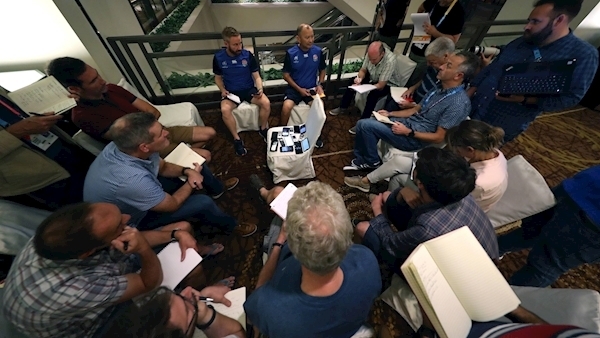
“Well I’m guessing they might be mate,” he laughs on a busy Tuesday evening on the Kobe waterfront, where the England rugby team are relaxing. Eddie had given the players some free time to recover from their 35-3 exertion against Tonga on Sunday.

“Had some Kobe beef for lunch. The afternoon off. A sharp run tomorrow.”

But Jones prefers to think of the USA players getting pumped for what is their prestige assignment against England here on Thursday, figuring that they couldn’t resist the temptation of military inspiration.

“Cos Okinawa is about 80% marines,” he says.

“So I’m sure they’ve got ‘em down there. And the area they are at I know well because I’ve visited and there is a big marine base ...Okinawa used to be part of America, it’s a great story there.

In 1971... they used to drive on the right hand side of the road because Americans drive on the right side. And all the economy there was in American dollars. And then, overnight it went to left side drive and Japanese yen. Most fascinating place in the world: this mixture between America and Japan.

It’s easy to gauge that Jones adores this World Cup. Here he is, back in his mother’s homeland, perfectly comfortable with slipping into Japanese to the delight of the Kobe’s locals and fronting an England effort that looks primed to make a charge when this tournament become serious.

Over the course of a coaching career that has brought him to the World Cup finals as head coach of Australia in 2003, where he lost to Jonny Wilkinson, and in 2007, where he won as South Africa’s technical advisor, Jones has developed a reputation for being spiky, confrontational and sardonic.

He’s already had to apologise for referring to the “scummy Irish” and to Wales as a “little shit place” during a public speaking event from which content was leaked.

Politically incorrect and all that, but kind of funny to imagine the outrage. He has retained a magnificent indifference to what anyone thinks and is one of the few remaining professional sports coaches unafraid to speak his mind.

It makes him good company, even in a crowded setting of the third floor Sheraton where the staff assembles for a function in a vast dining room.

Jones knows Kobe well from his years coaching at club level and then transforming the culture of Japan’s national team into a group ready to ditch all excuses for losing.

“It has had the most iconic rugby team,” he says of the city. “The Kobelco Steelers had a great number 10, Hirao... unfortunately, he died.”

He’s talking about Seiji Hirao, the Kyoto-raised number nine who starred on the club team here before spending a few years in England with Richmond and leading Japan through World Cups as both player and coach. Hirao died in 2016 at the age of 53 after an illness.

“He was a beautiful player”, Jones said.

“I think he went to Oxford University. But the Steelers set the standard. You come to Kobe and rugby has been the predominant sport. It is not the case in most cities in Japan.

“It stands out — I’m sure you’ve frequented a few of the rugby bars in the town, which is unusual. Most people here are rugby fans rather than baseball fans.

“After the earthquake, Kobe has rebuilt itself and baseball has been a part of that. They won the championship last year for the first time in a while. So it’s important.”

Jones has brought teams here before, revealing with a smile that he watched Japan lose by 60-odd points to the Maori All Blacks in the autumn of 2014.

It’s significant because in just 12 months he would lead the same group to Japan’s transformative rugby moment in their shocking win over South Africa at the 2015 World Cup.

“But there’s a story to that,” he says, inviting someone to ask him what that might be.

“Well, we didn’t deliberately go out to get beaten but we deliberately played a game away from our strengths to send a message to the team about how we had to play. The next game we got beaten by one point. To reinforce the strength.”

“Did you ever to that with England?” someone asks.

“Yeah,” says Jones, shaking his head when asked how that experiment went. “Not well. Doesn’t usually go well when you play away from your strengths. But it can be a great education.”

Jones doesn’t even pretend he’s worried about England losing to the USA, despite making 10 changes for the game.

And he shakes his head at the idea that the newbies have something to prove.

“Nah, that’s the danger for us,” he clarifies.

I have seen this when South Africa played Tonga and guys think it might be their only game of the World Cup. So they go out and play for themselves rather than the team.

“And in 2007 South Africa were lucky to beat Tonga when a number of guys played outside the team. If they play for the team they have a better chance of putting themselves in the selection mix. It’s a marathon. The World Cup is not a sprint.”

The great survivor of Rugby Union is back in Japan for the long haul.

*(c) The Irish Times.

Rugby World Cup Podcast: Alright on the night for Joe but can we

outbok the Boks?

More in this section

Sport

Newsletter

Sign up to our daily sports bulletin, delivered straight to your inbox at 5pm. Subscribers also receive an exclusive email from our sports desk editors every Friday evening looking forward to the weekend's sporting action.

Cookie Policy Privacy Policy Brand Safety FAQ Help Contact Us Terms and Conditions

© Examiner Echo Group Limited