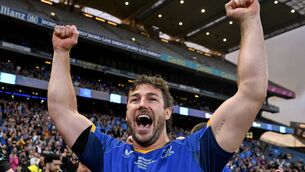
O'Driscoll to hand off to Henshaw
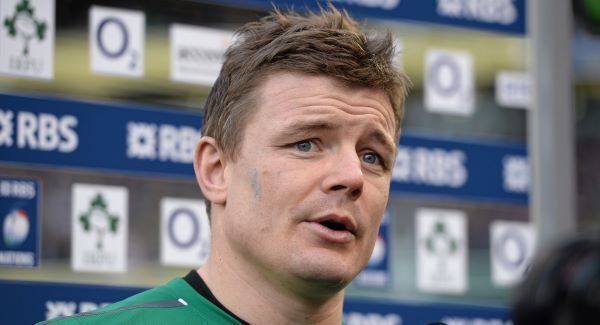
Brian O’Driscoll has anointed Connacht’s Robbie Henshaw as his heir apparent for Ireland’s outside centre role.
Iconic centre O’Driscoll will retire in the summer after 15 years in the international arena and 141 Test appearances.
The 35-year-old is acutely aware of the chasm to be left by his departure, especially when coupled with Gordon D’Arcy’s likely exit after Rugby World Cup 2015.
Leinster and Ireland midfield stalwarts O’Driscoll and D’Arcy will extend their world-record centre partnership international appearance tally to 56 in Saturday’s RBS 6 Nations clash against France in Paris.
The centre partners have been so good for so long that Ireland have hardly had to look elsewhere for an entire generation.
All that is about to change, with head coach Joe Schmidt facing the taxing prospect of replacing true great O’Driscoll this summer.
Former Ireland captain O’Driscoll had no qualms proposing three-cap Henshaw as his successor, while at the same time tipping Darren Cave and Ulster’s Jared Payne for supporting roles.
New Zealand-born Payne qualifies in November, and O’Driscoll sees no reason for the IRFU not to fast-track the 28-year-old into the squad in time for the next world cup.
“Robbie is a very, very talented young lad, who is a great listener, a really good young talent, and really good lad too,” said O’Driscoll, of the Athlone-born 20-year-old. “I think he has all the attributes to be a seasoned campaigner for Ireland for many, many years.
“And then you have the beauty of guys who have played there before in Luke Fitzgerald, someone like Jared Payne who qualifies in November.
“As 13s absolutely Robbie and Darren Cave are well-placed; we’ve an abundance of talent coming through.
“I think it’s testament to Darren, who has not been in the frame for a while, but keeping an eye on his form for Ulster he’s been playing extremely well.”
Leinster’s Luke Fitzgerald is a firm Schmidt favourite and a sure-fire bet for some time in the 13 shirt, potentially on the summer Argentina tour.
Fergus McFadden replaced O’Driscoll at 13 in the stalwart’s 52nd and final Lansdowne Road appearance, the 46-7 [burl=624579]thumping of Italy/burl], but should be more often deployed on the wing.Munster’s Keith Earls has long since harboured ambitions for the 13 shirt with both province and country.The injury-ravaged 26-year-old would have plenty more than his 39 caps had he not suffered one stint on the sidelines after another.
Read More:
As Brian O’Driscoll prepares to depart the international stage, welooks back at his five best moments.
O’Driscoll became the eighth Irishman to score an international hat-trick, dragging the team to their first win in France since 1972.
Hooker Keith Wood was Ireland captain that day, and firmly believes that treble from the 20-year-old changed the face of Irish rugby forever.
“I had felt all the hidings we’d had from France, and I remember that day, watching from about 30 yards away on my knees as he held the ball up in one hand,” said Wood of O’Driscoll completing his hat-trick.
“And I remember thinking ’anything is possible now’, thanks to this young kid who had come on and suddenly had a bit of magic about him.
“That was the change for me, it was the change for me as captain, but it was a change for the team too, because suddenly there was a belief that actually if things weren’t going so well you could still have somebody who could score three tries.”
O’Driscoll himself admitted he had no idea what he had done, until returning to Dublin thrust perspective his way.
“I didn’t realise the enormity of it until we got back home, it was nice to live all the craziness of it with my friends and family,” he said.
“I don’t think it was me who changed things, it was a generation of players, with the likes of Ronan O’Gara and John Hayes, who were not used to losing and refused to accept it.”
“Waltzing O’Driscoll” was born as the Leinster centre danced round Wallabies full-back Matt Burke to score one of the greatest Lions tries of all time.
O’Driscoll scythed home from halfway for a try that elevated the Ireland centre from European to world renown.
England fly-half Jonny Wilkinson later revealed his admiration for O’Driscoll’s nerveless confidence on that Australia tour.
The Wallabies edged the series 2-1 in the event, but Wilkinson admitted O’Driscoll’s supreme faith in his own abilities left a lasting impression.
“Give me the ball and I’ll score”, World Cup-winner Wilkinson recalls O’Driscoll telling the Lions backline in the midst of match action: a pledge on which he delivered.
Not even a rare drop-goal from the outside centre and skipper could drag Ireland to victory over the tournament hosts.
O’Driscoll produced an inch-perfect finish into the left corner for a fine try to bamboozle the Wallaby defence.
The drop-goal summed up his refusal to admit defeat, desperate for Ireland to win any which way.
George Smith’s try, three penalties from Elton Flatley and a George Gregan drop-goal edged Australia home.
Despite the defeat this was another Herculean O’Driscoll performance, further illustrating his world box-office status.
Captain marvel O’Driscoll steered Ireland to their first Grand Slam since 1948 with a superlative, try-scoring performance.
Stephen Jones’ four penalties kept Wales firmly in the hunt, but O’Driscoll and Tommy Bowe produced vital second-half scores.
Wales pilfered a 15-14 lead in the dying stages through fly-half Jones’ drop-goal, only for Ronan O’Gara to drop a goal of his own to clinch the dramatic overtime victory.
O’Gara’s big-match temperament had been called into question in the build-up to the clash, but the Munster fly-half’s late strike secured the clean sweep, sending Ireland into raptures.
O’Driscoll can eschew the acclaim all he likes, but without his talismanic, stubborn and driven leadership Ireland could still be waiting to break that Grand Slam duck.
O’Driscoll’s 25th Ireland try broke Scotland wing Ian Smith’s tournament scoring record that had stood since 1933.
Just a short-range dart across the line, but O’Driscoll still had the presence of mind to fling himself lower than England’s whitewash defenders.
The arch-poacher scooped up a loose ball 15 metres from the line, whipping home before Nick Easter and the like could set themselves to offer sufficient resistance.
Few begrudged a 78-year tournament record tumbling at the hands of a genuine world power.