OBITUARY: Bertie O’Hanlon, last surviving member of Ireland’s 1948 Grand Slam winning team
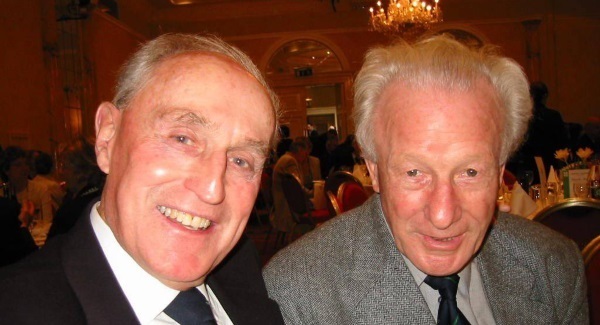
BERTIE O’Hanlon, who died recently at the age of 92, was one of the country’s finest wing three-quarters during some of the most successful years in Irish rugby.
The last surviving member of the legendary, 1948 Grand Slam-winning team, he also played in everyone of Ireland’s matches the following season, when the Triple Crown was retained.
He represented Ireland on 12 occasions, scoring two tries on his debut, against England in 1947, and he was a regular on Munster teams from 1945 into the 1950s.
He won three Munster Senior Cup medals, the first in 1944, with Cork Constitution, while still a schoolboy at Rockwell, and two with Dolphin, in 1945 and ’48.
An unassuming gentleman, he was popular in his sporting life and in his business career as a senior executive with Standard Life Insurance.
Born in Ballyclough, Mallow, the son of a dispensary doctor, the family moved to Cork in time for O’Hanlon to begin his rugby career at Presentation Brothers College,before he moved to Rockwell College at the age of 12. He helped Rockwell to beat Pres in the Munster Schools Senior Cup final, in 1942.
Originally a scrum-half, his pace and footwork inevitably meant a switch to the three-quarter line. For school and club, he played much of his rugby in the centre, although, at the highest level, selectors preferred to use his pace on the wing, which is where he achieved greatness in the green jersey.
That potential had been evident from his earliest days. During his time at Rockwell, he helped Clonmel to reach the final of the Munster Junior Cup, in 1943, before Cork Con enlisted him in their Senior Cup bid the following year.
“They sent a taxi up to Rockwell for me, so that I could get down to the Mardyke to play for them in the semi-final of the Cup, against UCC,” he recalled. “We won 12-11, with four penalties by Liam O’Brien. I was only a sub in the final, but Con beat the army and I got a medal.
“On leaving Rockwell, I joined Dolphin, where all my friends were members — 1945 was probably the greatest year in the club’s history. My old school friend, Gerald Aherne, Dick Dennehy, Dave O’Loughlin, Johnny Williams and, of course, Jim McCarthy were among my teammates. Jim Mac, Gerald and Dick were also in the victorious ’48 side captained by Pierce O’Leary. A try by Alfie Nicholson made all the difference in the final win, over Tom Clifford’s Young Munster.”
By then, Bertie was a household name in Irish rugby, as a member of a Grand Slam and two Triple Crown-winning teams. Of the 1948 heroics against Wales, in Belfast, he rejoiced: “That remains the highlight of my rugby memories. We hadn’t done it in 49 years and the tension was fierce. But we had great men in that team and fully deserved to win.”
His great friend, Jim McCarthy, scored the decisive try in the ’49 Triple Crown finale, in Swansea, though Bertie admits the buzz wasn’t quite the same.
“Of course, it meant an awful lot to us, especially beating Wales on their home territory, but, somehow, we didn’t get the same kick out of it as we had 12 months before. The first one is always the best and the one you never forget.”
Injury ended his career at the age of 28, while a busy business career also reduced his involvement in subsequent years. However, Bertie watched closely, as rugby changed considerably from the way it was played in his heyday, in the 1940s, when players were a good deal lighter, physically, and when the emphasis was on speed and guile as the best means of breaching a defence.
Even as far back as the 1980s, when professionalism was still considered an impossibility and a taboo subject, he noted how rugby was being transformed.
“I think we enjoyed our rugby more,” he said. “In my time, we would assemble at lunchtime on the eve of an international, have a run around College Park, have a team meeting that night, a light chat from the captain before the kick-off, and we were back home again the following morning.”
Not that O’Hanlon didn’t admire and respect the modern-day professionals. He was proud to be in the Millennium Stadium, in Cardiff, in 2009, when an Irish team coached by another Dolphin man, Declan Kidney, beat Wales to bridge the 61-year gap since the last Grand Slam.
You only had to mention the names of Dolphin club mates, like Jim McCarthy, Gerald Aherne, Dave O’Loughlin, Dick Dennehy, and many others, to have O’Hanlon reminisce on happy times. He was equally vocal when recalling the brilliance of Irish colleagues of his time — men like Dessie McKee (“big, strong and fast in the centre”) and Karl Mullen (“a great captain”).
There were others, too, who commanded his total respect. Jack Kyle: “Incomparable. There was nobody to equal him. He was a sheer genius, who never relied on the kick to get him out of trouble. He had everything — all-round ability in defence and attack, and a little bit of extra pace when he needed it. The All Blacks still say he was the best of any out-half from these islands to visit New Zealand.”
Tommy Moroney and Paddy Reid: “As schoolboys, they were so good that the rest of us looked up to them. Moroney was in the Jack Kyle class, and would have played for Ireland had he not chosen soccer and West Ham. Reid was a superb player, too. What a pair of hands he had. It was a pleasure to play on the same Munster teams and I always had the highest regard for him.”
Chris Daly and Tom Clifford: “Daly, from Cobh, was the iron man of the 1948 team. No man could bend him. Clifford was an excellent replacement for Daly, when he went Rugby League. He was a great character. There was only one Tom Clifford.”
Haydn Tanner (the legendary Welsh scrum-half): “They called him ‘The Fox’. His reverse-pass was incredible. He would dive one way and pass the ball the other way.”
Generous in his appraisal of others, Bertie O’Hanlon was an extraordinarily talented rugby player himself.
And the last of an incredible squad of Irish players who fully merited the status of legends of the game.
CONNECT WITH US TODAY



Be the first to know the latest news and updates