CJ Stander feeling positive but pressure still on for Munster
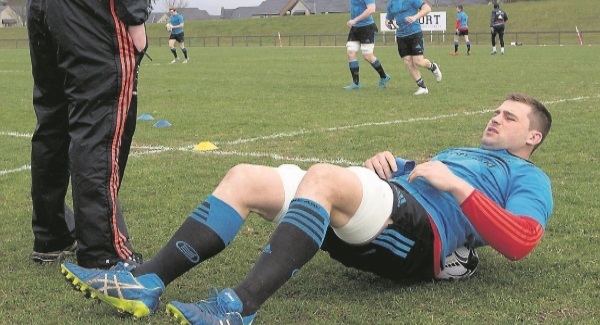
Stander leads his adopted province into the breach for the last time in what has been a difficult season as Munster attempt to secure Champions Cup rugby for 2016-17 with a victory over Scarlets at Thomond Park on Saturday.
While his team have struggled in both Europe and the league during a turbulent campaign, Stander has remained a pillar of strength, growing into his temporary captaincy role in the long-term absence of the injured Peter O’Mahony and maintaining the performance levels that earned him a Test call-up for the Six Nations having qualified for Ireland on residency last November, some three years after his arrival from South Africa.
Stander is so at home in Limerick, he was even drafted into the front office to boost season ticket renewals although his agricultural upbringing back in George in the Western Cape made him less a salesman and more a chatline host.
“For some reason, I called all the farmers,” Stander said. “One time I was talking half an hour to one from Kerry who was telling me about the sheep and stuff. I think I made two phone calls and they said I can leave now.”
Stander insists he made the sale and was keen to point out he had more success than a fellow back-row. “That Kerry farmer did buy the season ticket. He was delighted. Then, Jack O’Donoghue rang people and he almost lost a few tickets. No one knew (him). They thought it was Jack O’Donoghue from the offices. Nice. They didn’t know he was playing. It was a good day, good day.”
The mood within the Munster camp certainly appears to have lifted following their bonus-point victory over Edinburgh in Cork last Friday, which put European qualification back within the province’s control. Saturday’s finale with a Scarlets side themselves still fully motivated as they chase fourth place and a play-off berth, remains a must-win fixture, and Stander said: “It is a bit easier to be positive but there is still a lot of pressure on us to perform at the weekend.”
It will be Stander’s task as captain to make sure his side take the field at the right emotional pitch and he is intent on getting that aspect of his captaincy spot on by working hard to find the right message for the players.
“You want to come over, you want to motivate everybody but also you don’t want to overcharge them too much, let them run out and knock the head off someone.
“You need to think about it, especially for me, coming from my background. This year, it’s changed but I usually think in Afrikaans but I speak in English. But now, luckily, I think in English. I think I’m turning into an English- speaking person now,” he laughed.
“Yeah, I try to read books, try to get some stuff during the week into myself, giving messages then, when we’re going into the game, small, accurate messages that we can go out onto the pitch and play the game.”
Stander may have captained teams since his schooldays but he acknowledges leading Munster has been a different sort of responsibility entirely, and one he initially found quite difficult.
“In the beginning, I wasn’t really sure. I knew what was expected of me and I could just ask questions, ‘what do I need to do there?’
“There was a lot to do. I have to see you guys (in the media) every week and I have to juggle that with talking to the players and also just look after myself. I have to train full-on and play full-on to keep my place in the team. I can’t just go ‘I’m captain, I’m starting every week’.
“So there’s a lot of stuff on your plate, a lot more stuff on your plate but in fairness to everyone else, they’ve made it easier for me, especially going into the last few games. They’ve made it a lot easier by taking responsibilities away from me.
“So it was difficult at the beginning but I got used to it. Get thrown in on the deep side, so swim.”
As with his performances, Stander’s captaincy approach has absorbed as much as he can from the leadership qualities of Paul O’Connell.
“From him, I think make the team the number one priority and then just look after your game personally. It’s not anything he taught me by words, it’s the way he conducted himself because you need to lead by example. You need to be the guy that sticks your head in somewhere or get onto the ball or be aggressive but then also turn around and tell the ref there’s something going on.
“Just the way he puts up personally, that’s something I’ve looked up to and tried to learn from him from October 2012, when I arrived. Not really just captaincy, just life in general.”