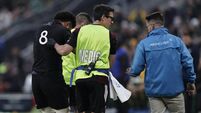
Dr Eanna Falvey has welcomed the growing public awareness of concussion in rugby
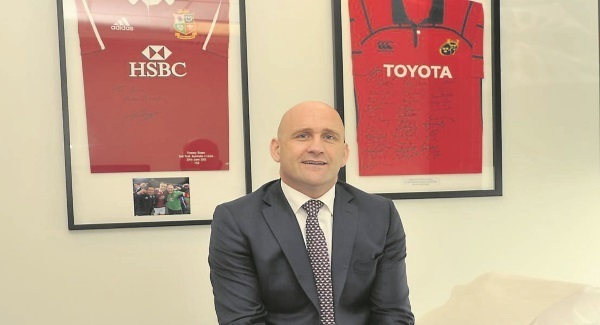
He’s a senior lecturer in UCC, helping to organise the sports medicine masters degree programme, and he’s in private practice (see eannafalvey.com) both in Cork and Dublin.
The time with the boys in green? “Unbelievable,” is his description.
“Six Nations titles, the Lions — I met some great people, coaches and players, and I’d have good friends on the other medical teams.
“It was a great experience, something everyone setting out in sports medicine should aspire to. But one way to help with player welfare and sports medicine is to carry out research in these areas, and I’d be hopeful that some of the research now in hand (in UCC) will help guide policy in the future.
“Having been a poacher, I’m moving towards gamekeeping, and advising on policy which helps make participation safer and more enjoyable for those involved.”
In rugby terms, there’s a clear safety issue right now. He welcomes the growing public awareness of concussion.
“Is that progress? 100% it is. The fact there’s more public discourse about this is better for a number of reasons.

“Most of the people who look after teams medically do so voluntarily, do so entirely free of charge, and we need to help them to do that job as well as they can.
“Everybody needs to be regularly educated — there’s an acknowledgement out there that medicine is changing so fast that if you don’t have your knowledge of a topic refreshed every five years, then you’re out of date.
“So if this type of public discourse drives people to reeducate or re-familiarise themselves with what’s happening, then it’s a good thing.
“It takes two to tango when managing a concussion. If a player is economical with the truth, then that changes how it’s managed. That’s why comments from the likes of Hayden Triggs last week indicate players are thinking about this more nowadays.
“Because most of the symptoms of concussion are subjective and not objective, it requires the player to be very honest and very in touch with what he’s feeling.
“From a parent’s perspective, the more information they have, the better, but the one downside is that it can swing in another direction — if it means some people aren’t involved in sport who might otherwise be involved, then that’s not a good thing. Overall the group we need to look after best are kids and adolescents.”
There are sound medical reasons for focusing on them, he adds: “Their brains are more fragile, more susceptible to concussion, and the group that probably have the least amount of medical attention in a game setting. If we can educate everyone around that better, that has to be positive.”
Answers aren’t immediately obvious.
He points to challenges with helmets and changes in the laws of the game.
“First you have to be cognisant that the more people are aware, the more they’ll diagnose, therefore the incidence will rise. A recent study in England published RFU rates (of concussion) and they appeared to have doubled.
“They probably haven’t, but players are reporting now what they wouldn’t have reported before.
“World Rugby released figures on player sizes and in the last 10 years, registered players didn’t appear to have gotten much bigger. Looking at the Welsh backline might suggest otherwise, but one case doesn’t prove a point. Overall, I think players are definitely better conditioned and moving faster than in the past. There are also changes in how the game is played, though that’s not my area of expertise. That could have a potential impact as well. The third point is protective equipment.”

Falvey did part of his PhD on protective equipment, an area he calls “phenomenally interesting”.
“What you have here is ‘risk compensation’: essentially, we all have an acceptable level of risk, whether that’s cycling a bike or skateboarding — we’ll do one thing but we won’t do another thing because we feel we have a good chance of getting hurt, so we won’t do that.
“If we use safety equipment, we lower that threshold. Much of the literature on this arose when seatbelts were first introduced: a significant group opposed seat belt introduction as it was felt that would make drivers feel safer and drive faster and endanger everybody else. Similarly, people wearing bicycle helmets take more risks, and when the hard helmet was introduced in American football, within five years there was a dramatic spike in catastrophic head and neck injuries.”
American football banned certain tackles and reduced the levels of those injuries, but he points out that head-to-head tackling was only banned a couple of years back: “The problem with equipment is that at the start, at least, it often makes the sport more dangerous. Parents wonder whether their child should wear a scrum cap in rugby, for instance. A scrum cap stops cuts but has no role in protecting against concussion — in fact, given that it can give a feeling of invulnerability to a player, it can actually make the situation worse.
“Realistically, no head impact is a good impact, as far as I’m concerned. We need to look at measures to limit those head impacts, but that’s something the game administrators definitely need to look at. From a medical perspective, that’s not something I can control.
“People will always want to be involved in contact sports, that’s our nature. We need to protect those playing sports as best we can, and if head injury happens, we need to manage that the best way possible.”
He’s the one who mentioned American football, which is being blamed for CTE (chronic traumatic encephalopathy) among its players, a topical issue focused on by a current movie, Concussion.
“You’d have to say that any head injury isn’t a good head injury, but one of the things I’ve read is that if you look at the number of people who’ve played professional American football — 32 NFL teams, there were 25 — in the last 60 years, then it’s a fraction of the number who’ve played high level rugby.
“We’re not seeing the number of cases in rugby that they’re seeing there. Maybe we will — I don’t know, but because they’re two contact sports played with an oval ball, people we need to be careful of conclusions we draw.”
He also points out that the physics of large men on a confined space is going to lead to concussions, pure and simple.
“The way we manage concussion has to improve, the means of preventing concussion has to improve, but looking at Mike McCarthy’s concussion against France — there’s no way to prevent that. He hit Jack McGrath’s head at a tackle. That could happen in a Gaelic football match or a soccer match. Those things are going to happen. What we need to try to control are the potentially preventable ones.”

CONNECT WITH US TODAY



Be the first to know the latest news and updates