Peter Jackson: Steve Hansen’s Rugby World Cup ascent started with race to the bottom
His debut as a Test coach with Wales, at Lansdowne Road on the first Sunday of February 2002, resulted in his torpedoed team shipping more than 50 points to Ireland on the day Paul O’Connell won his first cap. It got worse at the airport the next morning when Hansen and his disheveled team beat a retreat to the departure gate.
Spotting the players, a group of disgruntled fans burst forth to the tune of the gospel song He’s Got The Whole World In His Hands with their own mocking words: ‘’We’ve got the worst team in the world.’’

Hansen, drafted in by Graham Henry a few weeks earlier for a salvage operation, must have felt like the boy on the burning deck with nothing much left to salvage. In giving Wales up as a bad job the next day, Henry threw his untried assistant a hospital pass of Titanic proportion.
Hansen needed all his survival instincts just to keep his head above water, a tricky exercise as the captain of a sinking ship.
Dragging it off the rocks without a lifeboat in sight was never going to be a bundle of laughs and so, not unnaturally, they called him ‘Mr Grumpy.’
“After one game, I thought to myself: ‘How the hell are you going to do this?’ ’’ he said recently. “I probably got 20 years’ experience crammed into two-and-a-half.’’
The man who would climb Everest twice in taking his country to stratospheric heights of achievement spent that long trying to reach sea-level. Wales went down so often that a lesser coach would have gone down with them.
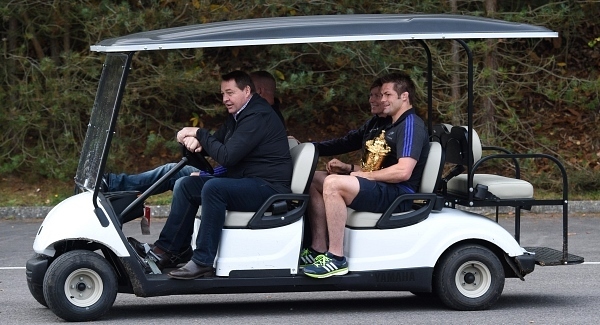
Hansen lost 20 of 30 Tests in charge before Henry recalled him to help him fry some much bigger fish back home. After helping the old headmaster regain the World Cup in 2011, Hansen has now gone and done what no coach has ever done and retained it.
He has done so in real style, losing just three Tests out of 54. The boy who wanted to be a jockey before outgrowing that ambition has become instead the most successful coach in World Cup history.
Nobody can say the All Blacks’ commander-in-chief has got there the easy way, from a meat freezer in Christchurch, seven years in the police, hell and high water in Wales, and now two World Cups, one for each failed marriage.
At 56, he owns a stable of racehorses and has done a course in horse whispering. Watching his thoroughbreds make history at a gallop, he could have been forgiven for thinking he had found the two-legged version of Arkle, Kauto Star and Desert Orchid.
The AP McCoy award for turning the coach of the tournament into a one-horse race: Steve Hansen.
Respect always used to be big in rugby until Craig Joubert did his runner at Twickenham after awarding Australia their jailbreak penalty against Scotland. The hounds of fury came flying out of the traps in his wake, led by an indignant Matt Dawson.
He gave the hapless South African referee both barrels. Joubert, according to Dawson, was a disgrace who should never referee again because he had been, wait for it, ‘disrespectful to the game.’ Now Dawson knows a bit about being disrespectful. He has been there and done it, during the Lions tour of Australia in 2001. Could this be the same Dawson who slated the tour management in a first-person piece for one of the British national dailies?
The one who ‘dissed’ coach Graham Henry as lacking inspiration and manager Donal Lenihan for, he claimed, treating the players like kids. Instead of thrashing it out internally man-to-man, Dawson went public.
It hit the streets as the Lions were celebrating one of their greatest Test victories, 29-13 against Australia in Brisbane, a victory which Dawson watched from the bench as the non-playing reserve scrum-half. He turned the Jose Mourinho award for disrespecting the referee into a no- contest.
The Usain Bolt award for the fastest exit: Craig Joubert, safe and sound behind the locked door of his dressing-room before the Scottish Nationalist Party and other tartan hordes knew where he had gone.
Only the English with their renowned capacity for staging the big event better than anyone else could lose their national team and still make this the best World Cup of all.
Even without a white shirt or a Red Rose to be seen, they still managed to pave the streets with gold just as their athletes had done at the London Olympics.
Exorbitant was hardly the word for ticket prices but nobody seemed to be complaining at paying £715 for the best seats at the final.
No wonder, then, that ticket revenue alone reached around €400m with aggregate attendances at an all-time high of almost 2,500,000.
As well as the excellence of the stadia, the billiard-table pitches, the stunning rugby, the wondrous Spanish- speaking armada of Argentinian fans, the army of volunteers were never less than unfailingly courteous and helpful.
At least Ireland has a rough idea of the act it hopes to follow in 2023.
If six of the seven prospective GAA venues are upgraded, as planned, then what’s to stop the country showing the world what it can do?
If the gap between the champions and the runners-up is an accurate gauge of true greatness, then the All Blacks of McCaw and Carter are not the best of all-time. Almost, but not quite.
For all the hype that they are, a strong case can be made for the All Blacks of 1987. They scored 43 tries in six matches and were so far ahead of the rest that in the final they swamped France, then Grand Slam champions, by 20 points.
The current champions ran in 39 tries from seven matches in defending their title, beating the second best team on the planet, Australia, by 17 points. There is another reason for defending the original World Cup winners as the best and not just because they had Buck Shelford, Michael Jones, John Kirwan and a young Sean Fitzpatrick.
They also had at full-back an Anglo-Irishman from south London whose mother came from Limerick and father from Derry – John Gallagher. And he scored 13 tries in 18 Tests. Beat that.
1 Karne Hesketh, shifting the tectonic plates as never before with his last-minute winner for Japan against the Springboks.
2 DTH van der Merwe for Canada against Italy at Elland Road.
3 Verenik Goneva for Fiji against Wales in Cardiff.
4 Juan Imhoff for Argentina against Tonga at Leicester City.
Japan, beating the Springboks 34-32 in Brighton.
New Zealand, in the final against Australia.
Argentina, against Ireland in the quarters.
15 Ben Smith (New Zealand) 14 Santiago Cordero (Argentina) 13 Conrad Smith (New Zealand) 12 Matt Giteau (Australia) 11 Juan Imhoff (Argentina) 10 Dan Carter (New Zealand) 9 Fourie du Preez (South Africa) 1 Marcos Ayerza (Argentina) 2 Rory Best (Ireland) 3 Ramiro Herrera (Argentina) 4 Brodie Retallick (New Zealand) 5 Leone Nakawara (Fiji) 6 Scott Fardy (Australia) 7 Sam Warburton (Wales) 8 David Pocock (Australia)
Bismarck du Plessis (South Africa – hooker), Tony Woodcock (New Zealand – loosehead), Sekope Kefu (Australia – tighthead), Alun-Wyn Jones (Wales – second row), Richie McCaw (New Zealand – back row), Aaron Smith (New Zealand – scrum half), Nicolas Sanchez (Argentina – fly half), Adam Ashley-Cooper (Australia – outside back).