Jonathan Sexton ready to hit a new level
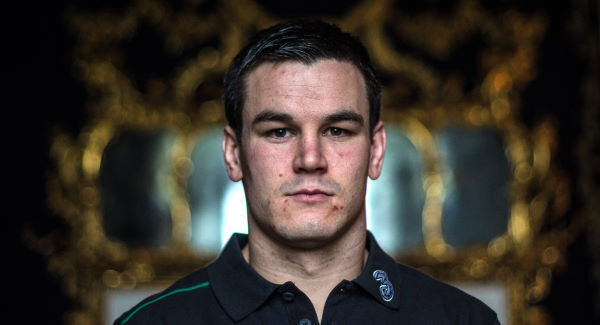
After Ireland and Jonathan Sexton saw off France a fortnight ago in as bruising a game as the old field on Lansdowne Road has known, the Irish out-half made a gesture that said as much about him as anything he had done during the game. He made a point of tracking down every French player and shaking their hands. The look in his eyes told them though it wasn’t so much a gesture of sportsmanship as defiance.
“Hard luck, lads, you didn’t break us. You won’t break me.”
Neil Francis, in particular, could only smile and applaud. “In that moment, we got to know Sexton’s two best qualities,” the former international would observe. “His right testicle and his left testicle.”
For someone who once described Leinster as the ‘ladyboys of Europe’, clearly Francis placed huge importance on such fortitude.
When you think about it though, Sexton has been all about providing such daring moments since he first broke onto the scene. Cast your mind back to that landmark 2009 Heineken Cup semi-final in Croke Park against Munster. It had only been a few months earlier Francis had mocked and labelled Leinster’s constitution. When their first-choice out-half Felipe Contepomi had to go off injured, the nation had no idea who his 23-year-old replacement was. In an instant he would declare to us just who he was and what he was about, a statement he’s kept making ever since.
Leinster had a penalty. Sexton’s first act would be to take it. Teammates like Bernard Jackman have since admitted they would have understood and nearly expected him to miss it, coming on cold.
“Nine out of 10 guys in his situation would have crumbled under that pressure. But he nailed it.”
What made it all the more impressive for Jackman were some other circumstances surrounding that kick. The Leinster bagman had initially brought out the wrong kicking tee. Sexton told him to go back and get the right one. “Seconds must have seemed like minutes as he stood there, looking at that tee,” Jackman would write in his own book, Blue Blood.
“How he had the courage, never mind the patience and presence of mind, to tell the bag man that was absolutely incredible.”
It wasn’t that Sexton wasn’t nervous – he’d later admit his knees had been rattling during that pause in play. What was so impressive is he still had the awareness to know what would give him the best confidence and chance to make that penalty kick. In that moment, Leinster had a new out-half. Leinster were a new team. Within the month the ladyboys of Europe would be champions of Europe. Ireland had a new hero too. Almost six years on and he’s considered probably the most marketable sports star in the country. He’s now its most valued player, admired for his steel as much as his skill.
Over the last four months, due to a certain concussion controversy, his was the most discussed head and brain in Irish sport. But what actually goes on it? What way does he think? How is it he has the toughness for it, the head for it, or as Francis would bluntly put it, the balls for it?
PREPARATION IS POWER
“He prepares really well, he doesn’t leave anything to chance on a Saturday. That’s what we’ve seen and what you’ve got to do to be the best. He’s just so driven to succeed.”
- Ronan O’Gara, February 2015
The same year Sexton finally broke onto the Leinster team and the national stage, writer Daniel Coyle wrote a book The Talent Code, on how the most skilled performers grow and practise, having closely studied some of the best coaches and practitioners in sports and the performance arts. Reading Sexton’s own book four years later, Becoming A Lion, passages of it make it seem like a companion piece to Coyle’s.
One September Wednesday, he’s in UCD with Leinster’s kicking coach, Richie Murphy, working on place kicks, penalty kicks, but especially restarts. The summer tests in New Zealand had taught him the hard way Ireland’s restarts were off the standard set by the best.
It’s not easy for him. According to Coyle and the best skill acquisition coaches, there is little value in being in a comfort zone, where you feel at ease, it’s effortless. You practise and work best in what’s known as the sweet spot, that involves a certain level of frustration, difficulty, an alertness to errors. Sexton in that workout is right in the Sweet Spot, or the Deep Practice Cell.
“I’m focusing on getting the height and trajectory right for different distances. Some require letting the ball bounce and catching it on the up, rather than on the half-volley as you would for a drop-goal. Others require a flat trajectory and need to be hit like a low drop-goal.”
The session is also a designed deliberate practice. He stands on the touchline at halfway with a bagful of balls, and cones spaced at 10, 15, 20 and 25 metres infield. It’s measured. Then he tries to drop balls into each space based on whatever call Murphy gives. Maybe 10 metres for a restart to an imaginary Rob Kearney right up the middle, or 25 for a winger to attack.
All his sessions are like that. In that season’s Six Nations opener in the Millennium Stadium he goes 20 for 20 in place kicks in the pre-match warm-up. Again, it’s designed. And the only reason it seems like he’s in a comfort zone is because he even that week he was in that struggling sweet spot, that deep practice cell.
“Back in Carton House, I was practising in winds of 40 to 50kph, getting lads to hold the ball still on the tee for me. This feels a doddle.” By practising ugly, in ugly conditions, knocking them over from the touchline in the Millennium seems simple.
MENTAL PREPARATION
Sexton has learned from his work with Enda McNulty not to expend too much energy thinking about a game. While his wife Laura knows it’s best to keep a distance from him on match day, Sexton chills out enough to watch a box set or do a crossword. A couple of days earlier he’d have packed his bag; no point expending anxious energy tracking down your gumshield on the day of the game itself. The day of the game, he’ll have a quick look at some pre-match notes he’d have drawn up the previous couple of days. On the left side will be his team’s calls. He’ll have the steps to his free-taking routine.
Then after the game he’ll review how those penalties went. He has every penalty he’s ever taken documented somewhere. Because....
REVIEWING: POSITIVES AND LESSONS
There’s been an increasing interest in recent years as to how sports experts work and what an overwhelming amount of research is showing is that the best players engage in what’s called reflective practice. In other words, they review performances in a more detailed and constructive manner than merely decent players. Sexton is particularly good at reflective practice. For sure, mistakes and defeats can really rankle with him.
“Lying in the darkness hours later, I’ll replay large chunks of the action in my head, wince at a poor option taken, then imagine the play as it should have developed.”
If he loses the last game of a season like he did in 2012 with a humiliating 60-0 defeat to New Zealand, he’ll admit it can sometimes make him unpleasant company on holidays. But notice how he’ll re-frame and see himself taking the right option after recalling taking a bad one. And as he’d say about that hammering to the All Blacks, there was huge learnings in it. “I’ve trained myself to take positives out of every situation,” he’d say in his book. Even losing to them in the Aviva when he had a kick to finally beat them.
He says he wasn’t put off by the historic magnitude of the kick; he was thinking more process than outcome. But a couple of other things he admits did distract him. There was a slight breeze from left to right and he started to shuffle his feet waiting for it to calm. He should have just banged it down the middle instead of second-guessing himself. And he maybe should have come off a bit earlier than that. He’d gone into the game with an injury. In the second-half he hurt it again. He felt devastated and culpable after the game, but so was the entire team, especially for the seven process errors they made in the last 90 seconds in which time the All Blacks were able to sweep down the whole length of the field.
It wasn’t the first big kick he missed. In 2010, if he had kicked well against Scotland Ireland would have won the Triple Crown. Instead the last rugby game in Croke Park finished in defeat. Some critics doubted if Sexton would mentally recover from such a defeat. Yet the following Sunday he was in all the papers, having put himself forward at the Leinster press day. A setback like that would help him, improve him, not define him.
He spoke about that, while he would have liked to have been kept on for the last 20 minutes of the game he wasn’t “too disappointed” as he was happy with his overall play; he particularly cherished a text message from Ollie Campbell complementing his game management throughout the game. His dead ball kicking was in the spotlight alright largely because of how it had contrasted to his superb form in the autumn internationals and with Leinster. “There’s something a bit off,” he said, “and I’ll get it sorted.” Instead of going into himself and deriding his whole game, Sexton chose to view his under-performance in one aspect of his game as a mere “blip”.
It’s not that he waves off mistakes. He just doesn’t let them affect his confidence. Nor will he allow victories make him arrogant. In every game, in every win and good performance, there are glitches and lessons. In that 2012-2013 season documented in his book, he plays well in a league win over Munster in front of 50,000 in the Aviva, yet admits at 2.30 that night two misses are still niggling at him. Not getting too high or too low; as a freetaker that middle ground is the only place you can operate.
Even when he was laid off for the 12 weeks with concussion he looked at the positives. He would be fresh for the rest of the year. A World Cup year.
A POSITIVE-DEMANDING LEADER
You can be both, you know, and Sexton is the personification of it. He’s needed some work on it. Bernard Jackman in his own book recalls the 2009 Heineken Cup final against Leicester and when Leinster committed a few errors in the closing minutes, Sexton, in only his second start in the competition, started to flail his arms. When Jamie Heaslip had the presence of mind to tell his young out-half to relax, Jackman knew Leinster would win. At times though, especially on the training ground, challenging teammates is precisely what the team needs.
“There’s a bit of a Roy Keane about him – world-class vision and a mentality that is stubborn and utterly uncompromising in pursuit of excellence and trophies,” Brian O’Driscoll would remark in his own book. “He’s a perfectionist, and a deep thinker, encyclopaedic in his knowledge. He doesn’t just know his own role, he knows everyone else’s too.”
For Sexton it has been a continuing struggle to get that balance right in when and how to challenge teammates, but it’s something he’s always had and something that’s also been admired. Jackman remembers that before Sexton even broke onto the Leinster team in place of Contepomi, he wasn’t afraid to challenge more senior teammates.
“If we had played badly on a Saturday, Johnny would be there the following Monday naming guys and asking what they were doing. Even when he had not been playing himself, he’d stand up and say what he thought and he’d be genuine and emotional in how he said it.”
It’s all about generating the right level of energy. Challenging guys if they’re being lax or flat.
Energising and encouraging them if they’re deflated, uncertain. His intervention at half-time in the 2011 Heineken Cup final is now legendary but the following year’s competition showcased the same qualities again.
At half-time in the semi-final against Clermont, in Bordeaux, Leinster trailed by six points. This is where his tactical and mental awareness kicked in. Recalls O’Driscoll: “In the dressing room Sexto suggested running with a lineout play we haven’t used in more than five months and says we’ll score if everyone does their job right.”
A minute later the chance would present itself with a lineout which Leo Cullen would claim, leading to a try by Cian Healy.
It’s one thing being a vocal leader though, another by example. With a minute to go in that titanic clash, Sexton illustrated both. Even when the referee was looking at a TMO, O’Driscoll can vividly recall Sexton marching around the forwards “like a man possessed”, getting them to refocus: “Big scrum! Big scrum!” Seconds later Clermont’s second row Jamie Cudmore drove right at Sexton. He barely made half a metre. “Johnny rushed up and hit him with everything he had. He was four stone lighter but he slowed him up.”
Not for the last time a French team’s best effort at pummelling him hadn’t worked.
Tomorrow he’ll take and inflict more punishment. And being him, take the positives as well as lessons from it. Always something to draw confidences from, always something to work on.
“I think there’s more in the tank,” said Ronan O’Gara recently. “I think we’ll see him in the next two to three years hit a new level.”
It’s O’Gara’s theory but Sexton’s idea. Always getting better has been his mindset all along.
CONNECT WITH US TODAY



Be the first to know the latest news and updates