A pup who could bark and bite
It’s still a bit weird, especially weekends like this. For all the times he’d tell and still tells young fellas in Munster to remember there’s more to life than rugby and there’s life after rugby, Marcus Horan has found this first season not being out on that field, in the thick of that scrum, all a bit strange, frightening even.
Take last month when Ireland won the Six Nations Championship. Earlier that Saturday afternoon he was up in Dublin doing a bit of radio work. It left him with a bit of a dilemma: stay up and watch the game on the box there but not be home till all hours, or head back home to Castleconnell and get to see the kids before they went to bed? He headed home. Listened to the game from Paris on the radio. For 15 years he’d have ran 15 miles just to see a game like that.
Was there something wrong with him not making the effort to see it now?
“I’ve found it hard to watch games,” he admits in that very honest, sincere way of his. “It’s great to see Ireland and Munster doing well but there’s also a part of me very jealous about it, thinking, ‘Feck it, I’d love to be there, it’s a killer not being there.’ And sometimes you’re thinking, ‘Do I not want them to win so?’ How am I not excited about something that I love? That’s an odd feeling to have.”
The good thing that he’s learned is that it is also a very understandable feeling to have. He’s noted how Shane Horgan has talked about how galling it was to miss out on the 2009 Grand Slam success but in 2014 he could thoroughly enjoy and revel in the success of old colleagues and new faces. A few weeks ago then Horan himself had great chat with Denis Leamy who had experienced similar mixed emotions.
“Denis said he was so excited watching the French game. He’s giddy watching games now, whereas for awhile there after he retired he found it very tough. So that was great therapy for me. One of the things I’ve learned doing the job I’m doing now is that it typically takes two years to really adjust to retiring. That really shocked me when I heard it at first but then it also relaxed me. Because now I’m thinking it’s normal to think and feel like I have.”
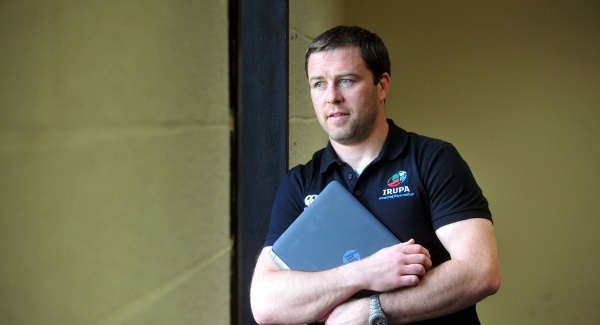
The job he has now is helping rugby players, past and current. A vacancy came up as a player development officer in IRUPA (Irish Rugby Union Players Association) with one of the staff out on maternity leave and players advocated that perhaps a former pro who could relate to them would best fit the bill.
Horan can certainly relate to them. He knows what it’s like to fob off any thoughts about life after rugby. He knows what it’s like to struggle for work after rugby. Even though he was an IRUPA rep with Munster pretty much since he walked into the team dressing room 15 years ago and even served as chairman of the association’s national board, he tended not to heed his own advice. In a way he was rugby’s own Dear Frankie Byrne, the renowned old Irish agony aunt: helping everyone else with their problems while struggling with his own.
“It was something Donncha [O’Callaghan] always slagged me about when I was doing a lot of stuff with IRUPA as a player. ‘God, instead of looking after everyone else, would you not look after yourself?’ I’d be saying to fellas, ‘Are you doing something outside of rugby? Do you need help with anything?’ But I didn’t really have any exit plan for myself.
“I suppose it was a bit of not admitting what was coming, a bit of denial really. But the way my last year panned out, it was time to finish up playing. I worked really hard in that last preseason [summer 2012] and was hoping to get another contract off the back of it but the writing was on the wall very early on when the new coach [Rob Penney] came in and I wasn’t going to be part of his new plans. What they ended up offering me [a new one-year extended contract] was a PFO (polite f*** off) to be honest and I wasn’t going to hold tackle bags for fellas after the career I had. People might think that’s snobby of me but maybe that was the best way of telling myself that it was over. That made the decision for me. But then there’s the realisation ‘Oh shit, I’m out on my own’.”
He did get job offers. An insurance company approached him about working in sales and he tried it for a few months but while he’s glad he did and remains grateful for the opportunity, it wasn’t for him. By last September he was at a loose end: 36, father of three. He was doing a bit of scrum coaching around the province but that wasn’t going to meet the bills.
He was getting to spend a lot of time with Cate and the kids (Heather 6, Grace 4 and Isobel 2) but they still needed to be fed. Then at Christmas this job came up. One he was made for.
It probably came from always being the young fella. In all his days with Shannon and Munster and even now he’s been known as Puppy or Pup, the young pup, and back in 2001 or so when Mike Mullins needed a deputy as IRUPA rep in the Munster dressing room, Horan volunteered, or to be more precise, was elbowed into doing it.
“I was the young fella and maybe there was a bit of ‘Ah Marcus, you go and do that’ because no one else wanted to do it. They were probably a bit wary of it [IRUPA] because at the time the IRFU would have been suspicious of it too. Lads knew that it was needed but also were a bit fearful it might affect selection so they didn’t want to stick their neck out.”
As a prop Horan did that for a living. He also wanted to look out for others because from the start of his career there were always veterans who looked out for him.
“I wanted to be someone like Mick Galwey. A guy who’d take a young fella under his wing. I remember a few times in a scrum with Shannon and my opposite number would be acting the maggot and Gaillimh would come through the gap with this ferocious dig. If ever there was a fight I was hauled out right away and someone would stand in front of me. Either Gaillimh, Claw [Peter Clohessy], Anthony Foley, [Eddie] Halvey, John [Hayes], Quinny [Alan Quinlan]. On my first trip to Dublin and we had to get taxis to the train station, I didn’t have to put my hand in my pocket. Just small things like that, I was always taken care of.”
They did it because that’s what they did and also because he was worth it. “I’ll always remember we were playing a match above in Bective,” Galwey would tell the writer Richard Fitzpatrick for his book Where Clare Leads Ireland Follows, “and this young fella comes on with a baby face and I was saying to myself, ‘Who’s this little muppet?’ He looked like he was 15. But fair dues to him, what a player. There’s a fella who scrummages for the 80 minutes. Traditionally, scrummagers would take it easy after awhile but Marcus will be going as hard in the last scrum as he will be in the first. The guy would never give up. That’s the one thing I noticed about him.”
He wasn’t your typical prop in other ways. He was comfortable on the ball. And he was fearless.
“I didn’t really give a shit for reputations,” Horan himself admits. “I remember going up to Dublin to play certain teams and you’d hear lads talking about this and that fella having played for Ireland. I wouldn’t have known who was who. I had this healthy ignorance you could say. Once I got the ball in my hand I was away.
“I remember starting out in the club dealing with certain coaches who would have told me ‘Look, get the ball in your hands at kick-off and hold on to it because you won’t touch it for the rest of the game’. Props didn’t touch the ball, they were there just to scrummage. Looking back, it was a bit comical. But I’d studied a guy like Nick Popplewell who to me changed prop play. I liked the ball, side-stepping a fella, while I was fiery enough at that age too. And I think the lads appreciated that and felt then that I needed to be protected.”
They did it in different ways. Claw wasn’t as warm or engaging as Galwey. After all, they were fighting for the same Munster jersey.
“In those days Claw would have been very much about himself and playing. I would have got on with him but he wouldn’t have been giving me advice or anything like that. I remember one day John [Hayes] got injured and Claw went back to tight head and I came on at loose head. I thought I played well and I was buzzing coming into the changing room when Claw said, ‘Hayes, you better hurry to fuck back because I’m not playing there anymore!’ And of course it triggered a great laugh but I kind of took it to heart and was deflated.
“We were different players, personalities. I’d be in the gym working my ass off. I never saw Claw in the gym. Yet the damage he could do around the field and his cleverness. You take Wally’s (David Wallace) try in Twickenham in 2000. That started with Claw hitting a ruck in the opposite corner. It was a car crash. And I remember Deccie [Kidney] saying to me, ‘You know all the stuff you do around the field? Can you do what Claw did just there?’ And it was true. Claw did those basic things so well. And in his last few years he became better with the ball, not just because of me but the other young fellas that were coming through. And we got old school stuff from him. It helped everyone that way. The skill levels went up right across the board.
“Since Claw’s retired I have an unbelievable relationship with him. He’s invited me down to do a few gigs in the [Sinbin] club. He’s always up for a chat. I have so much time for him. I suppose everything is in hindsight. I don’t think he gave me the time when he was playing because he saw me as a threat, which I think is a great compliment to me. But now he’s way more relaxed. He’s a real confidant, a real friend. It’s great to say that about a fella when he’s left.”
Horan won’t lie though that he was glad when Clohessy left after the 2002 Heineken Cup final.
Claw’s retirement was Horan’s opportunity and he took it. For almost a decade he would make the number one jersey pretty much his own. Not that it was ever a long-time goal.
“There were guys challenging you and you had to fight them off. Munster would bring in a foreign player and you’d be thinking the typical Irish thing, ‘My days are numbered here.”
Probably the best of them was Federico Pucciariello. He was a threat and a rival. A team-mate and a friend.
“Freddie lived next door to me. An absolute lunatic. I remember the first day he was going to Cork. I had to show him where to go. The following week he says, ‘I’ll drive’. We got stopped by the cops so many times it was ridiculous. He had no regard for himself at all. But he was a great fella and a great asset to Munster. He could play both sides and he lit a fire under me. You need that competition. Quinny (Alan Quinlan) would slag me, ‘It’s fine for you, Horan, there’s no props out there!’ But there was. I was just lucky John and myself were the main two at the time and we had great times.”
They did. The two Heineken Cups in ’06 and ’08. The Grand Slam in ’09. But probably their finest hour was ’07. England, in Croke Park. For two GAA men it stirred the blood and emotions like no other.
Horan grew up in Clonlara, County Clare. Hurling country. His father was from Tipperary where they play a bit of it too and personally found rugby “like watching milk go sour”. Instead he preferred to go off with his sons to see Nicky English and the lads play. Even when Marcus went to St Munchin’s in Limerick and began playing with the oval ball, the small ball was still a passion. He’d try out for Clare underage teams but only get a few minutes at those trials. “It was quite political. You’d be sitting in a dressing room and guys going around what school you went to. I said St Munchin’s and they’d look at me quare.”
But in 2007 he would finally get his hands on the Clare jersey. The then county senior manager Tony Considine presented him a signed jersey from the whole senior panel in the run up to that game and Horan had it in his kit bag that momentous day.
“That meant an awful lot to me. Because I was a GAA man before I was a rugby man. I remember going to Croke Park in the old days when it was a rickety old place in the stands. I was there on the pitch in ’95 when as Clare people we only dreamed of seeing a team of ours play in the place. And now here I was playing there, at last, on a different stage. It wasn’t lost on me. Generally I’d like to be fired up going out because where I play it’s pretty confrontational from the start, but that day I was really stoked.
“Their pack was really good. Phil Vickery is a guy that I’ve had good battles with but also a guy I was comfortable against. I didn’t fear him at all. I remember Gloucester played us in Thomond Park and we did a job on him. I never had trouble with Phil. Julian White was a different story. I found him a tougher scrummager. But he came on later in that game and we were so pumped at that stage he wasn’t an issue for me either.”
The only problem with that day for Horan was that they should have been playing for it all. That gnawed at him. Still does.
“Everyone says it must have been some feeling after that game. And it was. We were as high as kites. For about 10 minutes. Then the realisation set in ‘Look at what we could have achieved. We’ve left a Slam behind us’. The French game was a killer. Still is. It was only last month I could watch the documentary for the first time. You wake up on that Monday morning and you feel like you’ve let the whole nation down. There was such a relief when we finally went ahead in that game that we simply took our eyes off the ball for those last few minutes. We were all around long enough to know what to do when you’re in that position.
“I still feel bad that we didn’t win a championship under Eddie [O’Sullivan]. A lot of people say he wasn’t great with people but I think if you went around to all the lads you’d find there’d be a seriously healthy respect for that man. He has a great rugby brain. It’s sad to see him on the outside looking in now and people think him and Deccie are kind of damaged goods. To me they still have a huge amount to offer Irish rugby.”
It’s a brutal sport in so many ways. Criticism was incessant. If you were a coach. And if you were a prop. Horan feels at times Munster overdid it, that when they were struggling there were times they could have done more to catch fellas doing something right for their confidence, but there was never any shortage of fellas to tell you when you did something wrong.
“Some guys thrive on hanging guys out and making sure they don’t do it again. And there is a lot to be said for it. There was no hiding place for us. John and myself would laugh about it, if we got a pushover try the eight forwards would get a slap in the back and if we got driven back the two props would get murdered for it. I would always have rated myself on how the scrum would have gone. Even if I got a few carries and a few tries but if the scrum didn’t go well I would have had a problem with that. And it would always have been at my door and John’s rather than the whole pack if the scrum didn’t go well.
“I remember one time we played Biarritz in San Sebastian. The scrum was under pressure but I felt that I did pretty well against my guy early on and I made some comment in the press and ROG bawled me out of it afterwards. ‘What are you talking to the press about? Our scrum was mauled! You were shit!’ But I remember in the following preseason myself, John and Mushy [Anthony Buckley] had to do analysis of the scrums and in fairness to the two boys they said ‘That was our fault there’. That was enough for me, even though I got the brunt of it at the time.”
Horan thrived on a certain type of criticism. “If someone said to me ‘Your man that you’re playing against thinks you’re no good’ that was a big motivation for me. I remember Wales in one Six Nations [2007] saying our front row was poor and they were really going to go after us. We ended up doing a job on them. In 2009 Italy had a go at me personally. Even in the first scrum [Martin] Castrogiovanni was saying to me, ‘It’s going to be a long day for you!’ Donncha behind me went ballistic so we drove him off it. We had a good day that day scrum-wise and after about 25 minutes Castrogiovanni was leaving the field. And Donncha made the point of running after him. ‘Twas a fairly short day for you anyhow!’”
In a way, it’s all so short. Even a career as long and as decorated as Horan’s still felt too short. It wasn’t his idea that 2012/2013 ended up his last season in red. It wasn’t his idea that his last game of competitive rugby would be back with Shannon losing their top-flight status.
“Everyone thinks of getting the nice send-off but it doesn’t work like that. I remember one evening last year I was playing for Shannon against Young Munster and they beat us well, it was demoralising when I was asked to come across [to Thomond] and wave to the crowd before the Leinster game. And while it was nice, it just felt contrived. I stepped onto the field with my three kids with me but I just wanted to get out of there. I’d envisaged taking to the field for my last day. But rarely does a fella go out the way he wants.”
If anything, he’s been lucky. Injury didn’t end his career. He was 36. He’s lucky now with the job he has, even if it’s only a nine-month gig. And he’s lucky he retired when he did.
Five years ago if he had retired he’d nearly have been on his own. Not now. Last week he was on the phone to Jerry Flannery who’s over in London working with Arsenal. It was one of those deep conversations Jerry can get into, even though he was walking along the street. Next thing Flannery left out an expletive. He was after walking into the wrong hotel. Right man to be talking to though.
“It’s something I’ve said to Cate a lot recently,” says Horan. “I was blessed with the guys I got into rugby with and now who I’m leaving rugby with. We can all help each other.”
He’s especially helping out the current players and academy players in Munster. All the time appreciating they’re in a way helping him out too.
“There’d be a lot of guys who wouldn’t know what they want to do outside of rugby. Even guys who have a degree behind them might say they don’t want to do anything related to that degree. There can be a mentality there that if you go off doing a course or something you’re diluting your focus from rugby. Whereas we’re saying it’s the opposite. It will help your rugby.
“You’ll be more at peace with yourself. We have Neil Ronan now who is after graduating from Setanta College. He said the four years flew. He was still able to play his rugby. You have a lot of downtime as a rugby player.”
So, as he helps them look at possible courses and options, he’s seeing some for himself.
By looking out for and helping others, others have ended up helping him. Just like it was when the Pup played himself.
CONNECT WITH US TODAY



Be the first to know the latest news and updates