‘Killer’ enjoying turbulent adventure
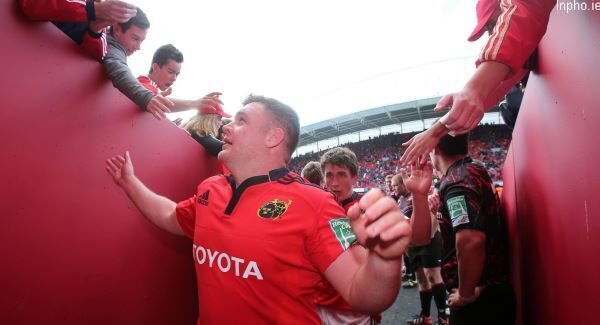
There may not have been enough time in a whirlwind season of Heineken Cup debuts and first Test caps for Dave Kilcoyne to bask but such has been the turbulent nature of the team experience, with both Munster and Ireland, that the prop has lingered long enough to learn some valuable lessons.
Personal achievement and rapid development are tricky subjects to discuss when wider, collective objectives are not being reached. Areticence to speak of individual satisfaction and career progression is understandable when one’s province has just slumped to its heaviest defeat in nine years. Yet for 24-year-old Dave Kilcoyne, in the initial year of his first senior contract with Munster, the dichotomy also offers perspective.
Take a Six Nations debut off the bench during Ireland’s opening-day win in the white-hot atmosphere of the Millennium Stadium and the Munster loosehead will accept the positive start to his championship career but, raise the draw and three defeats that followed, and he tells of an experience usually reserved for more seasoned campaigners.
“I suppose it doesn’t get more intense than that in terms of international rugby,” Kilcoyne said of that win in Cardiff two months ago, “but in terms of being involved in the international set-up I’ve seen what can happen when you come out the other end of those games, when scorelines go against you, and it’s not a good place to be.”
Good and bad, all part of the learning experience on an upward curve that saw the promotion-winning kid from UL Bohs progress to a British & Irish Cup-winning campaign last season with Munster A and onto a Heineken Cup debut at Stade de France last October.
An Ireland call-up followed on the back of his performances in red, less than a year after his Munster senior debut against Connacht in December 2011, and come the start of November Kilcoyne found himself in green and coming off the bench at the Aviva Stadium for a Test debut against South Africa.
Five more caps have followed, all as a replacement, including four high-intensity stints in the Six Nations and yet tomorrow’s Heineken Cup quarter-final at Harlequins represents yet another breakthrough for Kilcoyne as he dips his toe in the water of European knockout rugby for the first time.
“I came into the season wanting to be first choice in Munster and I suppose I was lucky I got handed the opportunity to play and I got lucky and took my opportunity. I got lucky with Ireland as well in that it stood to me in terms of preparation for high-intensity big games like the one in Cardiff. They all stand to you.
“So I haven’t had the experience of a Heineken Cup quarter-final under my belt but I’ve certainly the experience of Heineken Cup level and Test level, which will stand to me.”
Winning is a mindset borne of experience, at whatever level, be it in the All-Ireland League or the British & Irish Cup, both competitions in which Kilcoyne feels he has derived benefit, the B&I semi-final win over Leinster at the RDS last season a particularly memorable instance.
“That was a big game for all the young lads coming through. We’re still talking about it to the lads involved in the B&I game coming up (tomorrow against Cornish Pirates) because it was such a huge turning point in our season. Getting a win over Leinster any day is just huge but the fact it went into extra time added to the occasion. I was involved a lot with my club UL Bohs, as well, and when we got promoted we were involved in big games there. I know it’s at a different level but you learn that winning is a habit and you can build on that habit and I’ve tried to take that into this season.
“We got through the group stages in the Heineken Cup and now we’re in a quarter-final on Sunday because of it. Obviously we wanted to build on the win we got in the Connacht game (two weeks ago) but it wasn’t to be and no doubt it was a setback (losing 51-24 to Glasgow last Friday) but now it’s a case of clearing the mind and getting back into that habit of winning and take it from there.”
Kilcoyne has been rising to fresh challenges all season. From an ultimately unsuccessful backs to the wall RaboDirect Pro12 rearguard action at Ravenhill in September through to his Heineken Cup debut as a starter ahead of Wian du Preez in Paris against Racing Metro and a standout performance the following week against Edinburgh, he has proven himself on every elevation. And two lengthy spells in camp with Ireland this season have seen Kilcoyne return to his province invigorated despite the deeply disappointing outcome.
Speaking to the Irish Examiner before news broke of Declan Kidney’s departure as Ireland head coach, Kilcoyne said: “It was a huge moment for me and my family and getting that first cap against South Africa was something you always dream of growing up. Getting it at 23, as a prop, was big dream of mine come true and I was grateful that the coaches felt confident to put me in there.
“I certainly envisaged being first-choice for Munster but didn’t think about much outside of that. My goal in pre-season was just being number one by the end of the year. I suppose if you’re number one with Munster you’re never too far away, so I suppose hats off to Deccie and the coaches for deciding to pick me. As I say, it was a dream come true.”
Kilcoyne featured in both autumn Tests and a strong campaign in the Heineken pool stages over December and January kept him in the frame ahead of the equally in-form and more experienced Ulster loosehead Tom Court as Kidney looked for back-up to Test starter Cian Healy for the Six Nations.
“I met the coaches up there and learned what’s required at Test-level rugby and now I can take that experience back into the Munster set-up and I’ll take the experience into this weekend’s game.
“I’m sharing a house with a couple of the young lads here, JJ Hanrahan and Paddy Butler and I suppose I’m just trying to influence them now into what is required in terms of that step up into Heineken Cup. It’s all part of the experience and I feel I’m definitely a better player after coming back from international duty.”
There was also a personal setback to overcome during the Six Nations as Kilcoyne, who had subbed for Healy against Wales and England, found himself still on the bench at Murrayfield, after the Leinster loosehead was suspended for a stamp on Dan Cole. Rather than win his first start for Ireland, Kidney parachuted Court into the Test line-up for the first time in 11 months.
“Obviously I was disappointed and I would have loved the chance to start against Scotland but that’s the way it goes,” Kilcoyne said. “Deccie, I suppose, felt that I offered more of an impact off the bench so he went with that. I have no complaints there with that decision but, yes, it was frustrating.”
So too, in Kilcoyne’s mind, has been the perception that as he is such an effective operator in the loose, the Limerick man announcing himself at Ravenhill last September with a massive and perfectly fair hit on former All Blacks tighthead John Afoa and ever since with some rampaging bursts upfield, he must therefore be a less than optimal scrummager.
To suggest that his scrummaging is something that needed work arouses some passion within this son of UL Bohs loosehead stalwart Pat ‘Killer’ Kilcoyne who started rugby life in the Ardscoil Rís back row and progressed to the front row at age 16.
“To be honest, no, I wouldn’t have highlighted scrummaging as my weakness. Scrummaging was always my bread and butter. I was conscious when I made the switch to loosehead that it was ultimately what you were going to be judged on. It’s your duty to provide good set-piece ball to the backs.
“Our scrummaging has been used as a weapon all year with Munster, just as it was last year in the B&I and with the club, it was always a strength.
“When people hear someone is good around the loose then they would assume that something else must be in need but for me it would always be scrummaging first and foremost and anything else is a bonus.
“It’s been a little frustrating (the perception) but then again it’s one area that you can always improve. I’ve learned more being up in [Ireland] camp and at international level every prop poses a different challenge. It’s a one-on-one physical battle and there’s not many areas of the game where you actually get that. I enjoy that physical confrontation.”
Kilcoyne may have benefited from his recent work in Ireland camp with scrummaging coach Greg Feek and forwards coach Gert Smal but he also credits Munster’s scrum coach Paul McCarthy, Anthony Foley and head coach Rob Penney for providing him with a top-notch front-row education.
“Paul Mac down here, I’ve been working closely with him since I’ve been 19 or 20 and a lot of credit must go down to him, and Axel, for the work they’ve put into me over the years. And Rob coming in give you another train of thought into scrummaging. He’s a forwards coach himself and he understands it. Then, going up with Ireland, it was great to be able to pick Greg Feek’s mind and Gert Smal, take some new ideas and see what their train of thought is on various situations.”
Kilcoyne’s exposure to Test-intensity scrummaging will stand him in good stead as he goes toe-to-toe this weekend at The Stoop with Harlequins’ Samoan tighthead James Johnston, younger brother of Toulouse prop Census.
“Scrummaging at international level is a step up again, no doubt, you’re playing against serious players for obvious reasons but in saying that I’ve scrummaged against (Luc) Ducalcon in the Heineken Cup, who was on the bench for France in the Six Nations, and Matt Stevens was the Saracens tighthead and he has a huge amount of caps for England. So, you’re going to meet these guys with their clubs as well as in internationals but certainly at international level it’s more intense and in a more intense atmosphere. It’s more of a battle.
“The Harlequins front row is going well with Johnston and (loosehead Joe) Marler and they’ve good hookers in (Rob) Buchanan and the others. They’re a big pack so we’ll have the battle cut out for us.”
Munster, playing with an extra man for most of their final match against Racing Metro at Thomond Park, sealed their place in a quarter-final at the cosy Twickenham Stoop. There they’ll face a high-scoring opponent in London club Harlequins, who ran in over 40 points per game in the pool stages.
Munster’s 22 points scored per game might seem low in comparison, just half that of Harlequins, but when the London team scored 110 points in 160 minutes against Zebre their massive per-game total should be taken with a small pinch of salt. Both club’s defences were impressive in the pool stages, allowing just 12 points per game.
The scrum will be an area of concern for Munster, having lost 25% of possession from their own ball over the first six games. This 75% scrum success is against the whooping 95% managed by Quins.
Outstanding discipline (or outstanding referee management) was a feature of the London club’s play. They conceded under eight penalties per game — a competition low — while their opponents in those game games coughed up 17 penalties. Munster? They conceded 13½ to the opposition per game while getting just 11 themselves.
If Munster manage to force Harlequins to concede kickable penalties they’ll also want to improve a 69% success rate achieved in the pool stage; that’s not the sort of thing of which long Heineken Cup runs are made.
However, if Munster fans see Ronan O’Gara taking the kicks at the Stoop it will be a good sign. The veteran kicked 16 goals, missing just three (88%), while Ian Keatley landed eight and missed eight (50%).
Conor Murray scored three tries during the pool stages but he’ll have a job on his hands shutting down Danny Care. With four tries, two try assists and an enormous 320 metres made in six games, his electric pace makes the Quins nine a real handful.
While both teams had an identical 83% lineout success rate, Munster also managed to steal twice as much ball as Harlequins from opposition throws despite being in a tougher pool.
Some good news for Munster from looking at the first round of the 2012-13 Heineken Cup is that they played a very suffocating game very well. Based on Amlin Opta Index data, in a competition during which teams allowed an average of nine clean breaks per game Munster allowed just 1.7. This figure, on a per-carry basis, was twice as effective as Harlequins. If Munster can employ the same tight game at the Stoop they’ll potentially throw Harlequins off tilt. Managing to do this against a side that spent the pool stages running in tries for fun would make it even sweeter.
CONNECT WITH US TODAY



Be the first to know the latest news and updates