A game of two halves and one legend
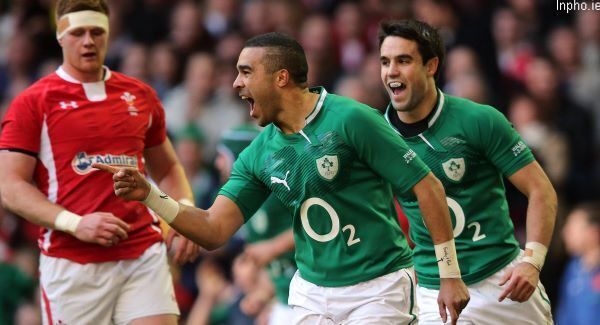
The Welsh journalist who made the inquiry knows a trick or two about eliciting a response from an interviewee and in that eve-of-match press conference, he wondered whether O’Driscoll’s “advancing years” and suggestion this might be his final Six Nations, combined with a lack of game time following injury and the recent loss of his captaincy made his return to the green number 13 jersey he has made his own for a decade a less-than-automatic choice.
The Ireland coach, taking the question at face value, fixed his gaze on the inquisitor and issued an emphatic: “Not Brian, no.”
Just 24 hours later, it was Wales defence coach Shaun Edwards who doubtless spoke for the entire Welsh nation when he broached the subject of O’Driscoll and muttered: “I wish somebody had left him in Ireland.”
For all the attacking verve shown by the Ireland team in the first half of this opening RBS 6 Nations victory of 2013 at the Millennium Stadium, its bristling intensity at the breakdown and the defensive heroics of the second period, O’Driscoll’s contribution was outstanding.
He figured significantly in all of those facets during a pulsating encounter where, with the crown of his head bandaged to protect a cut sustained in the line of duty, he created the opening try of the game for Simon Zebo and scored another himself. For a short while, the inspirational O’Driscoll even forgot he was no longer the captain, as he barked at fly-half Jonathan Sexton to kick for the corner rather than aim for goal on the cusp of half-time.
The actor and writer Stephen Fry once wrote of author PG Wodehouse, “you don’t analyse such sunlit perfection, you just bask in its warmth and splendour” and in rugby terms, O’Driscoll is a bit like that.
We should cherish him while he is still around, even for the moments when he slips from the ideal and walks among us as a mere mortal. Those rare instances are just as memorable and quite as telling about the Irish icon, such as the dodgy box kick in the last 10 minutes, which squirted into touch just 10 metres in front of him. Why? Because it came as O’Driscoll was turning in a shift as an auxiliary scrum-half with Conor Murray in the sin bin. Equally, if he had taken the lineouts when the otherwise outstanding Rory Best had earlier been yellow-carded, you would not have been surprised, but just as he let Jamie Heaslip captain Ireland for 79 minutes, the outside centre allowed Sean O’Brien throw the ball in a couple of times in the hooker’s absence.
“Bottom line, you’d love to have the guy around forever, wouldn’t you?” Kidney said after victory had been secured in the face of a terrific Welsh onslaught.
“Brian’s everything that you write about him. He’s one of the few fellas who lives up to the adjectives that are said about a player.”
From the head coach, that’s as close as you’re going to get to the highest of praise. Likewise Simon Zebo, who grabbed Ireland’s opening try after 10 minutes thanks to a wonderful play from O’Driscoll, the centre timing his pass to perfection once he had drawn three players into contact to create the space for his wing to glide over the line.
Zebo, in just his fourth Test appearance and making his Six Nations debut, then provided his own magic when, after a Best charge down of a Dan Biggar kick and a wonderful pass to Heaslip, he saw the captain’s offload skid low and behind him. The Munster wing, showing the hunger for the ball that separates the great from the good, instinctively flicked out his left heel, tapped the ball up to waist height and with a couple of touches, gathered it into his chest to keep alive a move that would lead to Cian Healy’s try a couple of phases later.
“Match of the Day stuff,” Heaslip said of Zebo’s skills, while Kidney, having survived a desperate request for superlatives regarding O’Driscoll, said with a smile of his fellow Corkman on the wing: “No, you’re not getting any adjectives about that fella from me.”
Healy’s try had secured Ireland’s foothold and with Sexton faultless in front of the posts with two conversions and three penalties as Wales floundered at the breakdown in front of referee Romain Poite, Ireland had taken a commanding position at 23-3 by half-time, having got off to the flying start that was so desperately needed at the outset.
With so much riding on this opening encounter against a Grand Slam champion that had inflicted three straight wins over the Irish, Kidney could not have asked for more. He still got it, when two minutes after the interval, O’Driscoll put the game beyond Wales by diving over from a metre out after the Irish forwards had inflicted another successful choke tackle to turnover Welsh ball from the kick-off.
Facing an eighth defeat in a row and fifth in succession at home, Wales needed to get their act together for interim head coach Rob Howley and they finally stirred, forcing Ireland onto the back foot for the remainder of the game as the silky attacking patterns of O’Driscoll, Zebo and fellow wing Craig Gilroy gave way to the power running of Welsh backs Jon Davies, George North and Alex Cuthbert. It was the latter who started the rally, evading a desperate tackle from substitute Keith Earls, and Wales piled further pressure on with a further score from Leigh Halfpenny to reduce the deficit to 30-15 with 20 minutes to go.
Ireland’s cause was further hindered by Best’s yellow card and although the green defensive line remained heroically intact, the binning of Murray just as the hooker returned to the fray inevitably produced cracks. Fortunately only Craig Mitchell breached the line, reflecting the massive rearguard put in by the Irish defence.
Ireland made a staggering 176 tackles compared to Wales’s 101, while O’Brien marked his return to the back row by making 23 of them, a huge tally that was more than Sam Warburton and Toby Faletau’s 11 each combined. Second rows Donnacha Ryan and Mike McCarthy made 18 and 16 respectively and Kidney described the effort as “colossal”.
“You can only coach so much. It’s only if they want to do it that they would do some of the stuff that they did out there. Systems are there to be put in place but in fairness if there was a hole to be plugged, the willingness of fellas to do that is colossal. Hopefully the reward is when they wake up in the morning and they’re sore, they’ll feel it was worth it.”
Not that there will be too much time to dwell on it, for there is the visit of England to the Aviva Stadium next Sunday and Ireland will need every minute of the eight days between games to expunge the physical toll.
For Ireland supporters, however, it is a victory to savour and, after less than satisfying returns in this championship since the Grand Slam of 2009, gives hope for a much-needed return to Six Nations glory.
IRELAND: R Kearney; C Gilroy, B O’Driscoll, G D’Arcy (K Earls, 44), S Zebo (E Reddan, 80); J Sexton, C Murray; C Healy (D Kilcoyne, 74), R Best, M Ross (D Fitzpatrick, 69); M McCarthy (D O’Callaghan, 74), D Ryan; P O’Mahony (C Henry, 52), S O’Brien, J Heaslip (capt).
Replacements not used: S Cronin, R O’Gara.
WALES: L Halfpenny; A Cuthbert, J Davies, J Roberts, G North; D Biggar (J Hook, 74), M Phillips (L Williams, 64); G Jenkins (P James, 38-40; 67), M Rees (K Owens, 14-22; 52), A Jones (C Mitchell, 74), A Coombs, I Evans (O Kohn, 74), A Shingler (J Tipuric, 44), S Warburton (capt), T Faletau.
Replacements not used: S Williams.
Referee: Romain Poite (France).

CONNECT WITH US TODAY



Be the first to know the latest news and updates