Patience and realism: Munster’s watchwords
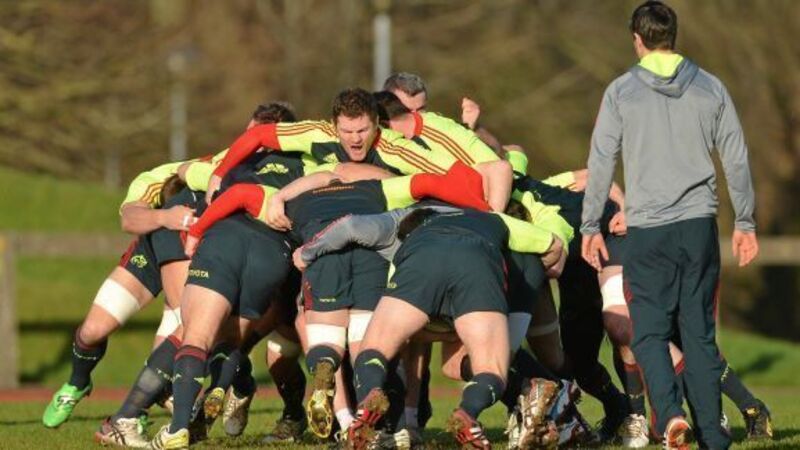
Fitzgerald appointed New Zealander Rob Penney last summer to lead a new generation of Munster players into a brave new world, assisted by those remaining heroes of the European glory runs of 2006 and ’08.
No-one said it was going to be easy and guarantees of immediate success were not offered, but a few wobbly performances under the new coaching regime in the course of the first four months of the season have rattled the cages of those amongst the brave and faithful still demanding season after season of success.
That the most recent and spectacular of those wobbles came a week ago, in a dismal, try-less 17-6 home league defeat to Cardiff Blues at Musgrave Park has hardly boosted confidence in the rank and file, coming as it did in the final outing before tomorrow’s trip to Edinburgh. Penney’s Munster team go to Murrayfield needing a four-try winning bonus point if they are to retain hope of reaching the quarter-finals into the sixth and last pool game back at Thomond Park a week tomorrow against Racing Metro.
Yet while Fitzgerald makes it clear that reaching the last eight every season is the minimum he should expect as Munster chief executive, he is also realistic enough to acknowledge that in sport, just as in business, you do not always get what you want and as he sits in a meeting room at the branch’s new administrative offices at Musgrave Park in Cork, he stated now is not the time to start changing direction from the path laid out by Penney. “People use the term that we’re going through a transitionary period. I don’t particularly like using that word, transitionary. I think it’s a term people use when they’re not happy with the results we’re getting.
“I think we’re on the right track. We’ve a new coach and I think Rob is a very positive person. He’s a very good rugby person, very good with players and with people and at the end of the day he’s only been coaching the team for four months since the matches started in September.
“So it’s a getting to know the situation for him and for the whole squad and all the management and to date he’s done exceptionally well. We’re in for the long haul and it’s going to take time.
“We’ve had some results this year that we certainly wouldn’t be happy with. One of the things we set out at the start of the year was to try and win all our home games and we’ve fallen down in that in the RaboDirect Pro12.
“I think people are possibly disappointed with the manner in which we lost some of those games and I’m sure the players and management are themselves. So it’s something they’ve got to learn from. It’s a long, hard endurance test for the whole season and sometimes there are things required that you don’t need at other times of the season, when you just have to get results. That’s what people have to learn and you only get that by, as the saying goes, you have to lose some to win some.”
Penney’s mission to develop his young squad and reeducate his more experienced players into intelligent, athletic and powerfully intense rugby players, able to play what they see in front of them rather than stick rigidly to a preordained gameplan was never going to pay dividends as early as this.
However, glimpses of a bright future have so far been overshadowed by alarmingly high individual error rates and too many poor decisions that seem the antithesis of what the former Canterbury head coach is seeking. The upshot has been costly defeats in Europe at Racing Metro and Saracens and home losses to both Scarlets and Cardiff Blues in the RaboDirect Pro12.
Penney himself has made it clear that time is the essential ingredient but can Fitzgerald afford to be as long-termist as his head coach?
“You have to be patient but you have to be realistic,” the chief executive said.
“The bottom line is you want to be involved in the knockout stages of competitions and if you get to the knockout stages anything is possible.
“The challenge is to get to there. We’re still hanging in there in those situations and it’s up to ourselves that it’s in our own hands.
“If you get to the knockout stages of competitions you then set yourself new targets and that’s the key issue. It’s an endurance test to get to the knockout stages and we’re in January and we haven’t taken ourselves out of that situation so we have to be happy.
“We’d love to be in a better situation in the league, something we’ve control of ourselves and in the Heineken Cup the key thing for us is to try and win two games. Whatever that brings to us after the two games I think it will be a fair achievement.”
So what does a chief executive do in the wake of such a miserable defeat when the next two games have a massive bearing on how rest of season pans out? Has he suggested to Penney that long-term goals should be parked awhile for the sake of Heineken Cup qualification?
“You don’t just start suddenly changing things in the middle of the year,” Fitzgerald said.
“The goal at the start of the year is to win your home games and qualify for the knockout stages. That has always been our target and when you employ a person to manage a situation, whether it’s your financial controller or your marketing manager or your head coach, you don’t micro-manage them, and if you do you’ve probably employed the wrong person.
“In other words, the plan is there and they have their own departments to work in and their own staff to do it. You let them off to do it and you discuss things on and off with them. That’s the way I would manage situations.
“You don’t suddenly become a different person. If you play 26 or 30 games a year you’re going to have bad days and good days. You just hope you’re going to have more good days than bad days.”
Munster, of course, are operating in a very different Europe to the one they conquered twice in three years less than a decade ago. French rugby has struck gold with independently wealthy investors ploughing money into clubs, not quite on the level of Roman Abramovich at Chelsea and his ilk in football, but with a similar impact on the rest of the playing field.
Players are naturally following the money and the cream of both the southern hemisphere and Six Nations playing pools are signing for French clubs to the detriment of their Heineken Cup rivals in Ireland and the UK.
“You just can’t compete with France,” Fitzgerald said. “If a player says he’s going to France you just tell them to enjoy themselves. You’re not even going to try to compete, both from a retainer point of view and from a taxation point of view.”
And yet, he added: “I don’t think that system will work in Ireland and I don’t think Ireland need it in that fashion but the landscape is certainly changing.
“When you see clubs, even in France, like Stade Francais, being passed out having been a consistent performer, by Racing Metro down the road from them suddenly. It wasn’t because they suddenly became better rugby players, they just bought better rugby players and they’re continuing to buy them.
“So we just need to be realistic. You have to play within the constraints your business is set up under.
“So we’re going to continue to do it the Irish way.
He added: “We had a couple of years with a phenomenal group of people and it takes time to turn it around again, but we’re turning it around in our own fashion. We’re not turning it around in a French fashion, where you buy 15 new players in a year. That’s not what Irish rugby is about and we just need to do it in our way.
“We will have cycles of ups and downs but we’ve just go to be realistic. Through the good days of the Celtic Tiger all people wanted to do was to follow winning teams all the time but I think we’ve enough genuine supporters that realise what people are trying to do.”
CONNECT WITH US TODAY



Be the first to know the latest news and updates