Irish query cost of return trip
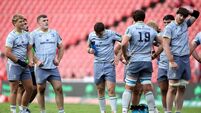
Six Nations officials are weighing up whether to play the game on Sunday or in three weeks, on the weekend of March 2/3/4, following a night of confusion at Stade de France on Saturday, where referee Dave Pearson called off the game six minutes before kick-off as temperatures plummeted to -3C with a windchill factor of -8C and the pitch rapidly deteriorated in patches, making it “dangerous” and “unplayable” less than two hours after being passed fit for purpose. While there were no dissenting voices about the postponement among the squads and management teams, the costs of funding away trips are incumbent upon the incoming team.
“We will certainly be bringing it up with the Six Nations about how our costs for the game might be affected. That will certainly be part of the discussions,” IRFU spokesperson Karl Richardson said.
Richardson declined to put a figure on any potential compensation claim but with sources estimating a €45,000 bill for the Irish travelling party of players, coaches and union officials, taking in the cost of a chartered plane, two nights’ hotel accommodation and team rooms, the IRFU is understandably keen to discuss the possibility of compensation rather than take such a substantial financial hit.
Irish supporters may not be so fortunate if they wish to make good the French Rugby Federation’s request to retain their match tickets for the re-scheduled fixture. Federation president Pierre Camou said on Saturday night that all ticket holders unable to attend will be given refunds on their tickets but as for help in making a quick return to the City of Lights, that is likely to be at their own expense.
While the postponement was necessary on issues of player safety, the timing of the decision has raised several questions the Six Nations will need to address. It appears the tournament organisers gambled and lost on their belief the pitch would be playable, even though the forecast for sub-zero temperatures over the weekend had been in place for several days and French wing Vincent Clerc had declared the Stade de France pitch dangerous following the opening game against Italy seven days prior.
When asked if the game could have been called off earlier in the week, Ireland head coach Declan Kidney said: “I walked it 45 minutes beforehand and it was getting firmer. Would I second guess the man above? No. But the forecast indicated it wasn’t going to get warmer. I did think all right about 5pm walking around town that it wasn’t as bitterly cold as it had been but maybe they were just the streets I was walking on.
“Forecasts are now pretty accurate. I’m sure everyone will take a look at it and see what can be done.”
The France-Italy game had kicked off in the afternoon with temperatures of -2C, so what chance did Ireland’s game have with a 9pm kick-off local time when the mercury was likely to plunge even further on a pitch which remarkably has no undersoil heating?
“I don’t think guys are too mad about that kick-off time anyway,” Ireland captain Paul O’Connell said. “Tonight probably adds to it a little bit anyway.”
Television companies keen to maximise audience figures usually get the blame for such scheduling anomalies but there have been claims from Saturday’s host broadcaster, France Télévisions, that it had offered to switch the game to 3pm in a bid to beat the evening’s plummeting temperatures and had been told to press on with the late kick-off by the Six Nations.
Regardless, there appear to be different views on the likelihood of rescheduling the game for this weekend, particularly as Stade de France is already booked for a French Top 14 game between Stade Francais and Toulon on Saturday.
French coach Phillipe Saint-Andre saw no problem with that, however, and was keen to push for the game to be staged next Sunday but Kidney was typically equivocal.
“It’s a difficult one,” he said. “Two [matches] and a gap and two [more matches] is fine but the lads are looking to go home. We’ve had three weeks of it now. They had two weekends of Heineken Cup before that. They’re looking forward to going home. If I tell them ‘sorry lads you’re back into camp for another week’ that would be a challenge but then four on the trot (if the game were in March) is also a daunting challenge. Maybe we would be better off waiting and getting four on the trot. Fellas need a break so maybe just come in and go for it with four on the trot.”
Referee Pearson failed to appear as initially scheduled at the post-match press conference, where tournament officials refused to answer questions, instead leaving Six Nations committee spokesperson Christine Connolly to read a prepared statement explaining the referee’s decision. Sitting next to Connolly, however, French Federation president Pierre Camou was more forthcoming, placing the blame squarely at the door of Pearson.
“The French Rugby Federation is the organiser but not a decider and it’s very sad thinking of all the fans coming from all over France,” Camou said. “I’m really sad and really worried about what happened because the French Federation has always taken its responsibilities seriously but unfortunately the French Federation was not responsible for the decision.
“It is worth noting that today the Under-20 team played in Grenoble, the women’s team played in Pau and in Clermont played in Clermont, which is a very hot city as we all know,” he said sarcastically, referring to one of France’s coldest places. “And Italy played against England under the snow but there the referee was French.”
A week on from heavy criticism as a touch judge for recommending a yellow card instead of red for Wales lock Bradley Davies’s dangerous tackle on Donnacha Ryan, Pearson received nothing but sympathy from an Irish voice. “The policy of the Six Nations is that it is down to the referee,” Kidney said. “It’s an invidious position for one person to be put in. Talking to him it was a really difficult decision. It took a lot of courage to make it. At the same time the frustration for the supporters and the cost of that but that bottom right-hand corner was skatey. I can’t criticise him.”
CONNECT WITH US TODAY



Be the first to know the latest news and updates