Leinster ticking all the boxes

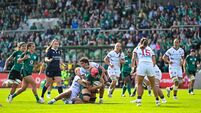
IT was hard at times last Saturday night, even in the midst of a live radio commentary, not to just sit back and admire the quality of rugby produced by Leinster.

It is easy to do that at times when doing the equivalent job for a television audience but with radio, part of the challenge is to paint a picture for the listener.

Even the setting for the game, with over 46,000 people engrossed in the entertainment being provided on the pitch, smacked of class. The new Aviva Stadium radiates on occasions such as this. With the benefit of hindsight and the restrictions placed on the capacity of the ground due to its city centre location, it has actually worked out for the better. Economic reality dictates that rugby no longer needs a stadium to hold in excess of 80,000 and the match day experience at the revamped Lansdowne Road is excellent. It helps, of course, when you’ve a side with the scope to play the type of rugby that Leinster produced against Bath.

It was almost a role reversal from the days when an Irish side would travel to England and be completely overawed and intimidated by the surroundings and quality of their English opponents before working out that they weren’t actually as good as they were given credit for. Bath were the ones that looked sheepish on Saturday and in playing terms were so inferior to Leinster that it was embarrassing.

Leinster has travelled a long way since the days when they would pat themselves on the back for producing another sell out crowd of 7,000 at Donnybrook when it was clear to all that their target audience in a city the size of Dublin was upwards of 20,000. They have cracked that now and on the back of their two Heineken Cup successes over the last three seasons are going from strength to strength.

The facility to play at least three games a year at the Aviva has been a godsend for Leinster not least because of the financial benefits. The additional revenue generated from the Rabo Direct game against Munster coupled with one Heineken Cup pool game — and more recently a home quarter-final in the same tournament — puts Leinster on a very solid financial footing. That offers them additional bargaining power to retain their best home grown players and also the facility to cherrypick the best the global game has to offer.

In addition, Leinster have 13,000 season ticket holders, all paid up and registered before the start of the season. From a cash flow and budgetary point of view that puts them in a very strong position. That couldbecome even more important from next year as the IRFU are seeking to reduce the number of non Irish-qualified overseas players from five to four per squad. Leinster have the financial clout to go after the very best.

Toulouse, with a playing budget three times the size of Leinster and Munster have had that facility for years and Guy Noves has chosen wisely. Despite that defeat at home to Harlequins, they will still be in the mix at the quarter final stage but that loss could consign them to an away draw. They are the last side you would want at that stage. Harlequins were superb and really took Toulouse on at their own game. As always at this time of year they are vulnerable but when they get to the business end of the Heineken Cup — as they showed when they pushed Leinster all the way in that classic semi-final last season — they have the class to produce when the stakes are at their highest.

It is also worth noting that Toulouse have a stronger squad than last season due to a summer shopping spree that has brought Gurthro Steenkamp, Luke Burgess, Luke McAlister, Gary Botha and Lionel Beauxis on board even if McAlister is struggling to solve their issues at out-half. In addition promising French centre Yann David is back after a complicated leg break last year and they have unearthed yet another Fijian scoring sensation in new wing Timoci Matanavou. Having met at the semi-final stage over the last two seasons, what a prospect a third rematch between Leinster and Toulouse would offer.

Results apart and with Munster, Leinster and Ulster topping their respective pools going into the festive break we could hardly ask for any more. But the most pleasing thing for me is the manner with which some of the younger Irish players have grabbed centre stage over the opening four rounds of Heineken action.

While Munster still have an over reliance on Ronan O’Gara and Paul O’Connell, there is evidence to suggest that a shifting of the guard is taking place and a vision of what the future holds is beginning to emerge. The emergence of another quality half back and a forward leader in the O’Connell mould, ready to grasp the baton of responsibility when the time comes, have already put their hands up in the shape of Conor Murray and Peter O’Mahony.

Murray, in a very short space of time, has graduated to the status of Ireland’s first choice scrum-half but is now also taking a bit of pressure off O’Gara while also making an impact in broken play. O’Mahony is still coming to terms with the physicality of the game at this level and at times is a bit reckless for his own good but already he has emerged as a leader. He has always had this quality, captaining every underage squad he was part of, but in a short space of time has already earned the respect of players many years his senior in terms of age and experience. Those two are set to become the standard bearers within the Munster squad for years to come.

I N Leinster, Leo Cullen may bethe captain and Brian O’Driscolltheir totemic figure but Jonny Sexton has become their spiritual leader. Last season’s Heineken Cup final was a career defining experience for him. Vocal before the match and at half time, it was his ability to walk the walk that has elevated his status in the Leinster dressing room. Those two early second half tries against Northampton — not to mention his accuracy with the boot — inspired a win that looked very unlikely at the break.

The challenge for Sexton is to radiate that quality on the international stage. Despite his 24 caps to date, he has still to grab an international test by the scruff of the neck in the manner with which he does on a regular basis in the Heineken Cup for Leinster. I think he is spooked by the presence of Ronan O’Gara at this stage while O’Gara relishes the challenge that their rivalry for the Irish No 10 jersey brings. No different to when David Humphries eventually departed the international scene allowing O’Gara to take ownership of the jersey, I think that when Sexton finally makes the position his own, Ireland will be equally well served in the pivotal role for some time to come.

More in this section

Sport

Newsletter

Sign up to our daily sports bulletin, delivered straight to your inbox at 5pm. Subscribers also receive an exclusive email from our sports desk editors every Friday evening looking forward to the weekend's sporting action.

Cookie Policy Privacy Policy Brand Safety FAQ Help Contact Us Terms and Conditions

© Examiner Echo Group Limited