All’s well again in Ireland’s world
All the head-scratching performances and pent-up frustration of four disappointing, below-par matches in the 2011 RBS 6 Nations championship were banished at the Aviva Stadium on Saturday as Ireland put England to the sword in breathtaking fashion.
It was still not the 80-minute performance that has been demanded of the Irish squad by coach Declan Kidney but in rediscovering the self-belief that had been diminishing since the end of last year’s Six Nations, Ireland finally put together a display that actually added up to the sum of its parts.
It was certainly enough to stop a desperately disappointing England from repeating the Grand Slam in Dublin that their coach Martin Johnson achieved eight years previously.
Yet they were the ones that received the championship trophy on Saturday evening and if nothing else that should have tempered some understandable Irish exuberance as minds turn to the World Cup.
Ireland now have to turn the victories into successful campaigns again. The 2011 table will show them in third place with three wins and two defeats and for that they only have themselves, and Scottish linesman Peter Allan, to blame. It has been one of those seasons, with Ireland playing in flashes, hinting at the attacking prowess within their capabilities but undermining it with errors, penalties and missed opportunities.
Against England, however, those were the issues that plagued the visitors, a relatively inexperienced bunch who had arrived at the Aviva with four wins from four but with doubts surrounding their true status among rugby’s elite.
Kidney’s team delivered the reality check and in stunning fashion, blowing the visitors away in a torrid first-half that left the men in white punch drunk.
The omens had not been good when giant centre Matt Banahan used his 6ft 8ins frame to reclaim Toby Flood’s kick-off and reduced the Irish pack to spectators. There followed a short period of English dominance without penetration but from then on it was emphatically all Ireland.
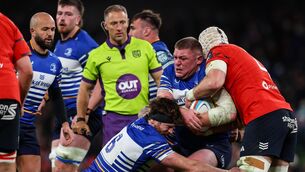
Out-hustled at the tackle area, the English back row that had conquered all this spring at the breakdown began to concede penalties there, five alone in the first 20 minutes, and Jonny Sexton, showing no signs of the ill-ease and low confidence that had marked his play earlier in the campaign, took advantage to kick his side into a 9-0 lead.
This time it was Flood who looked nervous, screwing a simple penalty kick across the Irish posts and the error was compounded by Ireland’s customary early try, albeit following a disallowed score for Brian O’Driscoll.
Again, it was down to quick Irish thinking as Tommy Bowe continued his outstanding form post-injury to scythe through a sleeping England defence after a quick tap and go by Sexton. And just like that, Ireland were 14-0 up and cruising.
A penalty apiece from Flood and Sexton followed but England were all over the place, ending an awful first-half by losing scrum-half Ben Youngs to the sin bin after he threw the ball into the stands as England desperately bundled it out of play following a rampaging run from the superb David Wallace.
Then came the killer blow, O’Driscoll’s brilliant pick up to cross the line for his championship-record breaking 25th try, Sexton’s conversion making it 24-3 and game over with just seven minutes of the second half gone.
Also gone was England’s Grand Slam, though, substitute hooker Steve Thompson got a try soon after, intercepting Eoin Reddan’s pass to Wallace from a lineout.
Waiting for slams can be a painful business. Johnson tasted bitter defeat in the final game of three of the previous four campaigns before England got it right in 2003 and Triple Crowns came to represent under-achievement for Ireland before they reached the promised land in 2009.
In many ways, this campaign has been a microcosm of that journey. What began with frustration, errors and indiscipline in Rome, went through wasted chances against France, breakdown woe in Scotland and a return of those errors in Cardiff and some questionable substitutions in those latter two before it finally all came right on Saturday.
There were still moments of anxiety when Ireland threatened to undo their good work in the second half. Over-exuberance led to mistakes in attack, then came Reddan’s stray pass for England’s try and the removal of Mike Ross just before the hour mark threatened to wobble an exemplary scrummaging performance.
The comfort of Ireland’s lead and the mentally and physically battered English players ensured they did not. England, clearly, have consistently been the best team in the year’s only average Six Nations. They deserve their championship but in beating them, Ireland have answered quite a few legitimate concerns that the previous four games had produced.
It all came right and not least at fly-half, where Sexton was under pressure, through no fault of his own, to prove his worth. He kicked with authority, he managed the game superbly and his quick-thinking led to Ireland’s opening try. And having been thrown ill-advisedly into the fray in both Edinburgh and Cardiff at Ronan O’Gara’s expense, order was restored when the veteran replaced his young rival at a sensible time and in order to finish a job rather than perform rescuing marvels.
Sexton’s performance vindicated Kidney’s decision to start him, although O’Gara’s play did nothing to deserve his demotion and ill-timed substitutions before it. It was a brave decision to start theLeinster out-half and having staked so much on his selection, Kidney had to deliver.
That he did so allows him to plan for the opening game of the World Cup unhindered by doubts surrounding his capabilities, while his players can now enjoy an international off-season with all well in their world once more.
IRELAND: K Earls; T Bowe, B O’Driscoll (c), G D’Arcy (P Wallace, 79), A Trimble; J Sexton (R O’Gara, 70), E Reddan (P Stringer, 79); C Healy, R Best (S Cronin, 79), M Ross (T Court, 58); D O’Callaghan, P O’Connell (L Cullen, 79); S O’Brien, D Wallace (D Leamy, 72), J Heaslip.
ENGLAND: B Foden; C Ashton, M Banahan, S Hape, M Cueto (D Strettle, 66); T Flood (J Wilkinson, 51), B Youngs (D Care, 46); A Corbisiero, D Hartley (S Thompson, 51), D Cole (P Doran-Jones, 51); L Deacon (T Croft, 53), T Palmer (S Shaw, 27); T Wood, J Haskell, N Easter(c).
Yellow card: B Youngs 36-46.
Referee: B Lawrence (New Zealand).
CONNECT WITH US TODAY



Be the first to know the latest news and updates