Kidney rings changes for Italy clash

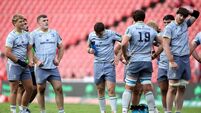
NINE changes, a first cap and a couple of Six Nations debutants will put Declan Kidney’s faith in the depth of his carefully assembled squad to the test on Saturday when Ireland face Italy in Rome.

Kidney rings changes for Italy clash

The job of building a large pool of players, each able to vie and conquer the world’s best has been two years in the making since Kidney’s first season ended with a Grand Slam.

This weekend sees the beginning of the next stage of the mission as Ireland attempt to regain the championship after a difficult second campaign and kick on to this September’s Rugby World Cup in New Zealand.

The starting line-up to face Italy at Stadio Flaminio is far from the first XV the head coach would have chosen from a fully fit squad. Yet with frontliners Tommy Bowe, Stephen Ferris, Jerry Flannery, Jamie Heaslip and Rob Kearney ruled out through injury and Tony Buckley, John Hayes, Shane Horgan, Geordan Murphy and Andrew Trimble also on the casualty list and denying Kidney cover in similar areas to his first-choice absentees, this opening fixture provides Kidney with a much-needed litmus test.

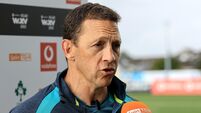
“When we beat Wales two seasons ago (to win the Grand Slam) it was great but we were the first to acknowledge that we had a run of luck with injuries,” Kidney said yesterday. “When you have been at it you realise that you have to build a squad and we are very fortunate that we have all 19 or 20 players that were involved two years ago with us and now we have another crop that has come through.

“We went to America and Canada two years ago and got a number of players capped on that one, the Churchill Cup is showing its benefits now (as well). You never like to see fellas injured but the tour last June where there were some guys injured, allowed players to pick up experience and you hope to get the benefits going forward.”

There are nine changes from the side which started the fourth and final autumn international last November against Argentina with Leinster centre Gordon D’Arcy, Munster’s Paul O’Connell and Tomás O’Leary, three of the Grand Slam winners of 2009, and Ulster hooker Rory Best all returning to the fold following injury.

The others represent a new Ireland, with Leinster wing Fergus McFadden making his international debut, his provincial team-mate Luke Fitzgerald chosen for the first time as a full-back and Munster’s Keith Earls making up a potentially exciting back three outside of captain Brian O’Driscoll and D’Arcy in midfield, with Jonny Sexton and O’Leary forming the half-backs.

Kidney continued: “With the way the laws are now, you want a back three who are willing to take on the opposition. What you are hoping is that they have the wisdom to pick the right time too and I would back them as footballers to know when to come back at them and when to nudge it, kick it back.

“I think they have the football in them and I think they can learn to play off each other, time will tell, but that happens with every new unit but I would back them to have the courage to have a go.”

There are also Six Nations debuts for Leinster tighthead Mike Ross and much-heralded back row Sean O’Brien, who replaces Heaslip at No.8, with David Wallace and Denis Leamy at seven and six respectively.

“Sean has been playing very well,” Kidney said when asked about the versatile O’Brien’s best position in the back row. “It will be good to see Sean and Fergus get on the plane on Thursday because we were thinking of bringing them to Australia and New Zealand too but for some reason (McFadden) declined to travel — it was to do with his (broken) jaw,” he joked.

“So, Sean has been going very well but I’m not going to put the hex on him, he’s a good lad.”

It is in the set-piece that will be the real challenge for Ireland against an Italian pack, whose forwards are the most physical in the championship. Which makes the return of O’Connell to the second row for the first time since the final Six Nations game of last year against Scotland all the more welcome; an invaluable leader to pack down with Donncha O’Callaghan behind the relatively inexperienced front row of Cian Healy, Best and Ross.

Kidney was part of a meeting last week in London with his rival coaches and the International Rugby Board’s chief of refereeing Paddy O’Brien, at which the IRB received backing to clamp down on the problems besetting scrum-time, from time wasted resetting scrums to the so-called cadence of “crouch, touch, pause engage” delivered by officials.

It all adds up to more focus on an Irish front row that came under the spotlight from officials throughout the autumn.

“There’s a few things that we pointed out to the referee in terms of trusting the cadence for the engagement. That will be up to us, if the tight-head is square and he has his arm up, then they will take a good look at the loose-head because tight-heads have been getting a hammering over the last number of years, it’s about perceptions on players more than the actual truth so we’re looking forward to see what happens.”

x

More in this section

Sport

Newsletter

Latest news from the world of sport, along with the best in opinion from our outstanding team of sports writers. and reporters

Cookie Policy Privacy Policy Brand Safety FAQ Help Contact Us Terms and Conditions

© Examiner Echo Group Limited