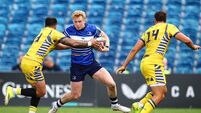
Flannery has a new full-time job — getting fit
The Munster and Ireland hooker had either the road to Dublin for the November internationals and a seat in the Aviva, or home.
Limerick it was.
“I find it hard going to games because if I watch them in the bar or at home I can watch and then switch off from rugby. If you head up to Dublin you dedicate the whole day to it, so I stayed away. I’d shout at the screen, though...
“I found it very frustrating, the negativity towards the team before the New Zealand game. I suppose I’m biased, but it’s easy to kick people when they’re down. I was delighted they showed glimpses of what they could do against New Zealand and carried on to have a good win over Argentina.”
Flannery would give a good deal to show what he can do on the field. He’s been trying to overcome injury for months and it’s a full-time job.
“There’s a misconception that you’re not as busy if you’re injured, when you’re probably busier than players who aren’t injured. Obviously there are different types of rehab, and physios will try to make it interesting, though a lot of it is work on your own in a gym. It’s mentally tough, but it’s work you have to do, and then when you go back to train with the squad it’s like ‘great, I’m back out of that isolation’.”
He’s been reading a bit to get over that isolation, like Sean Long’s life in rugby league — “I imagine rugby league in the north of England as like rugby union in Munster; if you read rugby union players’ books about playing in London or whatever they seem very different people, but I can identify more with the north of England people” — but he’s learned to be selective.
“I like biographies, full stop. I’ve read some garbage. Jaap Stam’s was terrible, for instance.
“I read Lance Armstrong’s book, and when you come across guys who’ve performed at a high level you can maybe pick one or two things out, but a lot of soccer books . . . you have a guy who’s got four England caps and he releases a book. That’s rubbish.”
So why was he reading Robbie Fowler’s biography?
“What was interesting in Fowler’s book for me was the fact that what I read in the paper about him, or other players, is probably not a reflection of what goes on in his lifestyle.
“His book gave me an idea of, say, how he perceives his career, and sometimes in Fowler’s book there’s a sense of ‘the reason we didn’t win more was we were unlucky; fair enough we went on the lash too much, and I didn’t help the image of the club by getting arrested once or twice, but I was unlucky’.
“And you’d think, does this guy not see the pattern? I was wondering about Fowler’s motives in doing a book — he’s probably financially sound, so maybe it was just his ambition to put his side of things.
“It seemed he was writing it to say ‘I was as big as Wayne Rooney’, which I didn’t understand. He was playing in 2003, not in the fifties, so it’s not as if people don’t remember him. There’s a touch of the ‘I came on the scene and got 30 goals a year in my first three seasons, amazing, and people think Wayne Rooney is incredible’.”
Fair enough. For a while every sportsman in Ireland was namechecking Roy Keane’s book in interviews. Did it make the Flannery reading list?
“You can see in Keane’s book that he doesn’t moderate,” says Flannery. “It’s balls-out, one hundred per cent on training, and then it’s on the lash all the time.
“We met him one time and he was telling us he used to have the highest body fat in the (United) squad and then he went to having his body fat too low.
“And you can pick up on those little behaviours — I can recognise things in my career when I didn’t train smart and was thinking ‘I need to do more than this guy’ when, if you do that extra stuff, you can set yourself back.”
Then there’s one of his teammates. Has Alan Quinlan’s ‘Red-blooded’ been picked through?
“I haven’t read that yet. It’ll be interesting . . . Neil Back’s was good. You can see sometimes a fella is trying to make a few quid, while other times the guy is trying to purge himself.
“Generally they’re pretty easy reading. Sometimes you’d read a rugby book which covers an incident you were involved in yourself, and you think, ‘I remember this, it didn’t happen exactly like that, but that’s a nice take on it’.
“Because of that, though, when you read other books you wonder what exactly happened in certain incidents. When Fowler says ‘we had our Christmas party, had a few pints and went home’, I’m thinking, ‘are you joking me?’ “They’re interesting. But I should probably read a book that would better me.”
He could do worse than Brian Moore’s new autobiography, if for no other eason than chapter 23, devoted to front row play. Flannery nods.
“I honestly think it’s very difficult for someone who hasn’t played to appreciate what’s going on in there.
“People like that cliche, ‘the dark arts of scrummaging’, but it’s true. It changes so often — different shapes and sizes of players, different strengths, even though there are fundamentals that don’t change. But I think if you don’t go out and lock into a scrum it’s going to be difficult.
“Rugby’s evolving all the time. People are trying to find an edge, then they find that edge, and others spend six months trying to catch up. The game changes so much . . . I put on ‘Rugby Gold’, the lads ramble in and lock ito the scrum, someone gets a box and they all roll on.
“It’s changed a lot — with our scrum coach, Paul McCarthy, there’s almost physics in it. At the last scrummaging review he had the angles of knees and backs and elbows; it’s that fine now. It’s difficult for people because I suppose it depends on the info the commentator needs.
“If you had a prop commentating, of course, you could have a dedicated prop channel. Just talk about scrums all day.”
A tasty prospect for the next front row facing lengthy rehab. Ask Flannery to tune in your telly.