Now the shoe is on the other foot...

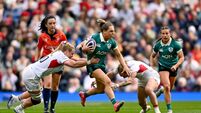
THE ENGLISH rugby team arrive in Croke Park today as rank outsiders. Their results and performances in the Six Nations so far have been well below the standards set by so many of their predecessors.

Historically, England have arrived on our shores and accounted for valiant but inferior Irish teams. The few successes we have had over the auld enemy have been etched in Irish rugby memories. ‘Ginger’ McLoughlin’s try in Twickenham in 1982 has achieved legendary status. Michael Kiernan’s drop-goal to seal the Triple Crown in 1985 is one of my treasured childhood moments. In the completely unexpected 13-12 win in 1994, Richie Wallace was on the end of a fantastic set-piece move and scored what is probably one of Ireland’s greatest tries.

Nothing gives Irish rugby supporters greater satisfaction than victory over the English. Usually these Irish victories were so special because they were so unexpected. English teams taking to the field against Ireland have invariably been favourites and could usually put any losses down to their own arrogance and complacency.


In 1993, Mick Galwey’s score in the corner sparked nationwide celebrations as Ireland defeated an English squad that boasted no less than 17 players who would travel to New Zealand with the Lions that summer.

They left Lansdowne Road shell-shocked, not understanding how they could have lost to a band of tournament no-hopers. It was fobbed off as an anomaly, a one-off disparity in the natural order.

However, the advent of professionalism has brought a shift in the dynamic of the relationship. Ireland are no longer a rag-tag bunch who might occasionally achieve an improbable success over England. Now there is an expectation. Victories have become the norm and results against our oldest foe are anticipated. Today Ireland are runaway favourites; this change in attitude didn’t occur overnight. It has developed gradually over ten years of professionalism.

In the 1999-2000 European Cup campaign, Declan Kidney brought his Munster side to Vicarage Road to take on Saracens, who at the time were dominating the English Premiership. They had adapted to professionalism quickly. They had music, cheerleaders, fezzes and Francois Pienaar. We didn’t even have the same t-shirt to warm up in before the match. We ran out on to pitch to the theme tune of The Munsters, a pretty poor television farce from the 80s.

It certainly gave us an appreciation of how little respect we commanded. At half-time the match was going as expected and we were 20-6 behind, looking dead and buried. But something sparked within us at half-time. Declan Kidney spoke fervently and we knew that he still believed in us. Mick Galwey asked for more heart. We came out in the second-half and clawed ourselves back into the game not once but twice. Ronan O’Gara characteristically sealed our victory with a last-minute conversion. That day we learned that if we were to beat English teams we would have to leave any inferiority complexes behind us. Following years of painful defeats, we had elevated them to god-like heights and now we had to knock them off that pedestal.

Seven years later Munster, by now a slick, professional outfit, travelled to Leicester. A weight of expectation had been imposed on the squad. Kidney’s teams usually don’t open up to the media but on this occasion one of his key players had given an interview that blasted Sky Sports and the English media for their coverage of rugby.

Ronan O’Gara is always honest, and spoke candidly of how ridiculous some of the Sky pundits were raving about the supposed greatness of several English players. Everybody on the Munster team agreed with Ronan but none of us would have had the bottle to speak up as he did. There was plenty of slagging prior to the game. Every once in a while someone would shout ‘No pressure, Rog’. For most of the week he was re-christened Keano.

But we also knew Ronan had made a statement that would have to be backed up. It was fitting that the game was won by O’Gara’s injury-time penalty from inside his own half. He is one of a handful of players who have been at the centre of Irish rugby’s transformation. His attitude epitomises the self-belief that is within this rugby generation.

Munster was the first Irish team to start picking off English sides with regularity and there is nothing like a bit of provincial rivalry to spur on Leinster. Over the years, they have taken the scalps of notable sides like Wasps, Leicester, Gloucester, Sale and Bath.

Ulster too have had their days out against London Irish and Harlequins. Beating these English club sides regularly has instilled confidence and belief in Irish players and has enabled them to carry this winning habit to the international arena.

However, while it was important to knock the English off their lofty pedestal it is vital that Ireland retains a healthy level of respect for Martin Johnson’s side.

Arrogance and complacency were the downfall of many superior English teams. Today Ireland are a superior side on paper. But no game is played on paper.

x

More in this section

Sport

Newsletter

Sign up to our daily sports bulletin, delivered straight to your inbox at 5pm. Subscribers also receive an exclusive email from our sports desk editors every Friday evening looking forward to the weekend's sporting action.

Cookie Policy Privacy Policy Brand Safety FAQ Help Contact Us Terms and Conditions

© Examiner Echo Group Limited